

Matrix Elements for Explicitly-Correlated Atomic Wave Functions
39
We could not find literature values of E-Hy-CI kinetic-energy integrals for comparison with the formula in Sect. 7 of the present contribution and therefore cannot
present data to provide its numerical confirmation.
9 Conclusions
This paper summarizes features of a variety of types of correlated-orbital atomic
calculations and identifies new formulas yielding kinetic-energy matrix elements
for the Hylleeraas-CI method of Sims and Hagstron and of Woźnicki and for the
extended Hylleraas-CI method proposed by the Nakatsuji group.
Acknowledgements Completion of the numerical verifications referred to in this work involved
significant consultations with Drs. María Belén Ruiz and James Sims. The author is pleased and
grateful to acknowledge their assistance.
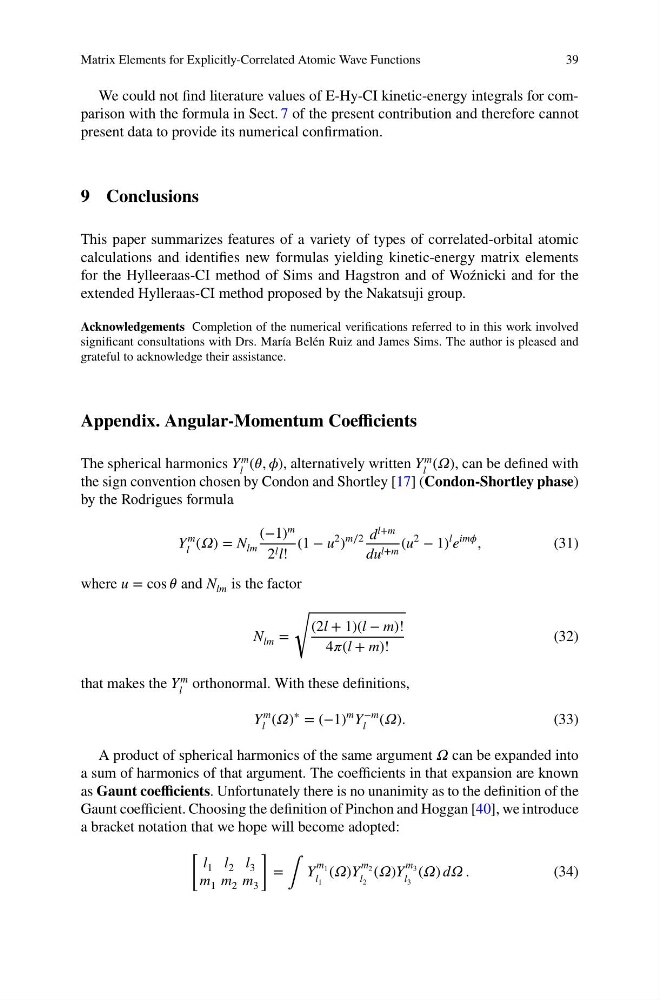
Appendix. Angular-Momentum Coefficients
The spherical harmonics Y
m
l
(í µí¼, í µí¼), alternatively written Y
m
l
(í µí»º), can be defined with
the sign convention chosen by Condon and Shortley [17] (Condon-Shortley phase)
by the Rodrigues formula
Y
m
l
(í µí»º) = N lm
(−1)
m
2 l l!
(1 − u
2
)
m∕2 d l+m
du l+m (u
2
− 1)
l e
imí µí¼
,
(31)
where u = cos í µí¼ and N lm is the factor
N lm =
√
(2l + 1)(l − m)!
4í µí¼(l + m)!
(32)
that makes the Y
m
l
orthonormal. With these definitions,
Y
m
l
(í µí»º)
∗
= (−1)
m Y
−m
l
(í µí»º).
(33)
A product of spherical harmonics of the same argument í µí»º can be expanded into
a sum of harmonics of that argument. The coefficients in that expansion are known
as Gaunt coefficients. Unfortunately there is no unanimity as to the definition of the
Gaunt coefficient. Choosing the definition of Pinchon and Hoggan [40], we introduce
a bracket notation that we hope will become adopted:
[
l 1 l 2 l 3
m 1 m 2 m 3
]
= ∫
Y
m 1
l 1
(í µí»º)Y
m 2
l 2
(í µí»º)Y
m 3
l 3
(í µí»º) dí µí»º .
(34)
39
We could not find literature values of E-Hy-CI kinetic-energy integrals for comparison with the formula in Sect. 7 of the present contribution and therefore cannot
present data to provide its numerical confirmation.
9 Conclusions
This paper summarizes features of a variety of types of correlated-orbital atomic
calculations and identifies new formulas yielding kinetic-energy matrix elements
for the Hylleeraas-CI method of Sims and Hagstron and of Woźnicki and for the
extended Hylleraas-CI method proposed by the Nakatsuji group.
Acknowledgements Completion of the numerical verifications referred to in this work involved
significant consultations with Drs. María Belén Ruiz and James Sims. The author is pleased and
grateful to acknowledge their assistance.
Appendix. Angular-Momentum Coefficients
The spherical harmonics Y
m
l
(í µí¼, í µí¼), alternatively written Y
m
l
(í µí»º), can be defined with
the sign convention chosen by Condon and Shortley [17] (Condon-Shortley phase)
by the Rodrigues formula
Y
m
l
(í µí»º) = N lm
(−1)
m
2 l l!
(1 − u
2
)
m∕2 d l+m
du l+m (u
2
− 1)
l e
imí µí¼
,
(31)
where u = cos í µí¼ and N lm is the factor
N lm =
√
(2l + 1)(l − m)!
4í µí¼(l + m)!
(32)
that makes the Y
m
l
orthonormal. With these definitions,
Y
m
l
(í µí»º)
∗
= (−1)
m Y
−m
l
(í µí»º).
(33)
A product of spherical harmonics of the same argument í µí»º can be expanded into
a sum of harmonics of that argument. The coefficients in that expansion are known
as Gaunt coefficients. Unfortunately there is no unanimity as to the definition of the
Gaunt coefficient. Choosing the definition of Pinchon and Hoggan [40], we introduce
a bracket notation that we hope will become adopted:
[
l 1 l 2 l 3
m 1 m 2 m 3
]
= ∫
Y
m 1
l 1
(í µí»º)Y
m 2
l 2
(í µí»º)Y
m 3
l 3
(í µí»º) dí µí»º .
(34)