

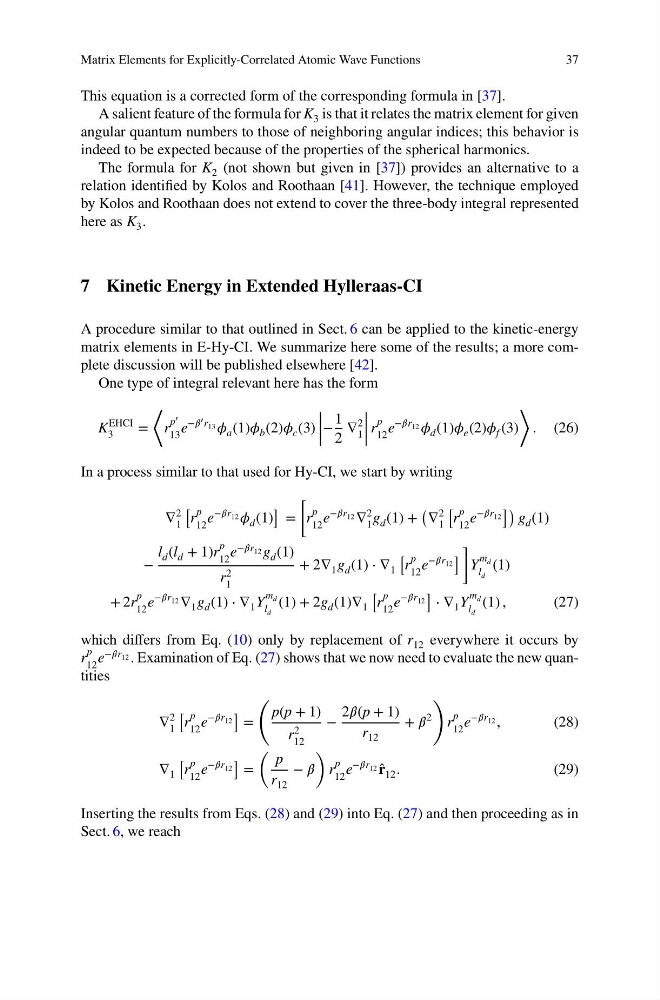
Matrix Elements for Explicitly-Correlated Atomic Wave Functions
37
This equation is a corrected form of the corresponding formula in [37].
A salient feature of the formula for K 3 is that it relates the matrix element for given
angular quantum numbers to those of neighboring angular indices; this behavior is
indeed to be expected because of the properties of the spherical harmonics.
The formula for K 2 (not shown but given in [37]) provides an alternative to a
relation identified by Kolos and Roothaan [41]. However, the technique employed
by Kolos and Roothaan does not extend to cover the three-body integral represented
here as K 3 .
7 Kinetic Energy in Extended Hylleraas-CI
A procedure similar to that outlined in Sect. 6 can be applied to the kinetic-energy
matrix elements in E-Hy-CI. We summarize here some of the results; a more complete discussion will be published elsewhere [42].
One type of integral relevant here has the form
K
EHCI
3
=
⟨
r
p ′
13
e
−í µí»½ ′ r 13 í µí¼ a (1)í µí¼ b (2)í µí¼ c (3)
|
|
|
|
−
1
2
∇
2
1
|
|
|
|
r
p
12
e
−í µí»½r 12 í µí¼ d (1)í µí¼ e (2)í µí¼ f (3)
⟩
. (26)
In a process similar to that used for Hy-CI, we start by writing
∇
2
1
[
r
p
12
e
−í µí»½r 12 í µí¼ d (1)
] =
[
r
p
12
e
−í µí»½r 12 ∇
2
1 g d (1) +
( ∇
2
1
[
r
p
12
e
−í µí»½r 12
])
g d (1)
−
l d (l d + 1)r
p
12
e
−í µí»½r 12 g d (1)
r
2
1
+ 2∇ 1 g d (1) ⋅ ∇ 1
[
r
p
12
e
−í µí»½r 12
]
]
Y
m d
l d
(1)
+ 2r
p
12
e
−í µí»½r 12 ∇ 1 g d (1) ⋅ ∇ 1 Y
m d
l d
(1) + 2g d (1)∇ 1
[
r
p
12
e
−í µí»½r 12
] ⋅ ∇ 1 Y
m d
l d
(1) ,
(27)
which differs from Eq. (10) only by replacement of r 12 everywhere it occurs by
r
p
12
e −í µí»½r 12 . Examination of Eq. (27) shows that we now need to evaluate the new quantities
∇
2
1
[
r
p
12
e
−í µí»½r 12
] =
(
p(p + 1)
r
2
12
−
2í µí»½(p + 1)
r 12
+ í µí»½
2
)
r
p
12
e
−í µí»½r 12 ,
(28)
∇ 1
[
r
p
12
e
−í µí»½r 12
] =
(
p
r 12
− í µí»½
)
r
p
12
e
−í µí»½r 12 ̂
í µí°« 12 .
(29)
Inserting the results from Eqs. (28) and (29) into Eq. (27) and then proceeding as in
Sect. 6, we reach
37
This equation is a corrected form of the corresponding formula in [37].
A salient feature of the formula for K 3 is that it relates the matrix element for given
angular quantum numbers to those of neighboring angular indices; this behavior is
indeed to be expected because of the properties of the spherical harmonics.
The formula for K 2 (not shown but given in [37]) provides an alternative to a
relation identified by Kolos and Roothaan [41]. However, the technique employed
by Kolos and Roothaan does not extend to cover the three-body integral represented
here as K 3 .
7 Kinetic Energy in Extended Hylleraas-CI
A procedure similar to that outlined in Sect. 6 can be applied to the kinetic-energy
matrix elements in E-Hy-CI. We summarize here some of the results; a more complete discussion will be published elsewhere [42].
One type of integral relevant here has the form
K
EHCI
3
=
⟨
r
p ′
13
e
−í µí»½ ′ r 13 í µí¼ a (1)í µí¼ b (2)í µí¼ c (3)
|
|
|
|
−
1
2
∇
2
1
|
|
|
|
r
p
12
e
−í µí»½r 12 í µí¼ d (1)í µí¼ e (2)í µí¼ f (3)
⟩
. (26)
In a process similar to that used for Hy-CI, we start by writing
∇
2
1
[
r
p
12
e
−í µí»½r 12 í µí¼ d (1)
] =
[
r
p
12
e
−í µí»½r 12 ∇
2
1 g d (1) +
( ∇
2
1
[
r
p
12
e
−í µí»½r 12
])
g d (1)
−
l d (l d + 1)r
p
12
e
−í µí»½r 12 g d (1)
r
2
1
+ 2∇ 1 g d (1) ⋅ ∇ 1
[
r
p
12
e
−í µí»½r 12
]
]
Y
m d
l d
(1)
+ 2r
p
12
e
−í µí»½r 12 ∇ 1 g d (1) ⋅ ∇ 1 Y
m d
l d
(1) + 2g d (1)∇ 1
[
r
p
12
e
−í µí»½r 12
] ⋅ ∇ 1 Y
m d
l d
(1) ,
(27)
which differs from Eq. (10) only by replacement of r 12 everywhere it occurs by
r
p
12
e −í µí»½r 12 . Examination of Eq. (27) shows that we now need to evaluate the new quantities
∇
2
1
[
r
p
12
e
−í µí»½r 12
] =
(
p(p + 1)
r
2
12
−
2í µí»½(p + 1)
r 12
+ í µí»½
2
)
r
p
12
e
−í µí»½r 12 ,
(28)
∇ 1
[
r
p
12
e
−í µí»½r 12
] =
(
p
r 12
− í µí»½
)
r
p
12
e
−í µí»½r 12 ̂
í µí°« 12 .
(29)
Inserting the results from Eqs. (28) and (29) into Eq. (27) and then proceeding as in
Sect. 6, we reach