

Matrix Elements for Explicitly-Correlated Atomic Wave Functions
31
í µí»¹ (1, 2) = Y
m 1
l 1
(í µí»º 1 )Y
m 2
l 2
(í µí»º 2 )í µí»·(1, 2) ,
(1)
í µí»¹ (1, 2, 3) = Y
m 1
l 1
(í µí»º 1 )Y
m 2
l 2
(í µí»º 2 )Y
m 3
l 3
(í µí»º 3 )í µí»·(1, 2, 3) ,
(2)
with
í µí»·(1, 2) = r
n 1
1
r
n 2
2
r
p
12
e
−í µí»¼ 1 r 1 −í µí»¼ 2 r 2 −í µí»½r 12 ,
(3)
í µí»·(1, 2, 3) = r
n 1
1
r
n 2
2
r
n 3
3
r
p 3
12
r
p 2
13
r
p 1
23
e
−í µí»¼ 1 r 1 −í µí»¼ 2 r 2 −í µí»¼ 3 r 3 −í µí»½ 3 r 12 −í µí»½ 2 r 13 −í µí»½ 1 r 23 .
(4)
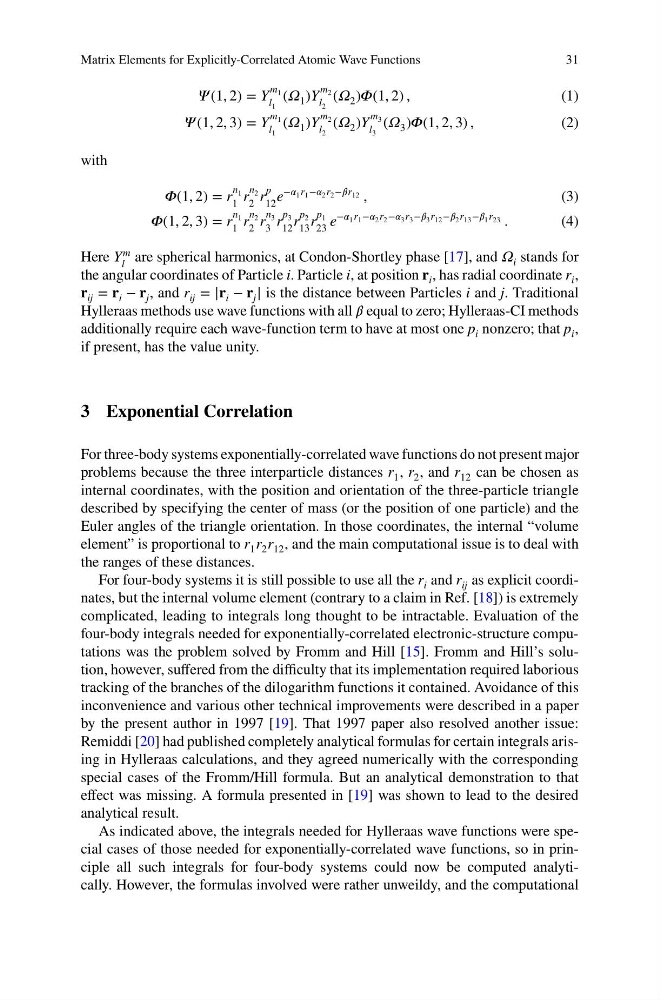
Here Y
m
l
are spherical harmonics, at Condon-Shortley phase [17], and í µí»º i stands for
the angular coordinates of Particle i. Particle i, at position í µí°« i , has radial coordinate r i ,
í µí°« ij = í µí°« i − í µí°« j , and r ij = |í µí°« i − í µí°« j | is the distance between Particles i and j. Traditional
Hylleraas methods use wave functions with all í µí»½ equal to zero; Hylleraas-CI methods
additionally require each wave-function term to have at most one p i nonzero; that p i ,
if present, has the value unity.
3 Exponential Correlation
For three-body systems exponentially-correlated wave functions do not present major
problems because the three interparticle distances r 1 , r 2 , and r 12 can be chosen as
internal coordinates, with the position and orientation of the three-particle triangle
described by specifying the center of mass (or the position of one particle) and the
Euler angles of the triangle orientation. In those coordinates, the internal “volume
element” is proportional to r 1 r 2 r 12 , and the main computational issue is to deal with
the ranges of these distances.
For four-body systems it is still possible to use all the r i and r ij as explicit coordinates, but the internal volume element (contrary to a claim in Ref. [18]) is extremely
complicated, leading to integrals long thought to be intractable. Evaluation of the
four-body integrals needed for exponentially-correlated electronic-structure computations was the problem solved by Fromm and Hill [15]. Fromm and Hill’s solution, however, suffered from the difficulty that its implementation required laborious
tracking of the branches of the dilogarithm functions it contained. Avoidance of this
inconvenience and various other technical improvements were described in a paper
by the present author in 1997 [19]. That 1997 paper also resolved another issue:
Remiddi [20] had published completely analytical formulas for certain integrals arising in Hylleraas calculations, and they agreed numerically with the corresponding
special cases of the Fromm/Hill formula. But an analytical demonstration to that
effect was missing. A formula presented in [19] was shown to lead to the desired
analytical result.
As indicated above, the integrals needed for Hylleraas wave functions were special cases of those needed for exponentially-correlated wave functions, so in principle all such integrals for four-body systems could now be computed analytically. However, the formulas involved were rather unweildy, and the computational
31
í µí»¹ (1, 2) = Y
m 1
l 1
(í µí»º 1 )Y
m 2
l 2
(í µí»º 2 )í µí»·(1, 2) ,
(1)
í µí»¹ (1, 2, 3) = Y
m 1
l 1
(í µí»º 1 )Y
m 2
l 2
(í µí»º 2 )Y
m 3
l 3
(í µí»º 3 )í µí»·(1, 2, 3) ,
(2)
with
í µí»·(1, 2) = r
n 1
1
r
n 2
2
r
p
12
e
−í µí»¼ 1 r 1 −í µí»¼ 2 r 2 −í µí»½r 12 ,
(3)
í µí»·(1, 2, 3) = r
n 1
1
r
n 2
2
r
n 3
3
r
p 3
12
r
p 2
13
r
p 1
23
e
−í µí»¼ 1 r 1 −í µí»¼ 2 r 2 −í µí»¼ 3 r 3 −í µí»½ 3 r 12 −í µí»½ 2 r 13 −í µí»½ 1 r 23 .
(4)
Here Y
m
l
are spherical harmonics, at Condon-Shortley phase [17], and í µí»º i stands for
the angular coordinates of Particle i. Particle i, at position í µí°« i , has radial coordinate r i ,
í µí°« ij = í µí°« i − í µí°« j , and r ij = |í µí°« i − í µí°« j | is the distance between Particles i and j. Traditional
Hylleraas methods use wave functions with all í µí»½ equal to zero; Hylleraas-CI methods
additionally require each wave-function term to have at most one p i nonzero; that p i ,
if present, has the value unity.
3 Exponential Correlation
For three-body systems exponentially-correlated wave functions do not present major
problems because the three interparticle distances r 1 , r 2 , and r 12 can be chosen as
internal coordinates, with the position and orientation of the three-particle triangle
described by specifying the center of mass (or the position of one particle) and the
Euler angles of the triangle orientation. In those coordinates, the internal “volume
element” is proportional to r 1 r 2 r 12 , and the main computational issue is to deal with
the ranges of these distances.
For four-body systems it is still possible to use all the r i and r ij as explicit coordinates, but the internal volume element (contrary to a claim in Ref. [18]) is extremely
complicated, leading to integrals long thought to be intractable. Evaluation of the
four-body integrals needed for exponentially-correlated electronic-structure computations was the problem solved by Fromm and Hill [15]. Fromm and Hill’s solution, however, suffered from the difficulty that its implementation required laborious
tracking of the branches of the dilogarithm functions it contained. Avoidance of this
inconvenience and various other technical improvements were described in a paper
by the present author in 1997 [19]. That 1997 paper also resolved another issue:
Remiddi [20] had published completely analytical formulas for certain integrals arising in Hylleraas calculations, and they agreed numerically with the corresponding
special cases of the Fromm/Hill formula. But an analytical demonstration to that
effect was missing. A formula presented in [19] was shown to lead to the desired
analytical result.
As indicated above, the integrals needed for Hylleraas wave functions were special cases of those needed for exponentially-correlated wave functions, so in principle all such integrals for four-body systems could now be computed analytically. However, the formulas involved were rather unweildy, and the computational