

contributed his visions with a tongue in cheek, it should not give him absolute
immunity and exemption from liability. His attack on the claims of a philosophical
legislation for the exercise of science is stimulating and inspirational, yet it ignores the
foundation of abstracting science as an art of knowledge. To avoid the most bizarre
forms of philosophical relativism the scientific practice should focus on scientific
disciplines and their evolution rather than narrowing the perspective to a comparison
and review of various individual methodological rules and standards.
In the development of a scientific field, the historian of science, Mary Jo Nye [7]
identifies essentially six characteristics of a scientific discipline, i.e. genealogy, core
literature, practices, physical location, recognition and shared values. Within this
perspective it is clear that disciplines, as attractors for accumulated knowledge,
communicated between its members, focused on a particular sphere of Mother
Nature, do evolve with respect to styles and traditions compatible with existing
scientific paradigms and their inevitable changes. Hence scientific disciplines, as
examples of evolutionary lineages, imbedded in the human genetic code, do arise,
develop, evolve, die and diversify. For a detailed example of this process, see e.g.
the historical account of the emergence and evolution of quantum chemistry as a
sub-discipline and its importance in the province of science [8].
Recently the author advocated an evolutionary approach to represent and interpret
the origin and emergence of life, established by modern advances in chemical physics,
from unstable chemical states to biological evolution and order [9]. The Zero Energy
Universe Scenario (ZEUS) was elaborated commensurable with Darwin’s theory of
evolution, from the microscopic ranks to the cosmological domain.
In this contribution we will present an authentic stochastic communication
hypothesis, building on the results portrayed in [9], i.e. combining the novel formulation of quantum mechanics for open systems, relativity theories, Gödel’s theorems,
Off-Diagonal Long-Range Order (ODLRO), the Correlated Dissipative Ensemble,
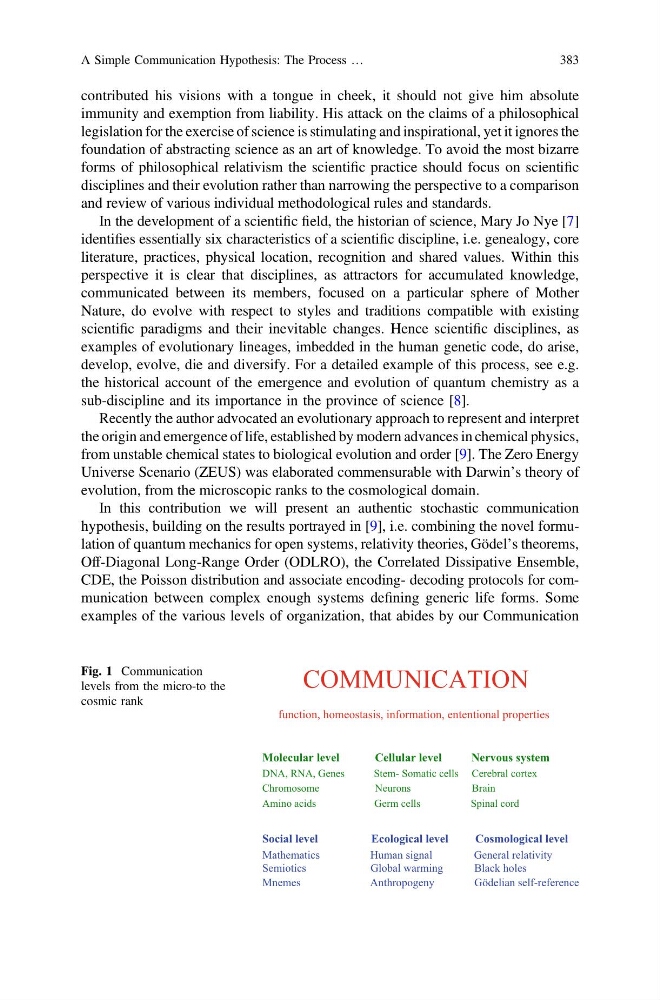
CDE, the Poisson distribution and associate encoding- decoding protocols for communication between complex enough systems defining generic life forms. Some
examples of the various levels of organization, that abides by our Communication
COMMUNICATION
function, homeostasis, information, ententional properties
Molecular level
Cellular level
Nervous system
DNA, RNA, Genes
Stem- Somatic cells Cerebral cortex
Chromosome
Neurons
Brain
Amino acids
Germ cells
Spinal cord
Social level
Ecological level
Cosmological level
Mathematics
Human signal
General relativity
Semiotics
Global warming
Black holes
Mnemes
Anthropogeny
Gödelian self-reference
Fig. 1 Communication
levels from the micro-to the
cosmic rank
A Simple Communication Hypothesis: The Process …
383
immunity and exemption from liability. His attack on the claims of a philosophical
legislation for the exercise of science is stimulating and inspirational, yet it ignores the
foundation of abstracting science as an art of knowledge. To avoid the most bizarre
forms of philosophical relativism the scientific practice should focus on scientific
disciplines and their evolution rather than narrowing the perspective to a comparison
and review of various individual methodological rules and standards.
In the development of a scientific field, the historian of science, Mary Jo Nye [7]
identifies essentially six characteristics of a scientific discipline, i.e. genealogy, core
literature, practices, physical location, recognition and shared values. Within this
perspective it is clear that disciplines, as attractors for accumulated knowledge,
communicated between its members, focused on a particular sphere of Mother
Nature, do evolve with respect to styles and traditions compatible with existing
scientific paradigms and their inevitable changes. Hence scientific disciplines, as
examples of evolutionary lineages, imbedded in the human genetic code, do arise,
develop, evolve, die and diversify. For a detailed example of this process, see e.g.
the historical account of the emergence and evolution of quantum chemistry as a
sub-discipline and its importance in the province of science [8].
Recently the author advocated an evolutionary approach to represent and interpret
the origin and emergence of life, established by modern advances in chemical physics,
from unstable chemical states to biological evolution and order [9]. The Zero Energy
Universe Scenario (ZEUS) was elaborated commensurable with Darwin’s theory of
evolution, from the microscopic ranks to the cosmological domain.
In this contribution we will present an authentic stochastic communication
hypothesis, building on the results portrayed in [9], i.e. combining the novel formulation of quantum mechanics for open systems, relativity theories, Gödel’s theorems,
Off-Diagonal Long-Range Order (ODLRO), the Correlated Dissipative Ensemble,
CDE, the Poisson distribution and associate encoding- decoding protocols for communication between complex enough systems defining generic life forms. Some
examples of the various levels of organization, that abides by our Communication
COMMUNICATION
function, homeostasis, information, ententional properties
Molecular level
Cellular level
Nervous system
DNA, RNA, Genes
Stem- Somatic cells Cerebral cortex
Chromosome
Neurons
Brain
Amino acids
Germ cells
Spinal cord
Social level
Ecological level
Cosmological level
Mathematics
Human signal
General relativity
Semiotics
Global warming
Black holes
Mnemes
Anthropogeny
Gödelian self-reference
Fig. 1 Communication
levels from the micro-to the
cosmic rank
A Simple Communication Hypothesis: The Process …
383