

352
P. Xiang and Y. A. Wang
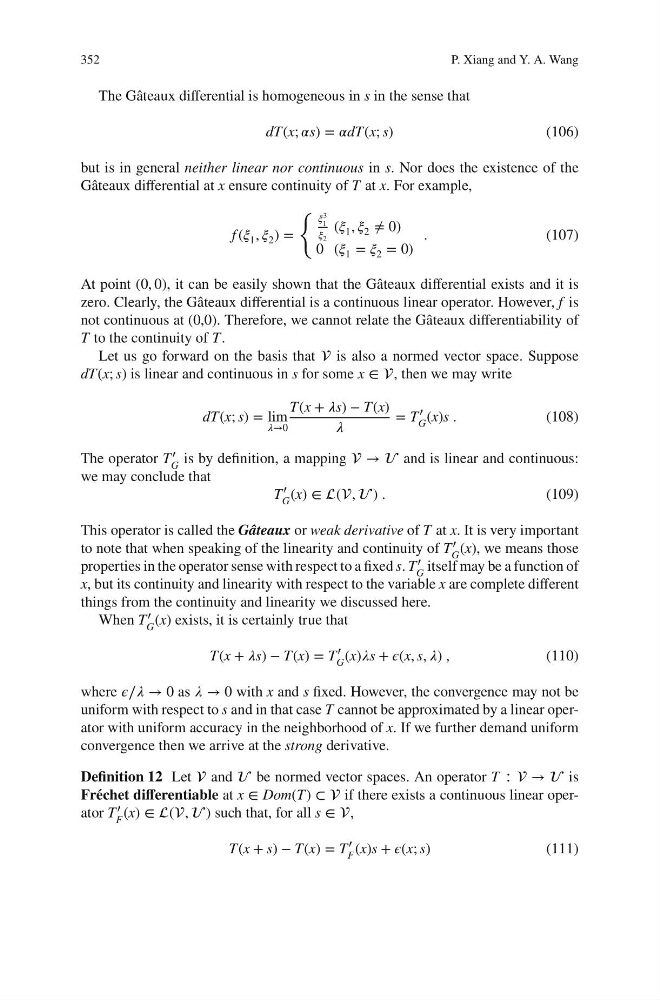
The Gâteaux differential is homogeneous in s in the sense that
dT(x; í µí»¼s) = í µí»¼dT(x; s)
(106)
but is in general neither linear nor continuous in s. Nor does the existence of the
Gâteaux differential at x ensure continuity of T at x. For example,
f (í µí¼ 1 , í µí¼ 2 ) =
{ í µí¼
3
1
í µí¼ 2
(í µí¼ 1 , í µí¼ 2 ≠ 0)
0 (í µí¼ 1 = í µí¼ 2 = 0)
.
(107)
At point (0, 0), it can be easily shown that the Gâteaux differential exists and it is
zero. Clearly, the Gâteaux differential is a continuous linear operator. However, f is
not continuous at (0,0). Therefore, we cannot relate the Gâteaux differentiability of
T to the continuity of T.
Let us go forward on the basis that is also a normed vector space. Suppose
dT(x; s) is linear and continuous in s for some x ∈ , then we may write
dT(x; s) = lim
í µí¼→0
T(x + í µí¼s) − T(x)
í µí¼
= T
′
G (x)s .
(108)
The operator T
′
G
is by definition, a mapping → and is linear and continuous:
we may conclude that
T
′
G (x) ∈ (, ) .
(109)
This operator is called the Gâteaux or weak derivative of T at x. It is very important
to note that when speaking of the linearity and continuity of T
′
G
(x), we means those
properties in the operator sense with respect to a fixed s. T
′
G
itself may be a function of
x, but its continuity and linearity with respect to the variable x are complete different
things from the continuity and linearity we discussed here.
When T
′
G
(x) exists, it is certainly true that
T(x + í µí¼s) − T(x) = T
′
G (x)í µí¼s + í µí¼(x, s, í µí¼) ,
(110)
where í µí¼∕í µí¼ → 0 as í µí¼ → 0 with x and s fixed. However, the convergence may not be
uniform with respect to s and in that case T cannot be approximated by a linear operator with uniform accuracy in the neighborhood of x. If we further demand uniform
convergence then we arrive at the strong derivative.
Definition 12 Let and be normed vector spaces. An operator T ∶ → is
Fréchet differentiable at x ∈ Dom(T) ⊂ if there exists a continuous linear operator T
′
F
(x) ∈ (, ) such that, for all s ∈ ,
T(x + s) − T(x) = T
′
F (x)s + í µí¼(x; s)
(111)
P. Xiang and Y. A. Wang
The Gâteaux differential is homogeneous in s in the sense that
dT(x; í µí»¼s) = í µí»¼dT(x; s)
(106)
but is in general neither linear nor continuous in s. Nor does the existence of the
Gâteaux differential at x ensure continuity of T at x. For example,
f (í µí¼ 1 , í µí¼ 2 ) =
{ í µí¼
3
1
í µí¼ 2
(í µí¼ 1 , í µí¼ 2 ≠ 0)
0 (í µí¼ 1 = í µí¼ 2 = 0)
.
(107)
At point (0, 0), it can be easily shown that the Gâteaux differential exists and it is
zero. Clearly, the Gâteaux differential is a continuous linear operator. However, f is
not continuous at (0,0). Therefore, we cannot relate the Gâteaux differentiability of
T to the continuity of T.
Let us go forward on the basis that is also a normed vector space. Suppose
dT(x; s) is linear and continuous in s for some x ∈ , then we may write
dT(x; s) = lim
í µí¼→0
T(x + í µí¼s) − T(x)
í µí¼
= T
′
G (x)s .
(108)
The operator T
′
G
is by definition, a mapping → and is linear and continuous:
we may conclude that
T
′
G (x) ∈ (, ) .
(109)
This operator is called the Gâteaux or weak derivative of T at x. It is very important
to note that when speaking of the linearity and continuity of T
′
G
(x), we means those
properties in the operator sense with respect to a fixed s. T
′
G
itself may be a function of
x, but its continuity and linearity with respect to the variable x are complete different
things from the continuity and linearity we discussed here.
When T
′
G
(x) exists, it is certainly true that
T(x + í µí¼s) − T(x) = T
′
G (x)í µí¼s + í µí¼(x, s, í µí¼) ,
(110)
where í µí¼∕í µí¼ → 0 as í µí¼ → 0 with x and s fixed. However, the convergence may not be
uniform with respect to s and in that case T cannot be approximated by a linear operator with uniform accuracy in the neighborhood of x. If we further demand uniform
convergence then we arrive at the strong derivative.
Definition 12 Let and be normed vector spaces. An operator T ∶ → is
Fréchet differentiable at x ∈ Dom(T) ⊂ if there exists a continuous linear operator T
′
F
(x) ∈ (, ) such that, for all s ∈ ,
T(x + s) − T(x) = T
′
F (x)s + í µí¼(x; s)
(111)