

a-b-e-f-g-h-p-v-x
a-b-e-f-g-h-q-v-x
a-b-e-f- g-h -q-t-x
a-b-e-f-g-h-q-v-y
a-b-e-f-g-h-p-t-x
b-c-e-f-g-h-p-t-x
a-d-e-f-g-h-p-t-x
c-d-e-f-g-h-p-t-x
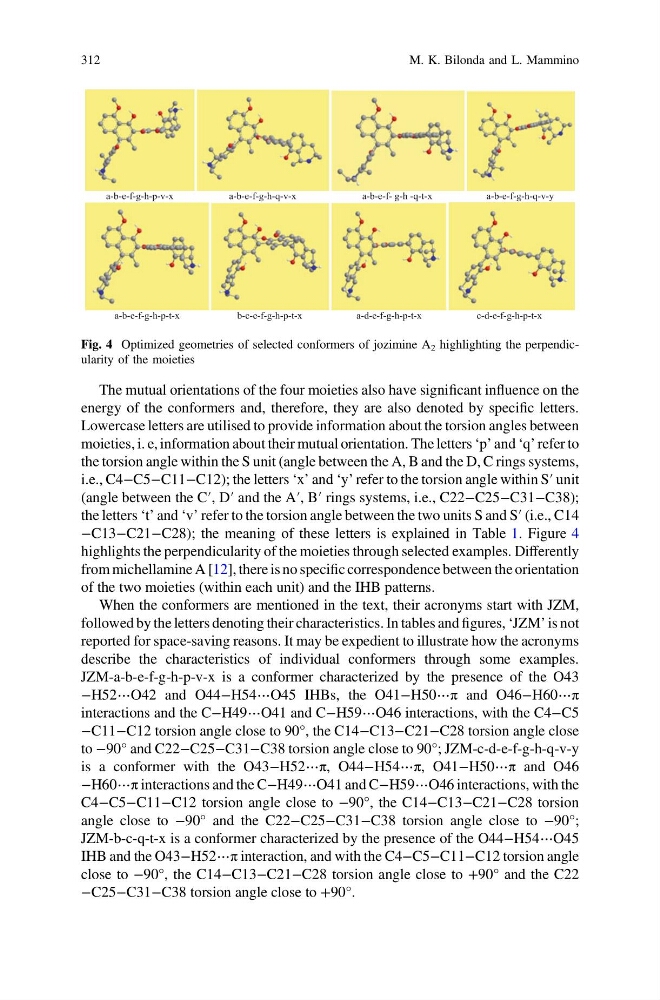
Fig. 4 Optimized geometries of selected conformers of jozimine A 2 highlighting the perpendicularity of the moieties
The mutual orientations of the four moieties also have significant influence on the
energy of the conformers and, therefore, they are also denoted by specific letters.
Lowercase letters are utilised to provide information about the torsion angles between
moieties, i. e, information about their mutual orientation. The letters ‘p’ and ‘q’ refer to
the torsion angle within the S unit (angle between the A, B and the D, C rings systems,
i.e., C4−C5−C11−C12); the letters ‘x’ and ‘y’ refer to the torsion angle within S′ unit
(angle between the C′, D′ and the A′, B′ rings systems, i.e., C22−C25−C31−C38);
the letters ‘t’ and ‘v’ refer to the torsion angle between the two units S and S′ (i.e., C14
−C13−C21−C28); the meaning of these letters is explained in Table 1. Figure 4
highlights the perpendicularity of the moieties through selected examples. Differently
from michellamine A [12], there is no specific correspondence between the orientation
of the two moieties (within each unit) and the IHB patterns.
When the conformers are mentioned in the text, their acronyms start with JZM,
followed by the letters denoting their characteristics. In tables and figures, ‘JZM’ is not
reported for space-saving reasons. It may be expedient to illustrate how the acronyms
describe the characteristics of individual conformers through some examples.
JZM-a-b-e-f-g-h-p-v-x is a conformer characterized by the presence of the O43
−H52⋯O42 and O44−H54⋯O45 IHBs, the O41−H50⋯π and O46−H60⋯π
interactions and the C−H49⋯O41 and C−H59⋯O46 interactions, with the C4−C5
−C11−C12 torsion angle close to 90°, the C14−C13−C21−C28 torsion angle close
to −90° and C22−C25−C31−C38 torsion angle close to 90°; JZM-c-d-e-f-g-h-q-v-y
is a conformer with the O43−H52⋯π, O44−H54⋯π, O41−H50⋯π and O46
−H60⋯π interactions and the C−H49⋯O41 and C−H59⋯O46 interactions, with the
C4−C5−C11−C12 torsion angle close to −90°, the C14−C13−C21−C28 torsion
angle close to −90° and the C22−C25−C31−C38 torsion angle close to −90°;
JZM-b-c-q-t-x is a conformer characterized by the presence of the O44−H54⋯O45
IHB and the O43−H52⋯π interaction, and with the C4−C5−C11−C12 torsion angle
close to −90°, the C14−C13−C21−C28 torsion angle close to +90° and the C22
−C25−C31−C38 torsion angle close to +90°.
312
M. K. Bilonda and L. Mammino
a-b-e-f-g-h-q-v-x
a-b-e-f- g-h -q-t-x
a-b-e-f-g-h-q-v-y
a-b-e-f-g-h-p-t-x
b-c-e-f-g-h-p-t-x
a-d-e-f-g-h-p-t-x
c-d-e-f-g-h-p-t-x
Fig. 4 Optimized geometries of selected conformers of jozimine A 2 highlighting the perpendicularity of the moieties
The mutual orientations of the four moieties also have significant influence on the
energy of the conformers and, therefore, they are also denoted by specific letters.
Lowercase letters are utilised to provide information about the torsion angles between
moieties, i. e, information about their mutual orientation. The letters ‘p’ and ‘q’ refer to
the torsion angle within the S unit (angle between the A, B and the D, C rings systems,
i.e., C4−C5−C11−C12); the letters ‘x’ and ‘y’ refer to the torsion angle within S′ unit
(angle between the C′, D′ and the A′, B′ rings systems, i.e., C22−C25−C31−C38);
the letters ‘t’ and ‘v’ refer to the torsion angle between the two units S and S′ (i.e., C14
−C13−C21−C28); the meaning of these letters is explained in Table 1. Figure 4
highlights the perpendicularity of the moieties through selected examples. Differently
from michellamine A [12], there is no specific correspondence between the orientation
of the two moieties (within each unit) and the IHB patterns.
When the conformers are mentioned in the text, their acronyms start with JZM,
followed by the letters denoting their characteristics. In tables and figures, ‘JZM’ is not
reported for space-saving reasons. It may be expedient to illustrate how the acronyms
describe the characteristics of individual conformers through some examples.
JZM-a-b-e-f-g-h-p-v-x is a conformer characterized by the presence of the O43
−H52⋯O42 and O44−H54⋯O45 IHBs, the O41−H50⋯π and O46−H60⋯π
interactions and the C−H49⋯O41 and C−H59⋯O46 interactions, with the C4−C5
−C11−C12 torsion angle close to 90°, the C14−C13−C21−C28 torsion angle close
to −90° and C22−C25−C31−C38 torsion angle close to 90°; JZM-c-d-e-f-g-h-q-v-y
is a conformer with the O43−H52⋯π, O44−H54⋯π, O41−H50⋯π and O46
−H60⋯π interactions and the C−H49⋯O41 and C−H59⋯O46 interactions, with the
C4−C5−C11−C12 torsion angle close to −90°, the C14−C13−C21−C28 torsion
angle close to −90° and the C22−C25−C31−C38 torsion angle close to −90°;
JZM-b-c-q-t-x is a conformer characterized by the presence of the O44−H54⋯O45
IHB and the O43−H52⋯π interaction, and with the C4−C5−C11−C12 torsion angle
close to −90°, the C14−C13−C21−C28 torsion angle close to +90° and the C22
−C25−C31−C38 torsion angle close to +90°.
312
M. K. Bilonda and L. Mammino