

solvents considered, HOMO-LUMO energy gaps, etc.), in the results of both calculation methods, and figures showing all the conformers, are included in the
Supplementary Information.
3 Results
3.1 Naming of Conformers
A system of symbols is introduced to be able to clearly and easily identify the
geometric characteristics of each conformer when analysing the results; thus, each
conformer is denoted by an acronym summarising its characterising features. Since
it is useful to be able to mention each ring individually and concisely, the rings are
denoted by uppercase letters [12]. Since the two units are identical, identical rings
are denoted with the same letter, primed for one of the units. Thus, the rings are
denoted as A, B, C, D, A′, B′, C′ and D′ as shown in Fig. 1. In order to be able to
mention each of the two units of the dimeric molecular structure individually, the
whole unit comprising the A, B, C and D rings is called S and the whole unit
comprising the A′, B′, C′ and D′ rings is called S′.
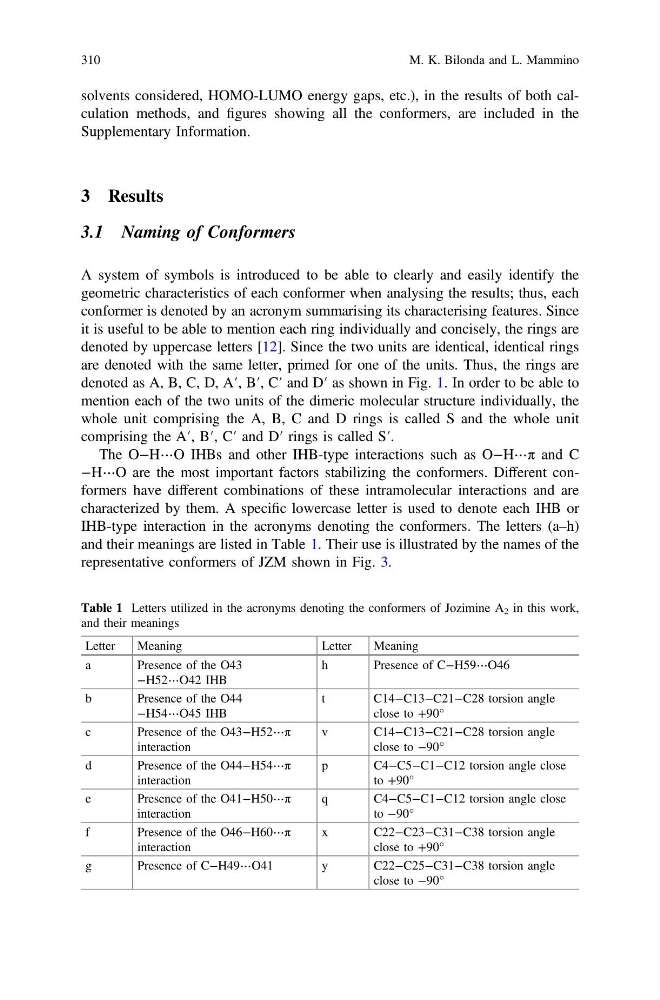
The O−H⋯O IHBs and other IHB-type interactions such as O−H⋯π and C
−H⋯O are the most important factors stabilizing the conformers. Different conformers have different combinations of these intramolecular interactions and are
characterized by them. A specific lowercase letter is used to denote each IHB or
IHB-type interaction in the acronyms denoting the conformers. The letters (a–h)
and their meanings are listed in Table 1. Their use is illustrated by the names of the
representative conformers of JZM shown in Fig. 3.
Table 1 Letters utilized in the acronyms denoting the conformers of Jozimine A 2 in this work,
and their meanings
Letter
Meaning
Letter
Meaning
a
Presence of the O43
−H52⋯O42 IHB
h
Presence of C−H59⋯O46
b
Presence of the O44
−H54⋯O45 IHB
t
C14−C13−C21−C28 torsion angle
close to +90°
c
Presence of the O43−H52⋯π
interaction
v
C14−C13−C21−C28 torsion angle
close to −90°
d
Presence of the O44−H54⋯π
interaction
p
C 4 −C5−C1−C12 torsion angle close
to +90°
e
Presence of the O41−H50⋯π
interaction
q
C 4 −C5−C1−C12 torsion angle close
to −90°
f
Presence of the O46−H60⋯π
interaction
x
C22−C23−C31−C38 torsion angle
close to +90°
g
Presence of C−H49⋯O41
y
C22−C25−C31−C38 torsion angle
close to −90°
310
M. K. Bilonda and L. Mammino
Supplementary Information.
3 Results
3.1 Naming of Conformers
A system of symbols is introduced to be able to clearly and easily identify the
geometric characteristics of each conformer when analysing the results; thus, each
conformer is denoted by an acronym summarising its characterising features. Since
it is useful to be able to mention each ring individually and concisely, the rings are
denoted by uppercase letters [12]. Since the two units are identical, identical rings
are denoted with the same letter, primed for one of the units. Thus, the rings are
denoted as A, B, C, D, A′, B′, C′ and D′ as shown in Fig. 1. In order to be able to
mention each of the two units of the dimeric molecular structure individually, the
whole unit comprising the A, B, C and D rings is called S and the whole unit
comprising the A′, B′, C′ and D′ rings is called S′.
The O−H⋯O IHBs and other IHB-type interactions such as O−H⋯π and C
−H⋯O are the most important factors stabilizing the conformers. Different conformers have different combinations of these intramolecular interactions and are
characterized by them. A specific lowercase letter is used to denote each IHB or
IHB-type interaction in the acronyms denoting the conformers. The letters (a–h)
and their meanings are listed in Table 1. Their use is illustrated by the names of the
representative conformers of JZM shown in Fig. 3.
Table 1 Letters utilized in the acronyms denoting the conformers of Jozimine A 2 in this work,
and their meanings
Letter
Meaning
Letter
Meaning
a
Presence of the O43
−H52⋯O42 IHB
h
Presence of C−H59⋯O46
b
Presence of the O44
−H54⋯O45 IHB
t
C14−C13−C21−C28 torsion angle
close to +90°
c
Presence of the O43−H52⋯π
interaction
v
C14−C13−C21−C28 torsion angle
close to −90°
d
Presence of the O44−H54⋯π
interaction
p
C 4 −C5−C1−C12 torsion angle close
to +90°
e
Presence of the O41−H50⋯π
interaction
q
C 4 −C5−C1−C12 torsion angle close
to −90°
f
Presence of the O46−H60⋯π
interaction
x
C22−C23−C31−C38 torsion angle
close to +90°
g
Presence of C−H49⋯O41
y
C22−C25−C31−C38 torsion angle
close to −90°
310
M. K. Bilonda and L. Mammino