

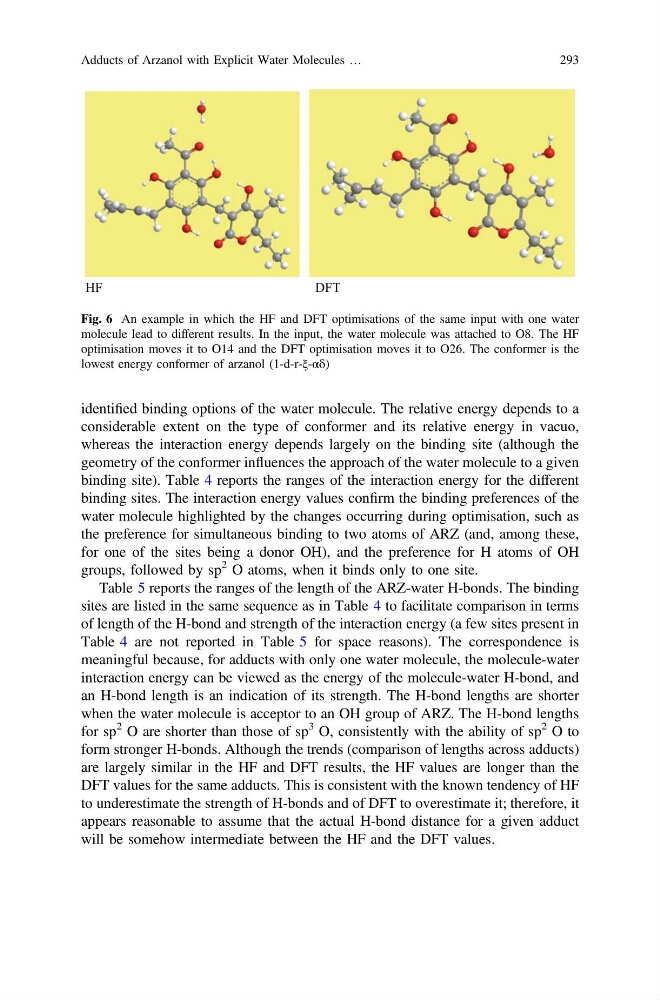
identified binding options of the water molecule. The relative energy depends to a
considerable extent on the type of conformer and its relative energy in vacuo,
whereas the interaction energy depends largely on the binding site (although the
geometry of the conformer influences the approach of the water molecule to a given
binding site). Table 4 reports the ranges of the interaction energy for the different
binding sites. The interaction energy values confirm the binding preferences of the
water molecule highlighted by the changes occurring during optimisation, such as
the preference for simultaneous binding to two atoms of ARZ (and, among these,
for one of the sites being a donor OH), and the preference for H atoms of OH
groups, followed by sp
2 O atoms, when it binds only to one site.
Table 5 reports the ranges of the length of the ARZ-water H-bonds. The binding
sites are listed in the same sequence as in Table 4 to facilitate comparison in terms
of length of the H-bond and strength of the interaction energy (a few sites present in
Table 4 are not reported in Table 5 for space reasons). The correspondence is
meaningful because, for adducts with only one water molecule, the molecule-water
interaction energy can be viewed as the energy of the molecule-water H-bond, and
an H-bond length is an indication of its strength. The H-bond lengths are shorter
when the water molecule is acceptor to an OH group of ARZ. The H-bond lengths
for sp
2 O are shorter than those of sp
3 O, consistently with the ability of sp
2 O to
form stronger H-bonds. Although the trends (comparison of lengths across adducts)
are largely similar in the HF and DFT results, the HF values are longer than the
DFT values for the same adducts. This is consistent with the known tendency of HF
to underestimate the strength of H-bonds and of DFT to overestimate it; therefore, it
appears reasonable to assume that the actual H-bond distance for a given adduct
will be somehow intermediate between the HF and the DFT values.
HF
DFT
Fig. 6 An example in which the HF and DFT optimisations of the same input with one water
molecule lead to different results. In the input, the water molecule was attached to O8. The HF
optimisation moves it to O14 and the DFT optimisation moves it to O26. The conformer is the
lowest energy conformer of arzanol (1-d-r-ξ-αδ)
Adducts of Arzanol with Explicit Water Molecules …
293
considerable extent on the type of conformer and its relative energy in vacuo,
whereas the interaction energy depends largely on the binding site (although the
geometry of the conformer influences the approach of the water molecule to a given
binding site). Table 4 reports the ranges of the interaction energy for the different
binding sites. The interaction energy values confirm the binding preferences of the
water molecule highlighted by the changes occurring during optimisation, such as
the preference for simultaneous binding to two atoms of ARZ (and, among these,
for one of the sites being a donor OH), and the preference for H atoms of OH
groups, followed by sp
2 O atoms, when it binds only to one site.
Table 5 reports the ranges of the length of the ARZ-water H-bonds. The binding
sites are listed in the same sequence as in Table 4 to facilitate comparison in terms
of length of the H-bond and strength of the interaction energy (a few sites present in
Table 4 are not reported in Table 5 for space reasons). The correspondence is
meaningful because, for adducts with only one water molecule, the molecule-water
interaction energy can be viewed as the energy of the molecule-water H-bond, and
an H-bond length is an indication of its strength. The H-bond lengths are shorter
when the water molecule is acceptor to an OH group of ARZ. The H-bond lengths
for sp
2 O are shorter than those of sp
3 O, consistently with the ability of sp
2 O to
form stronger H-bonds. Although the trends (comparison of lengths across adducts)
are largely similar in the HF and DFT results, the HF values are longer than the
DFT values for the same adducts. This is consistent with the known tendency of HF
to underestimate the strength of H-bonds and of DFT to overestimate it; therefore, it
appears reasonable to assume that the actual H-bond distance for a given adduct
will be somehow intermediate between the HF and the DFT values.
HF
DFT
Fig. 6 An example in which the HF and DFT optimisations of the same input with one water
molecule lead to different results. In the input, the water molecule was attached to O8. The HF
optimisation moves it to O14 and the DFT optimisation moves it to O26. The conformer is the
lowest energy conformer of arzanol (1-d-r-ξ-αδ)
Adducts of Arzanol with Explicit Water Molecules …
293