

pertains to an ongoing study of antioxidant ACPLs which, for ARZ, has so far
produced the results reported in [5, 18].
2 Calculation Details
2.1 Selection of Adducts
ARZ can have a high number of conformers, with different mutual orientations of
the PHL and PYR moieties and different IHB patterns. More than 90 conformers
were considered in [5] (which included all the lowest energy ones and disregarded
only some very high energy ones without the first IHB). Four mutual orientations of
the two moieties were identified and denoted with the numbers 1, 2, 3 and 4 [5].
Corresponding conformers of the #1 and #2 series differ only by the fact that the
orientation of the PYR ring is symmetrical with respect to the plane identified by
the PHL ring and have very close energies; the same is true for corresponding
conformers of the #3 and #4 series. Therefore, it is sufficient to select one series
from each pair to ensure the consideration of the different IHMB patterns. The #1
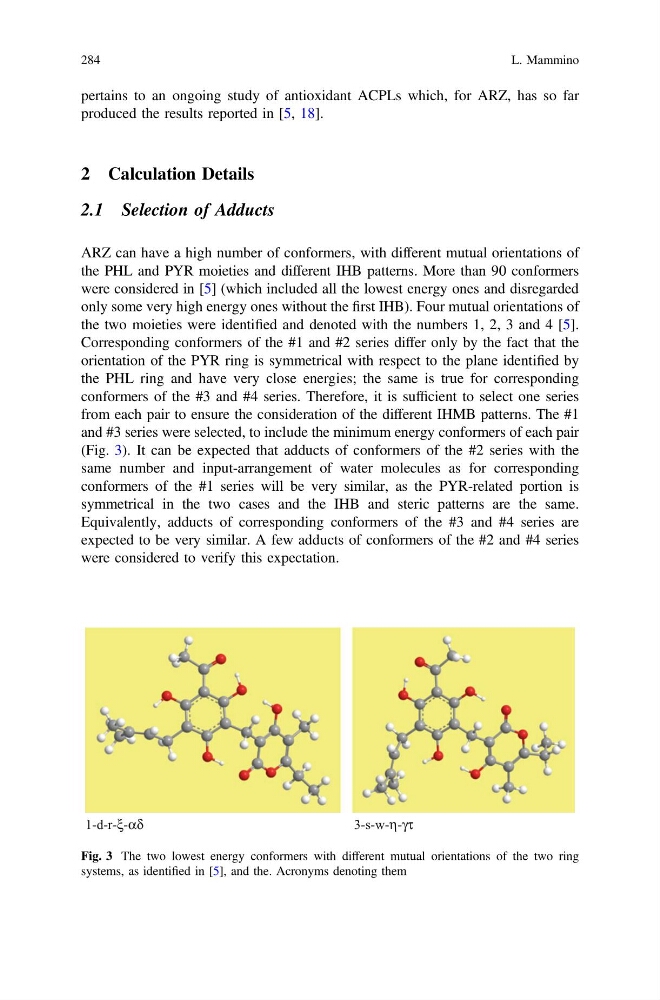
and #3 series were selected, to include the minimum energy conformers of each pair
(Fig. 3). It can be expected that adducts of conformers of the #2 series with the
same number and input-arrangement of water molecules as for corresponding
conformers of the #1 series will be very similar, as the PYR-related portion is
symmetrical in the two cases and the IHB and steric patterns are the same.
Equivalently, adducts of corresponding conformers of the #3 and #4 series are
expected to be very similar. A few adducts of conformers of the #2 and #4 series
were considered to verify this expectation.
1-d-r-ξ-αδ
3-s-w-η-γτ
Fig. 3 The two lowest energy conformers with different mutual orientations of the two ring
systems, as identified in [5], and the. Acronyms denoting them
284
L. Mammino
produced the results reported in [5, 18].
2 Calculation Details
2.1 Selection of Adducts
ARZ can have a high number of conformers, with different mutual orientations of
the PHL and PYR moieties and different IHB patterns. More than 90 conformers
were considered in [5] (which included all the lowest energy ones and disregarded
only some very high energy ones without the first IHB). Four mutual orientations of
the two moieties were identified and denoted with the numbers 1, 2, 3 and 4 [5].
Corresponding conformers of the #1 and #2 series differ only by the fact that the
orientation of the PYR ring is symmetrical with respect to the plane identified by
the PHL ring and have very close energies; the same is true for corresponding
conformers of the #3 and #4 series. Therefore, it is sufficient to select one series
from each pair to ensure the consideration of the different IHMB patterns. The #1
and #3 series were selected, to include the minimum energy conformers of each pair
(Fig. 3). It can be expected that adducts of conformers of the #2 series with the
same number and input-arrangement of water molecules as for corresponding
conformers of the #1 series will be very similar, as the PYR-related portion is
symmetrical in the two cases and the IHB and steric patterns are the same.
Equivalently, adducts of corresponding conformers of the #3 and #4 series are
expected to be very similar. A few adducts of conformers of the #2 and #4 series
were considered to verify this expectation.
1-d-r-ξ-αδ
3-s-w-η-γτ
Fig. 3 The two lowest energy conformers with different mutual orientations of the two ring
systems, as identified in [5], and the. Acronyms denoting them
284
L. Mammino