

1 Introduction
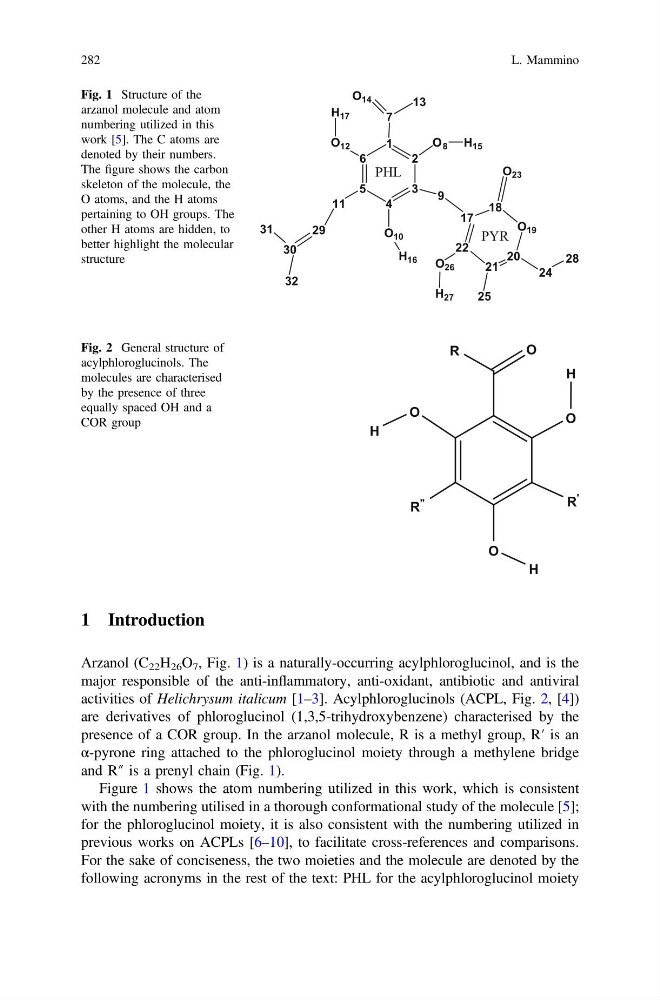
Arzanol (C 22 H 26 O 7 , Fig. 1) is a naturally-occurring acylphloroglucinol, and is the
major responsible of the anti-inflammatory, anti-oxidant, antibiotic and antiviral
activities of Helichrysum italicum [1–3]. Acylphloroglucinols (ACPL, Fig. 2, [4])
are derivatives of phloroglucinol (1,3,5-trihydroxybenzene) characterised by the
presence of a COR group. In the arzanol molecule, R is a methyl group, R′ is an
α-pyrone ring attached to the phloroglucinol moiety through a methylene bridge
and R″ is a prenyl chain (Fig. 1).
Figure 1 shows the atom numbering utilized in this work, which is consistent
with the numbering utilised in a thorough conformational study of the molecule [5];
for the phloroglucinol moiety, it is also consistent with the numbering utilized in
previous works on ACPLs [6–10], to facilitate cross-references and comparisons.
For the sake of conciseness, the two moieties and the molecule are denoted by the
following acronyms in the rest of the text: PHL for the acylphloroglucinol moiety
6
5
4
3
2
1
O 12
O 10
O 8
H 17
H 15
9
7
H 16
13
O 14
11
29
30
31
17
22
21
20
O 19
18
O 23
O 26
H 27
25
24
28
32
PHL
PYR
Fig. 1 Structure of the
arzanol molecule and atom
numbering utilized in this
work [5]. The C atoms are
denoted by their numbers.
The figure shows the carbon
skeleton of the molecule, the
O atoms, and the H atoms
pertaining to OH groups. The
other H atoms are hidden, to
better highlight the molecular
structure
O
H
O
H
O
H
R
'
R
"
O
R
Fig. 2 General structure of
acylphloroglucinols. The
molecules are characterised
by the presence of three
equally spaced OH and a
COR group
282
L. Mammino
Arzanol (C 22 H 26 O 7 , Fig. 1) is a naturally-occurring acylphloroglucinol, and is the
major responsible of the anti-inflammatory, anti-oxidant, antibiotic and antiviral
activities of Helichrysum italicum [1–3]. Acylphloroglucinols (ACPL, Fig. 2, [4])
are derivatives of phloroglucinol (1,3,5-trihydroxybenzene) characterised by the
presence of a COR group. In the arzanol molecule, R is a methyl group, R′ is an
α-pyrone ring attached to the phloroglucinol moiety through a methylene bridge
and R″ is a prenyl chain (Fig. 1).
Figure 1 shows the atom numbering utilized in this work, which is consistent
with the numbering utilised in a thorough conformational study of the molecule [5];
for the phloroglucinol moiety, it is also consistent with the numbering utilized in
previous works on ACPLs [6–10], to facilitate cross-references and comparisons.
For the sake of conciseness, the two moieties and the molecule are denoted by the
following acronyms in the rest of the text: PHL for the acylphloroglucinol moiety
6
5
4
3
2
1
O 12
O 10
O 8
H 17
H 15
9
7
H 16
13
O 14
11
29
30
31
17
22
21
20
O 19
18
O 23
O 26
H 27
25
24
28
32
PHL
PYR
Fig. 1 Structure of the
arzanol molecule and atom
numbering utilized in this
work [5]. The C atoms are
denoted by their numbers.
The figure shows the carbon
skeleton of the molecule, the
O atoms, and the H atoms
pertaining to OH groups. The
other H atoms are hidden, to
better highlight the molecular
structure
O
H
O
H
O
H
R
'
R
"
O
R
Fig. 2 General structure of
acylphloroglucinols. The
molecules are characterised
by the presence of three
equally spaced OH and a
COR group
282
L. Mammino