

254
D. G. Green and G. F. Gribakin
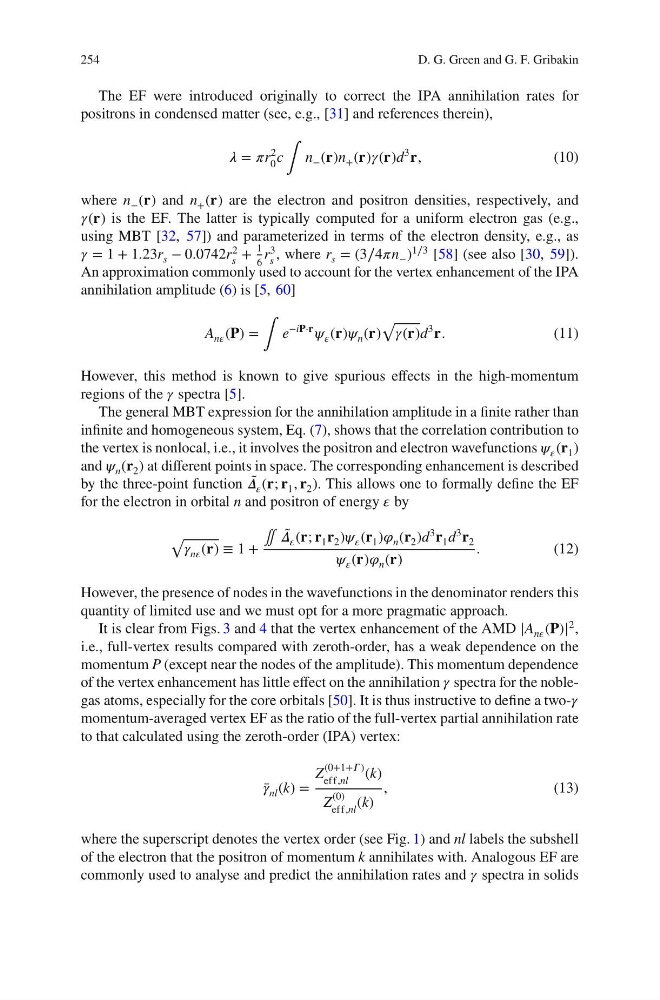
The EF were introduced originally to correct the IPA annihilation rates for
positrons in condensed matter (see, e.g., [31] and references therein),
í µí¼ = í µí¼r
2
0 c ∫
n − (í µí°«)n + (í µí°«)í µí»¾(í µí°«)d
3
í µí°«,
(10)
where n − (í µí°«) and n + (í µí°«) are the electron and positron densities, respectively, and
í µí»¾(í µí°«) is the EF. The latter is typically computed for a uniform electron gas (e.g.,
using MBT [32, 57]) and parameterized in terms of the electron density, e.g., as
í µí»¾ = 1 + 1.23r s − 0.0742r
2
s +
1
6
r
3
s , where r s = (3∕4í µí¼n − )
1∕3 [58] (see also [30, 59]).
An approximation commonly used to account for the vertex enhancement of the IPA
annihilation amplitude (6) is [5, 60]
A ní µí¼ (í µí°) = ∫
e
−ií µí°⋅í µí°«
í µí¼ í µí¼ (í µí°«)í µí¼ n (í µí°«)
√
í µí»¾(í µí°«)d
3
í µí°«.
(11)
However, this method is known to give spurious effects in the high-momentum
regions of the í µí»¾ spectra [5].
The general MBT expression for the annihilation amplitude in a finite rather than
infinite and homogeneous system, Eq. (7), shows that the correlation contribution to
the vertex is nonlocal, i.e., it involves the positron and electron wavefunctions í µí¼ í µí¼ (í µí°« 1 )
and í µí¼ n (í µí°« 2 ) at different points in space. The corresponding enhancement is described
by the three-point function ̃
í µí»¥ í µí¼ (í µí°«; í µí°« 1 , í µí°« 2 ). This allows one to formally define the EF
for the electron in orbital n and positron of energy í µí¼ by
√
í µí»¾ ní µí¼ (í µí°«) ≡ 1 +
∬ ̃
í µí»¥ í µí¼ (í µí°«; í µí°« 1 í µí°« 2 )í µí¼ í µí¼ (í µí°« 1 )í µí¼ n (í µí°« 2 )d 3 í µí°« 1 d 3 í µí°« 2
í µí¼ í µí¼ (í µí°«)í µí¼ n (í µí°«)
.
(12)
However, the presence of nodes in the wavefunctions in the denominator renders this
quantity of limited use and we must opt for a more pragmatic approach.
It is clear from Figs. 3 and 4 that the vertex enhancement of the AMD |A ní µí¼ (í µí°)| 2 ,
i.e., full-vertex results compared with zeroth-order, has a weak dependence on the
momentum P (except near the nodes of the amplitude). This momentum dependence
of the vertex enhancement has little effect on the annihilation í µí»¾ spectra for the noblegas atoms, especially for the core orbitals [50]. It is thus instructive to define a two-í µí»¾
momentum-averaged vertex EF as the ratio of the full-vertex partial annihilation rate
to that calculated using the zeroth-order (IPA) vertex:
̄
í µí»¾ nl (k) =
Z
(0+1+í µí»¤ )
ef f ,nl
(k)
Z
(0)
ef f ,nl
(k)
,
(13)
where the superscript denotes the vertex order (see Fig. 1) and nl labels the subshell
of the electron that the positron of momentum k annihilates with. Analogous EF are
commonly used to analyse and predict the annihilation rates and í µí»¾ spectra in solids
D. G. Green and G. F. Gribakin
The EF were introduced originally to correct the IPA annihilation rates for
positrons in condensed matter (see, e.g., [31] and references therein),
í µí¼ = í µí¼r
2
0 c ∫
n − (í µí°«)n + (í µí°«)í µí»¾(í µí°«)d
3
í µí°«,
(10)
where n − (í µí°«) and n + (í µí°«) are the electron and positron densities, respectively, and
í µí»¾(í µí°«) is the EF. The latter is typically computed for a uniform electron gas (e.g.,
using MBT [32, 57]) and parameterized in terms of the electron density, e.g., as
í µí»¾ = 1 + 1.23r s − 0.0742r
2
s +
1
6
r
3
s , where r s = (3∕4í µí¼n − )
1∕3 [58] (see also [30, 59]).
An approximation commonly used to account for the vertex enhancement of the IPA
annihilation amplitude (6) is [5, 60]
A ní µí¼ (í µí°) = ∫
e
−ií µí°⋅í µí°«
í µí¼ í µí¼ (í µí°«)í µí¼ n (í µí°«)
√
í µí»¾(í µí°«)d
3
í µí°«.
(11)
However, this method is known to give spurious effects in the high-momentum
regions of the í µí»¾ spectra [5].
The general MBT expression for the annihilation amplitude in a finite rather than
infinite and homogeneous system, Eq. (7), shows that the correlation contribution to
the vertex is nonlocal, i.e., it involves the positron and electron wavefunctions í µí¼ í µí¼ (í µí°« 1 )
and í µí¼ n (í µí°« 2 ) at different points in space. The corresponding enhancement is described
by the three-point function ̃
í µí»¥ í µí¼ (í µí°«; í µí°« 1 , í µí°« 2 ). This allows one to formally define the EF
for the electron in orbital n and positron of energy í µí¼ by
√
í µí»¾ ní µí¼ (í µí°«) ≡ 1 +
∬ ̃
í µí»¥ í µí¼ (í µí°«; í µí°« 1 í µí°« 2 )í µí¼ í µí¼ (í µí°« 1 )í µí¼ n (í µí°« 2 )d 3 í µí°« 1 d 3 í µí°« 2
í µí¼ í µí¼ (í µí°«)í µí¼ n (í µí°«)
.
(12)
However, the presence of nodes in the wavefunctions in the denominator renders this
quantity of limited use and we must opt for a more pragmatic approach.
It is clear from Figs. 3 and 4 that the vertex enhancement of the AMD |A ní µí¼ (í µí°)| 2 ,
i.e., full-vertex results compared with zeroth-order, has a weak dependence on the
momentum P (except near the nodes of the amplitude). This momentum dependence
of the vertex enhancement has little effect on the annihilation í µí»¾ spectra for the noblegas atoms, especially for the core orbitals [50]. It is thus instructive to define a two-í µí»¾
momentum-averaged vertex EF as the ratio of the full-vertex partial annihilation rate
to that calculated using the zeroth-order (IPA) vertex:
̄
í µí»¾ nl (k) =
Z
(0+1+í µí»¤ )
ef f ,nl
(k)
Z
(0)
ef f ,nl
(k)
,
(13)
where the superscript denotes the vertex order (see Fig. 1) and nl labels the subshell
of the electron that the positron of momentum k annihilates with. Analogous EF are
commonly used to analyse and predict the annihilation rates and í µí»¾ spectra in solids