

246
D. G. Green and G. F. Gribakin
w n (í µí¼) =
1
c ∫ ∫
∞
2|í µí¼|∕c
|A ní µí°¤ (í µí°)|
2 PdPdí µí»º í µí°
(2í µí¼) 3 ,
(2)
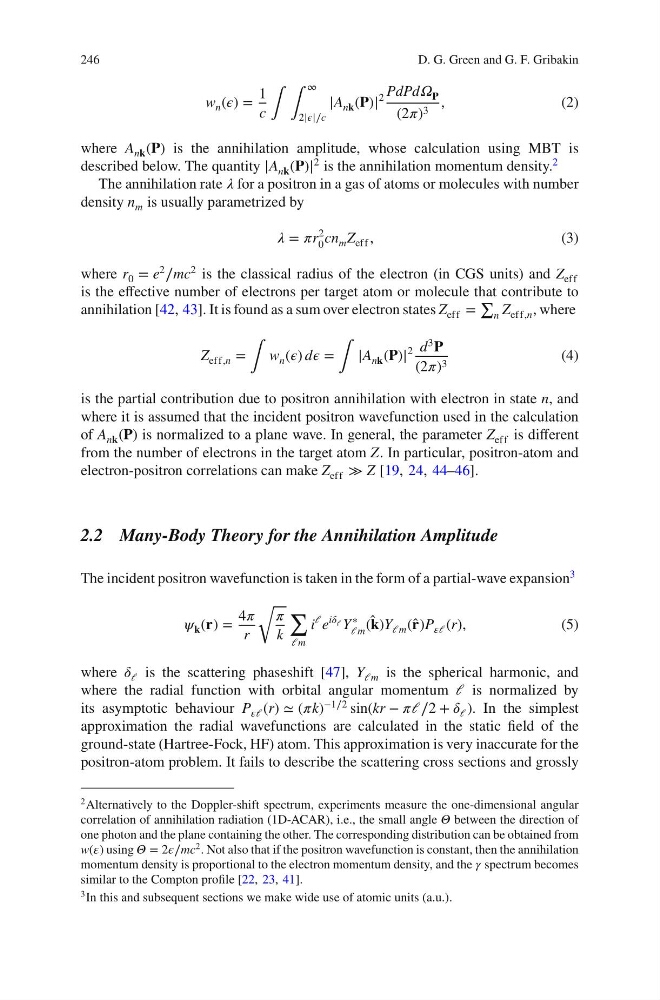
where A ní µí°¤ (í µí°) is the annihilation amplitude, whose calculation using MBT is
described below. The quantity |A ní µí°¤ (í µí°)|
2 is the annihilation momentum density.
2
The annihilation rate í µí¼ for a positron in a gas of atoms or molecules with number
density n m is usually parametrized by
í µí¼ = í µí¼r
2
0
cn m Z ef f ,
(3)
where r 0 = e
2 ∕mc
2 is the classical radius of the electron (in CGS units) and Z ef f
is the effective number of electrons per target atom or molecule that contribute to
annihilation [42, 43]. It is found as a sum over electron states Z ef f =
∑
n Z ef f ,n , where
Z ef f ,n = ∫
w n (í µí¼) dí µí¼ = ∫
|A ní µí°¤ (í µí°)|
2 d 3 í µí°
(2í µí¼) 3
(4)
is the partial contribution due to positron annihilation with electron in state n, and
where it is assumed that the incident positron wavefunction used in the calculation
of A ní µí°¤ (í µí°) is normalized to a plane wave. In general, the parameter Z ef f is different
from the number of electrons in the target atom Z. In particular, positron-atom and
electron-positron correlations can make Z ef f ≫ Z [19, 24, 44–46].
2.2 Many-Body Theory for the Annihilation Amplitude
The incident positron wavefunction is taken in the form of a partial-wave expansion
3
í µí¼ í µí°¤ (í µí°«) =
4í µí¼
r
√ í µí¼
k
∑
í µí³m
i
í µí³ e
ií µí»¿ í µí³ Y
∗
í µí³m
( ̂ í µí°¤)Y í µí³m (̂ í µí°«)P í µí¼í µí³ (r),
(5)
where í µí»¿ í µí³ is the scattering phaseshift [47], Y í µí³m is the spherical harmonic, and
where the radial function with orbital angular momentum í µí³ is normalized by
its asymptotic behaviour P í µí¼í µí³ (r) ≃ (í µí¼k) −1∕2 sin(kr − í µí¼í µí³∕2 + í µí»¿ í µí³ ). In the simplest
approximation the radial wavefunctions are calculated in the static field of the
ground-state (Hartree-Fock, HF) atom. This approximation is very inaccurate for the
positron-atom problem. It fails to describe the scattering cross sections and grossly
2 Alternatively to the Doppler-shift spectrum, experiments measure the one-dimensional angular
correlation of annihilation radiation (1D-ACAR), i.e., the small angle í µí»© between the direction of
one photon and the plane containing the other. The corresponding distribution can be obtained from
w(í µí¼) using í µí»© = 2í µí¼∕mc 2 . Not also that if the positron wavefunction is constant, then the annihilation
momentum density is proportional to the electron momentum density, and the í µí»¾ spectrum becomes
similar to the Compton profile [22, 23, 41].
3 In this and subsequent sections we make wide use of atomic units (a.u.).
D. G. Green and G. F. Gribakin
w n (í µí¼) =
1
c ∫ ∫
∞
2|í µí¼|∕c
|A ní µí°¤ (í µí°)|
2 PdPdí µí»º í µí°
(2í µí¼) 3 ,
(2)
where A ní µí°¤ (í µí°) is the annihilation amplitude, whose calculation using MBT is
described below. The quantity |A ní µí°¤ (í µí°)|
2 is the annihilation momentum density.
2
The annihilation rate í µí¼ for a positron in a gas of atoms or molecules with number
density n m is usually parametrized by
í µí¼ = í µí¼r
2
0
cn m Z ef f ,
(3)
where r 0 = e
2 ∕mc
2 is the classical radius of the electron (in CGS units) and Z ef f
is the effective number of electrons per target atom or molecule that contribute to
annihilation [42, 43]. It is found as a sum over electron states Z ef f =
∑
n Z ef f ,n , where
Z ef f ,n = ∫
w n (í µí¼) dí µí¼ = ∫
|A ní µí°¤ (í µí°)|
2 d 3 í µí°
(2í µí¼) 3
(4)
is the partial contribution due to positron annihilation with electron in state n, and
where it is assumed that the incident positron wavefunction used in the calculation
of A ní µí°¤ (í µí°) is normalized to a plane wave. In general, the parameter Z ef f is different
from the number of electrons in the target atom Z. In particular, positron-atom and
electron-positron correlations can make Z ef f ≫ Z [19, 24, 44–46].
2.2 Many-Body Theory for the Annihilation Amplitude
The incident positron wavefunction is taken in the form of a partial-wave expansion
3
í µí¼ í µí°¤ (í µí°«) =
4í µí¼
r
√ í µí¼
k
∑
í µí³m
i
í µí³ e
ií µí»¿ í µí³ Y
∗
í µí³m
( ̂ í µí°¤)Y í µí³m (̂ í µí°«)P í µí¼í µí³ (r),
(5)
where í µí»¿ í µí³ is the scattering phaseshift [47], Y í µí³m is the spherical harmonic, and
where the radial function with orbital angular momentum í µí³ is normalized by
its asymptotic behaviour P í µí¼í µí³ (r) ≃ (í µí¼k) −1∕2 sin(kr − í µí¼í µí³∕2 + í µí»¿ í µí³ ). In the simplest
approximation the radial wavefunctions are calculated in the static field of the
ground-state (Hartree-Fock, HF) atom. This approximation is very inaccurate for the
positron-atom problem. It fails to describe the scattering cross sections and grossly
2 Alternatively to the Doppler-shift spectrum, experiments measure the one-dimensional angular
correlation of annihilation radiation (1D-ACAR), i.e., the small angle í µí»© between the direction of
one photon and the plane containing the other. The corresponding distribution can be obtained from
w(í µí¼) using í µí»© = 2í µí¼∕mc 2 . Not also that if the positron wavefunction is constant, then the annihilation
momentum density is proportional to the electron momentum density, and the í µí»¾ spectrum becomes
similar to the Compton profile [22, 23, 41].
3 In this and subsequent sections we make wide use of atomic units (a.u.).