

“group” is also possible. That is, a molecule or residue might be considered as
having groups that are made up of atoms.
Normally a molecule is just a set of atoms, unless we are describing a protein or
dna-like structure where the residues would be amino acids or nucleic acids. In the
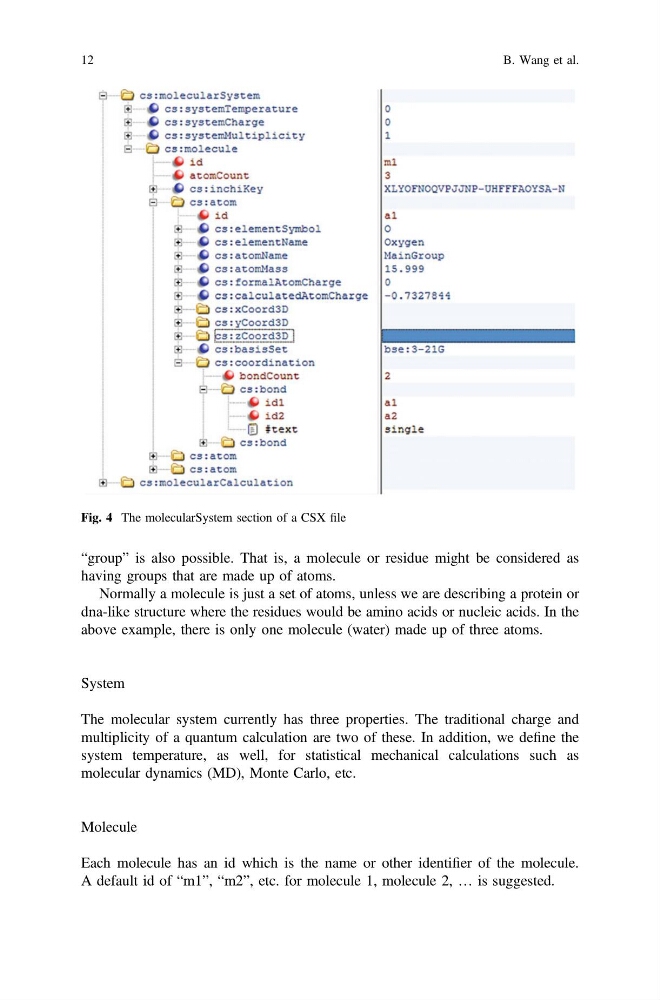
above example, there is only one molecule (water) made up of three atoms.
System
The molecular system currently has three properties. The traditional charge and
multiplicity of a quantum calculation are two of these. In addition, we define the
system temperature, as well, for statistical mechanical calculations such as
molecular dynamics (MD), Monte Carlo, etc.
Molecule
Each molecule has an id which is the name or other identifier of the molecule.
A default id of “m1”, “m2”, etc. for molecule 1, molecule 2, … is suggested.
Fig. 4 The molecularSystem section of a CSX file
12
B. Wang et al.
having groups that are made up of atoms.
Normally a molecule is just a set of atoms, unless we are describing a protein or
dna-like structure where the residues would be amino acids or nucleic acids. In the
above example, there is only one molecule (water) made up of three atoms.
System
The molecular system currently has three properties. The traditional charge and
multiplicity of a quantum calculation are two of these. In addition, we define the
system temperature, as well, for statistical mechanical calculations such as
molecular dynamics (MD), Monte Carlo, etc.
Molecule
Each molecule has an id which is the name or other identifier of the molecule.
A default id of “m1”, “m2”, etc. for molecule 1, molecule 2, … is suggested.
Fig. 4 The molecularSystem section of a CSX file
12
B. Wang et al.