

were performed by keeping the symmetry, i.e. only optimized bond distances
[19, 56].
For the cluster formed by 13 rhodium atoms, taking as the initial geometry that
presented in Fig. 3a, we performed two series of calculations using density functional theory. The first one using the Becke-Lee-Yang-Parr [58, 59] functional and a
double-Z basis set with effective core potential to represent the electrons close to the
nucleus, and the second using the PBE functional [44, 45]. Both sets of calculations
were carried out by varying the multiplicity from 2 to 26, performed with full
optimization, without symmetry constraints, and following the Berny algorithm for
minimization as it is implemented in the Gaussian 03 computer package.
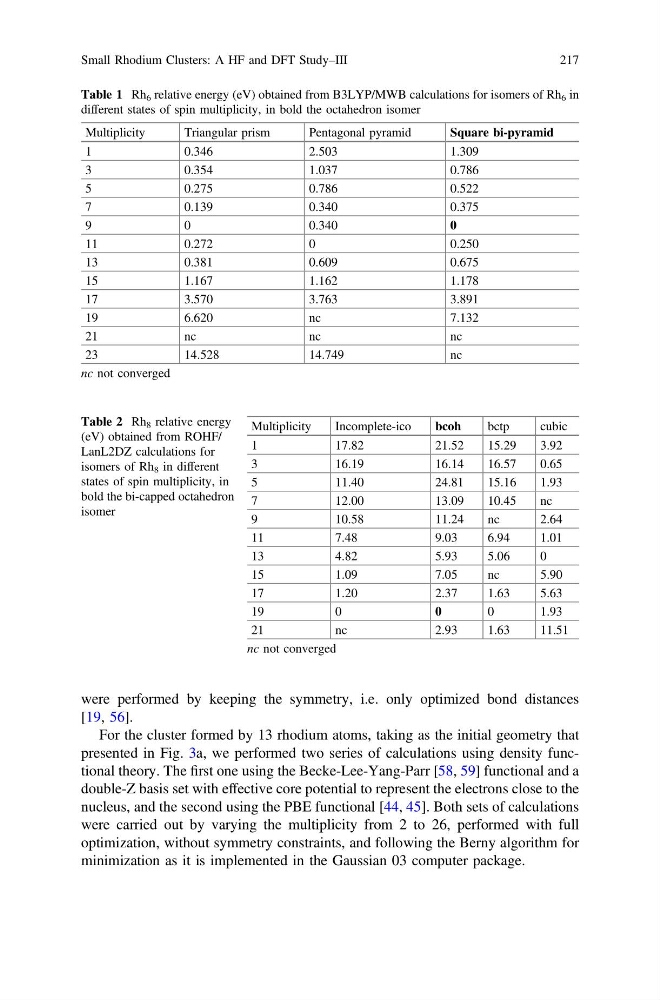
Table 1 Rh 6 relative energy (eV) obtained from B3LYP/MWB calculations for isomers of Rh 6 in
different states of spin multiplicity, in bold the octahedron isomer
Multiplicity
Triangular prism
Pentagonal pyramid
Square bi-pyramid
1
0.346
2.503
1.309
3
0.354
1.037
0.786
5
0.275
0.786
0.522
7
0.139
0.340
0.375
9
0
0.340
0
11
0.272
0
0.250
13
0.381
0.609
0.675
15
1.167
1.162
1.178
17
3.570
3.763
3.891
19
6.620
nc
7.132
21
nc
nc
nc
23
14.528
14.749
nc
nc not converged
Table 2 Rh 8 relative energy
(eV) obtained from ROHF/
LanL2DZ calculations for
isomers of Rh 8 in different
states of spin multiplicity, in
bold the bi-capped octahedron
isomer
Multiplicity
Incomplete-ico
bcoh
bctp
cubic
1
17.82
21.52
15.29
3.92
3
16.19
16.14
16.57
0.65
5
11.40
24.81
15.16
1.93
7
12.00
13.09
10.45
nc
9
10.58
11.24
nc
2.64
11
7.48
9.03
6.94
1.01
13
4.82
5.93
5.06
0
15
1.09
7.05
nc
5.90
17
1.20
2.37
1.63
5.63
19
0
0
0
1.93
21
nc
2.93
1.63
11.51
nc not converged
Small Rhodium Clusters: A HF and DFT Study–III
217
[19, 56].
For the cluster formed by 13 rhodium atoms, taking as the initial geometry that
presented in Fig. 3a, we performed two series of calculations using density functional theory. The first one using the Becke-Lee-Yang-Parr [58, 59] functional and a
double-Z basis set with effective core potential to represent the electrons close to the
nucleus, and the second using the PBE functional [44, 45]. Both sets of calculations
were carried out by varying the multiplicity from 2 to 26, performed with full
optimization, without symmetry constraints, and following the Berny algorithm for
minimization as it is implemented in the Gaussian 03 computer package.
Table 1 Rh 6 relative energy (eV) obtained from B3LYP/MWB calculations for isomers of Rh 6 in
different states of spin multiplicity, in bold the octahedron isomer
Multiplicity
Triangular prism
Pentagonal pyramid
Square bi-pyramid
1
0.346
2.503
1.309
3
0.354
1.037
0.786
5
0.275
0.786
0.522
7
0.139
0.340
0.375
9
0
0.340
0
11
0.272
0
0.250
13
0.381
0.609
0.675
15
1.167
1.162
1.178
17
3.570
3.763
3.891
19
6.620
nc
7.132
21
nc
nc
nc
23
14.528
14.749
nc
nc not converged
Table 2 Rh 8 relative energy
(eV) obtained from ROHF/
LanL2DZ calculations for
isomers of Rh 8 in different
states of spin multiplicity, in
bold the bi-capped octahedron
isomer
Multiplicity
Incomplete-ico
bcoh
bctp
cubic
1
17.82
21.52
15.29
3.92
3
16.19
16.14
16.57
0.65
5
11.40
24.81
15.16
1.93
7
12.00
13.09
10.45
nc
9
10.58
11.24
nc
2.64
11
7.48
9.03
6.94
1.01
13
4.82
5.93
5.06
0
15
1.09
7.05
nc
5.90
17
1.20
2.37
1.63
5.63
19
0
0
0
1.93
21
nc
2.93
1.63
11.51
nc not converged
Small Rhodium Clusters: A HF and DFT Study–III
217