

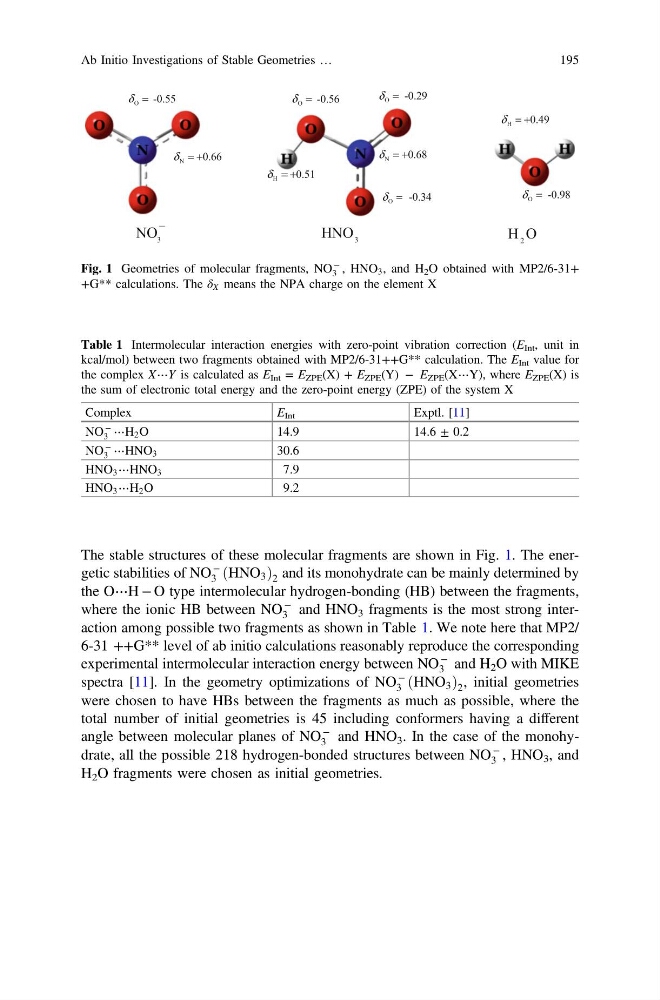
The stable structures of these molecular fragments are shown in Fig. 1. The energetic stabilities of NO
−
3 HNO 3
ð
Þ 2 and its monohydrate can be mainly determined by
the O⋯H − O type intermolecular hydrogen-bonding (HB) between the fragments,
where the ionic HB between NO
−
3 and HNO 3 fragments is the most strong interaction among possible two fragments as shown in Table 1. We note here that MP2/
6-31 ++G** level of ab initio calculations reasonably reproduce the corresponding
experimental intermolecular interaction energy between NO
−
3 and H 2 O with MIKE
spectra [11]. In the geometry optimizations of NO
−
3 HNO 3
ð
Þ 2 , initial geometries
were chosen to have HBs between the fragments as much as possible, where the
total number of initial geometries is 45 including conformers having a different
angle between molecular planes of NO
−
3 and HNO 3 . In the case of the monohydrate, all the possible 218 hydrogen-bonded structures between NO
−
3 , HNO 3 , and
H 2 O fragments were chosen as initial geometries.
H 2 O
δ H = +0.49
δ O = -0.98
HNO 3
δ O = -0.34
δ O = -0.29
δ O = -0.56
δ N = +0.68
δ H = +0.51
NO 3
δ O = -0.55
δ N = +0.66
Fig. 1 Geometries of molecular fragments, NO
−
3 , HNO 3 , and H 2 O obtained with MP2/6-31+
+G** calculations. The δ X means the NPA charge on the element X
Table 1 Intermolecular interaction energies with zero-point vibration correction (E Int , unit in
kcal/mol) between two fragments obtained with MP2/6-31++G** calculation. The E Int value for
the complex X⋯Y is calculated as E Int = E ZPE (X) + E ZPE (Y) − E ZPE (X⋯Y), where E ZPE (X) is
the sum of electronic total energy and the zero-point energy (ZPE) of the system X
Complex
E Int
Exptl. [11]
NO
−
3 ⋯H 2 O
14.9
14.6 ± 0.2
NO
−
3 ⋯HNO 3
30.6
HNO 3 ⋯HNO 3
7.9
HNO 3 ⋯H 2 O
9.2
Ab Initio Investigations of Stable Geometries …
195
−
3 HNO 3
ð
Þ 2 and its monohydrate can be mainly determined by
the O⋯H − O type intermolecular hydrogen-bonding (HB) between the fragments,
where the ionic HB between NO
−
3 and HNO 3 fragments is the most strong interaction among possible two fragments as shown in Table 1. We note here that MP2/
6-31 ++G** level of ab initio calculations reasonably reproduce the corresponding
experimental intermolecular interaction energy between NO
−
3 and H 2 O with MIKE
spectra [11]. In the geometry optimizations of NO
−
3 HNO 3
ð
Þ 2 , initial geometries
were chosen to have HBs between the fragments as much as possible, where the
total number of initial geometries is 45 including conformers having a different
angle between molecular planes of NO
−
3 and HNO 3 . In the case of the monohydrate, all the possible 218 hydrogen-bonded structures between NO
−
3 , HNO 3 , and
H 2 O fragments were chosen as initial geometries.
H 2 O
δ H = +0.49
δ O = -0.98
HNO 3
δ O = -0.34
δ O = -0.29
δ O = -0.56
δ N = +0.68
δ H = +0.51
NO 3
δ O = -0.55
δ N = +0.66
Fig. 1 Geometries of molecular fragments, NO
−
3 , HNO 3 , and H 2 O obtained with MP2/6-31+
+G** calculations. The δ X means the NPA charge on the element X
Table 1 Intermolecular interaction energies with zero-point vibration correction (E Int , unit in
kcal/mol) between two fragments obtained with MP2/6-31++G** calculation. The E Int value for
the complex X⋯Y is calculated as E Int = E ZPE (X) + E ZPE (Y) − E ZPE (X⋯Y), where E ZPE (X) is
the sum of electronic total energy and the zero-point energy (ZPE) of the system X
Complex
E Int
Exptl. [11]
NO
−
3 ⋯H 2 O
14.9
14.6 ± 0.2
NO
−
3 ⋯HNO 3
30.6
HNO 3 ⋯HNO 3
7.9
HNO 3 ⋯H 2 O
9.2
Ab Initio Investigations of Stable Geometries …
195