

the adiabatic picture. Furthermore, our method can be applied to proton transfer
system even when the transition state (TS) cannot be calculated, although the
information of TS requires the construction of potential in the previous work.
Therefore, it is concluded that our procedures are useful for PES construction by
using the diabatic picture for proton transfer systems and can be applied to large
molecular systems such as proteins.
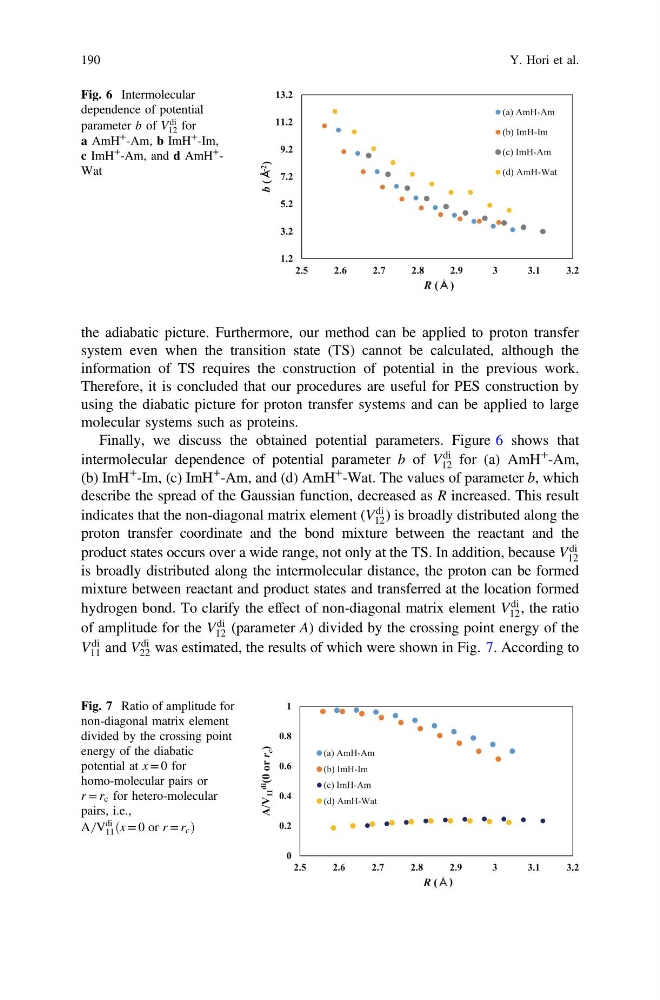
Finally, we discuss the obtained potential parameters. Figure 6 shows that
intermolecular dependence of potential parameter b of V
di
12 for (a) AmH
+
-Am,
(b) ImH
+ -Im, (c) ImH
+
-Am, and (d) AmH
+
-Wat. The values of parameter b, which
describe the spread of the Gaussian function, decreased as R increased. This result
indicates that the non-diagonal matrix element (V
di
12 ) is broadly distributed along the
proton transfer coordinate and the bond mixture between the reactant and the
product states occurs over a wide range, not only at the TS. In addition, because V
di
12
is broadly distributed along the intermolecular distance, the proton can be formed
mixture between reactant and product states and transferred at the location formed
hydrogen bond. To clarify the effect of non-diagonal matrix element V
di
12 , the ratio
of amplitude for the V
di
12 (parameter A) divided by the crossing point energy of the
V
di
11 and V
di
22 was estimated, the results of which were shown in Fig. 7. According to
1.2
3.2
5.2
7.2
9.2
11.2
13.2
2.5
2.6
2.7
2.8
2.9
3
3.1
3.2
b ( -2
)
R (
(a) AmH-Am
(b) ImH-Im
(c) ImH-Am
(d) AmH-Wat
)
Fig. 6 Intermolecular
dependence of potential
parameter b of V
di
12 for
a AmH
+ -Am, b ImH
+ -Im,
c ImH
+ -Am, and d AmH
+ -
Wat
0
0.2
0.4
0.6
0.8
1
2.5
2.6
2.7
2.8
2.9
3
3.1
3.2
A/V
11
di
(0 or r
c )
R (
(a) AmH-Am
(b) ImH-Im
(c) ImH-Am
(d) AmH-Wat
)
Fig. 7 Ratio of amplitude for
non-diagonal matrix element
divided by the crossing point
energy of the diabatic
potential at x = 0 for
homo-molecular pairs or
r = r c for hetero-molecular
pairs, i.e.,
A ̸ V
di
11 x = 0 or r = r c
ð
Þ
190
Y. Hori et al.
system even when the transition state (TS) cannot be calculated, although the
information of TS requires the construction of potential in the previous work.
Therefore, it is concluded that our procedures are useful for PES construction by
using the diabatic picture for proton transfer systems and can be applied to large
molecular systems such as proteins.
Finally, we discuss the obtained potential parameters. Figure 6 shows that
intermolecular dependence of potential parameter b of V
di
12 for (a) AmH
+
-Am,
(b) ImH
+ -Im, (c) ImH
+
-Am, and (d) AmH
+
-Wat. The values of parameter b, which
describe the spread of the Gaussian function, decreased as R increased. This result
indicates that the non-diagonal matrix element (V
di
12 ) is broadly distributed along the
proton transfer coordinate and the bond mixture between the reactant and the
product states occurs over a wide range, not only at the TS. In addition, because V
di
12
is broadly distributed along the intermolecular distance, the proton can be formed
mixture between reactant and product states and transferred at the location formed
hydrogen bond. To clarify the effect of non-diagonal matrix element V
di
12 , the ratio
of amplitude for the V
di
12 (parameter A) divided by the crossing point energy of the
V
di
11 and V
di
22 was estimated, the results of which were shown in Fig. 7. According to
1.2
3.2
5.2
7.2
9.2
11.2
13.2
2.5
2.6
2.7
2.8
2.9
3
3.1
3.2
b ( -2
)
R (
(a) AmH-Am
(b) ImH-Im
(c) ImH-Am
(d) AmH-Wat
)
Fig. 6 Intermolecular
dependence of potential
parameter b of V
di
12 for
a AmH
+ -Am, b ImH
+ -Im,
c ImH
+ -Am, and d AmH
+ -
Wat
0
0.2
0.4
0.6
0.8
1
2.5
2.6
2.7
2.8
2.9
3
3.1
3.2
A/V
11
di
(0 or r
c )
R (
(a) AmH-Am
(b) ImH-Im
(c) ImH-Am
(d) AmH-Wat
)
Fig. 7 Ratio of amplitude for
non-diagonal matrix element
divided by the crossing point
energy of the diabatic
potential at x = 0 for
homo-molecular pairs or
r = r c for hetero-molecular
pairs, i.e.,
A ̸ V
di
11 x = 0 or r = r c
ð
Þ
190
Y. Hori et al.