

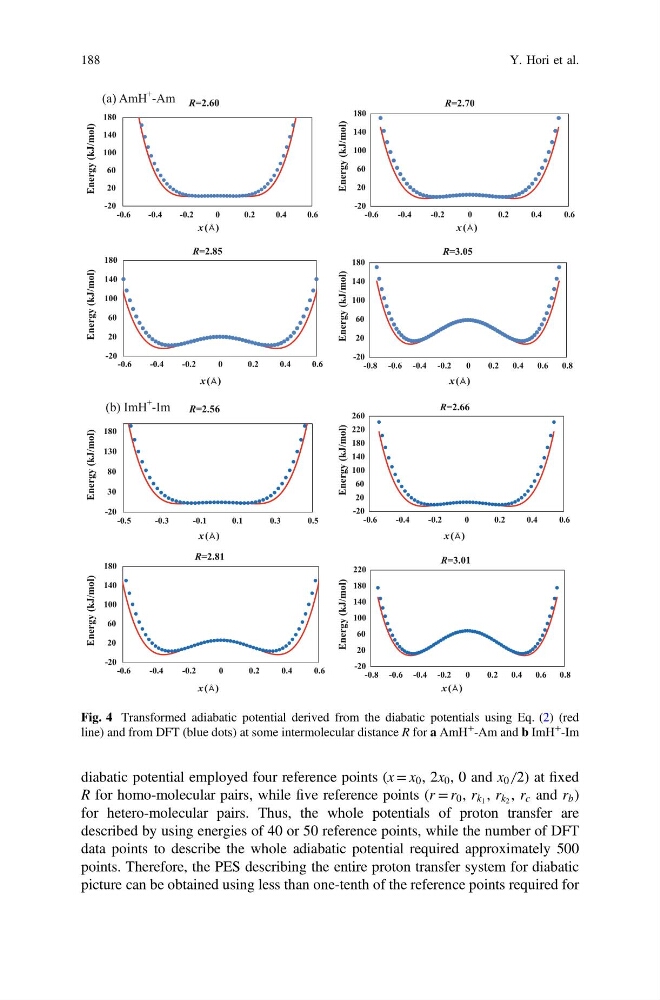
diabatic potential employed four reference points (x = x 0 , 2x 0 , 0 and x 0 ̸ 2) at fixed
R for homo-molecular pairs, while five reference points (r = r 0 , r k 1 , r k 2 , r c and r b )
for hetero-molecular pairs. Thus, the whole potentials of proton transfer are
described by using energies of 40 or 50 reference points, while the number of DFT
data points to describe the whole adiabatic potential required approximately 500
points. Therefore, the PES describing the entire proton transfer system for diabatic
picture can be obtained using less than one-tenth of the reference points required for
-20
20
60
100
140
180
-0.6
-0.4
-0.2
0
0.2
0.4
0.6
Energy (kJ/mol)
R=2.60
-20
20
60
100
140
180
-0.6
-0.4
-0.2
0
0.2
0.4
0.6
Energy (kJ/mol)
R=2.70
-20
20
60
100
140
180
-0.6
-0.4
-0.2
0
0.2
0.4
0.6
Energy (kJ/mol)
R=2.85
-20
20
60
100
140
180
-0.8 -0.6 -0.4 -0.2
0
0.2
0.4
0.6
0.8
Energy (kJ/mol)
R=3.05
(a) AmH
+
-Am
-20
30
80
130
180
-0.5
-0.3
-0.1
0.1
0.3
0.5
Energy (kJ/mol)
R=2.56
-20
20
60
100
140
180
-0.6
-0.4
-0.2
0
0.2
0.4
0.6
Energy (kJ/mol)
x (
R=2.81
-20
20
60
100
140
180
220
-0.8 -0.6 -0.4 -0.2
0
0.2
0.4
0.6
0.8
Energy (kJ/mol)
R=3.01
-20
20
60
100
140
180
220
260
-0.6
-0.4
-0.2
0
0.2
0.4
0.6
Energy (kJ/mol)
R=2.66
(b) ImH
+
-Im
)
x ( )
x ( )
x ( )
x ( )
x ( )
x ( )
x ( )
Fig. 4 Transformed adiabatic potential derived from the diabatic potentials using Eq. (2) (red
line) and from DFT (blue dots) at some intermolecular distance R for a AmH
+ -Am and b ImH
+
-Im
188
Y. Hori et al.
R for homo-molecular pairs, while five reference points (r = r 0 , r k 1 , r k 2 , r c and r b )
for hetero-molecular pairs. Thus, the whole potentials of proton transfer are
described by using energies of 40 or 50 reference points, while the number of DFT
data points to describe the whole adiabatic potential required approximately 500
points. Therefore, the PES describing the entire proton transfer system for diabatic
picture can be obtained using less than one-tenth of the reference points required for
-20
20
60
100
140
180
-0.6
-0.4
-0.2
0
0.2
0.4
0.6
Energy (kJ/mol)
R=2.60
-20
20
60
100
140
180
-0.6
-0.4
-0.2
0
0.2
0.4
0.6
Energy (kJ/mol)
R=2.70
-20
20
60
100
140
180
-0.6
-0.4
-0.2
0
0.2
0.4
0.6
Energy (kJ/mol)
R=2.85
-20
20
60
100
140
180
-0.8 -0.6 -0.4 -0.2
0
0.2
0.4
0.6
0.8
Energy (kJ/mol)
R=3.05
(a) AmH
+
-Am
-20
30
80
130
180
-0.5
-0.3
-0.1
0.1
0.3
0.5
Energy (kJ/mol)
R=2.56
-20
20
60
100
140
180
-0.6
-0.4
-0.2
0
0.2
0.4
0.6
Energy (kJ/mol)
x (
R=2.81
-20
20
60
100
140
180
220
-0.8 -0.6 -0.4 -0.2
0
0.2
0.4
0.6
0.8
Energy (kJ/mol)
R=3.01
-20
20
60
100
140
180
220
260
-0.6
-0.4
-0.2
0
0.2
0.4
0.6
Energy (kJ/mol)
R=2.66
(b) ImH
+
-Im
)
x ( )
x ( )
x ( )
x ( )
x ( )
x ( )
x ( )
Fig. 4 Transformed adiabatic potential derived from the diabatic potentials using Eq. (2) (red
line) and from DFT (blue dots) at some intermolecular distance R for a AmH
+ -Am and b ImH
+
-Im
188
Y. Hori et al.