

observe it spectroscopically. The vibrational frequencies of the most stable form are
given in Table 12. In the isotropic Raman spectra, one would predict the observation of the BO 3 deformation mode at around 415 cm
−1 , the BO(H) stretching
mode at around 800 cm
−1 , the BOH deformation mode at around 1100 cm
−1 , and
the BO stretching mode at about 1530 cm
−1 . There is a fair amount of coupling
between the BO stretching and BOH deformation modes.
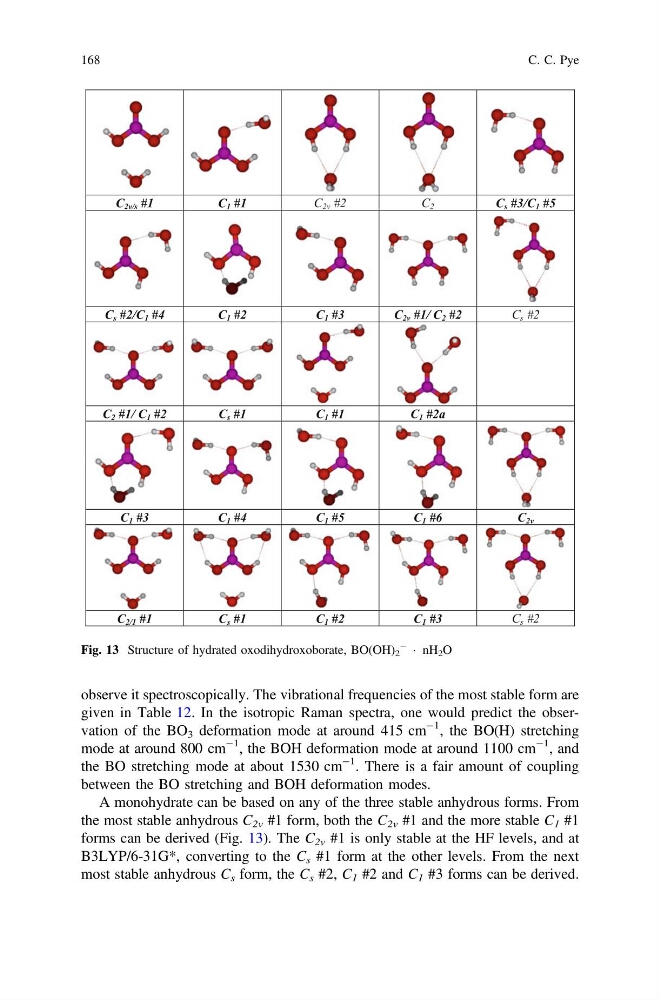
A monohydrate can be based on any of the three stable anhydrous forms. From
the most stable anhydrous C 2v #1 form, both the C 2v #1 and the more stable C 1 #1
forms can be derived (Fig. 13). The C 2v #1 is only stable at the HF levels, and at
B3LYP/6-31G*, converting to the C s #1 form at the other levels. From the next
most stable anhydrous C s form, the C s #2, C 1 #2 and C 1 #3 forms can be derived.
C 2v/s #1
C 1 #1
C 2v #2
C 2
C s #3/C 1 #5
C s #2/C 1 #4
C 1 #2
C 1 #3
C 2v #1/ C 2 #2
C s #2
C 2 #1/ C 1 #2
C s #1
C 1 #1
C 1 #2a
C 1 #3
C 1 #4
C 1 #5
C 1 #6
C 2v
C 2/1 #1
C s #1
C 1 #2
C 1 #3
C s #2
Fig. 13 Structure of hydrated oxodihydroxoborate, BO(OH) 2
− ⋅ nH 2 O
168
C. C. Pye
given in Table 12. In the isotropic Raman spectra, one would predict the observation of the BO 3 deformation mode at around 415 cm
−1 , the BO(H) stretching
mode at around 800 cm
−1 , the BOH deformation mode at around 1100 cm
−1 , and
the BO stretching mode at about 1530 cm
−1 . There is a fair amount of coupling
between the BO stretching and BOH deformation modes.
A monohydrate can be based on any of the three stable anhydrous forms. From
the most stable anhydrous C 2v #1 form, both the C 2v #1 and the more stable C 1 #1
forms can be derived (Fig. 13). The C 2v #1 is only stable at the HF levels, and at
B3LYP/6-31G*, converting to the C s #1 form at the other levels. From the next
most stable anhydrous C s form, the C s #2, C 1 #2 and C 1 #3 forms can be derived.
C 2v/s #1
C 1 #1
C 2v #2
C 2
C s #3/C 1 #5
C s #2/C 1 #4
C 1 #2
C 1 #3
C 2v #1/ C 2 #2
C s #2
C 2 #1/ C 1 #2
C s #1
C 1 #1
C 1 #2a
C 1 #3
C 1 #4
C 1 #5
C 1 #6
C 2v
C 2/1 #1
C s #1
C 1 #2
C 1 #3
C s #2
Fig. 13 Structure of hydrated oxodihydroxoborate, BO(OH) 2
− ⋅ nH 2 O
168
C. C. Pye