

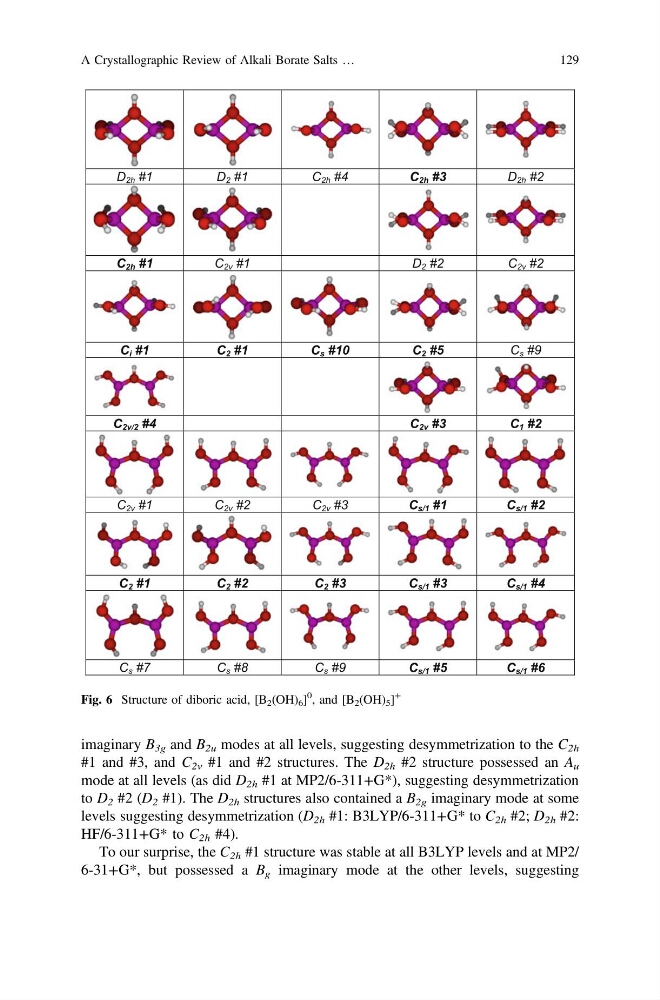
imaginary B 3g and B 2u modes at all levels, suggesting desymmetrization to the C 2h
#1 and #3, and C 2v #1 and #2 structures. The D 2h #2 structure possessed an A u
mode at all levels (as did D 2h #1 at MP2/6-311+G*), suggesting desymmetrization
to D 2 #2 (D 2 #1). The D 2h structures also contained a B 2g imaginary mode at some
levels suggesting desymmetrization (D 2h #1: B3LYP/6-311+G* to C 2h #2; D 2h #2:
HF/6-311+G* to C 2h #4).
To our surprise, the C 2h #1 structure was stable at all B3LYP levels and at MP2/
6-31+G*, but possessed a B g imaginary mode at the other levels, suggesting
D 2h #1
D 2 #1
C 2h #4
C 2h #3
D 2h #2
C 2h #1
C 2v
D
1
#
2 #2
C 2v #2
C i #1
C 2 #1
C s #10
C 2 #5
C s #9
C 2v/2
C
4
#
2v #3
C 1 #2
C 2v #1
C 2v #2
C 2v #3
C s/1 #1
C s/1 #2
C 2 #1
C 2 #2
C 2 #3
C s/1 #3
C s/1 #4
C s #7
C s #8
C s #9
C s/1 #5
C s/1 #6
Fig. 6 Structure of diboric acid, [B 2 (OH) 6 ]
0
, and [B 2 (OH) 5 ]
+
A Crystallographic Review of Alkali Borate Salts …
129
#1 and #3, and C 2v #1 and #2 structures. The D 2h #2 structure possessed an A u
mode at all levels (as did D 2h #1 at MP2/6-311+G*), suggesting desymmetrization
to D 2 #2 (D 2 #1). The D 2h structures also contained a B 2g imaginary mode at some
levels suggesting desymmetrization (D 2h #1: B3LYP/6-311+G* to C 2h #2; D 2h #2:
HF/6-311+G* to C 2h #4).
To our surprise, the C 2h #1 structure was stable at all B3LYP levels and at MP2/
6-31+G*, but possessed a B g imaginary mode at the other levels, suggesting
D 2h #1
D 2 #1
C 2h #4
C 2h #3
D 2h #2
C 2h #1
C 2v
D
1
#
2 #2
C 2v #2
C i #1
C 2 #1
C s #10
C 2 #5
C s #9
C 2v/2
C
4
#
2v #3
C 1 #2
C 2v #1
C 2v #2
C 2v #3
C s/1 #1
C s/1 #2
C 2 #1
C 2 #2
C 2 #3
C s/1 #3
C s/1 #4
C s #7
C s #8
C s #9
C s/1 #5
C s/1 #6
Fig. 6 Structure of diboric acid, [B 2 (OH) 6 ]
0
, and [B 2 (OH) 5 ]
+
A Crystallographic Review of Alkali Borate Salts …
129