

and desymmetrize to C 1 #5 and #6, respectively. Structure C 1 #5 fragments at all levels
except HF/6-31+G*, but structure C 1 #6 is either stable (B3LYP/6-31+G*, MP2/6-31
+G*, and MP2/6-311+G*) or coalesces into C 1 #4.
3.3.3 [B 5 O 6 (OH) 8 ]
5−
The pentaborate ion, [B 5 O 6 (OH) 8 ]
5−
, is given in Fig. 4. We initially started with a
D 2d structure, but this was not stable and possessed imaginary B 1 (all levels), A 2
(HF and MP2), and E (MP2/6-31G* and MP2/6-311+G*) modes, to give D 2 , S 4 ,
and C s structures, respectively. Both the D 2 and S 4 structures are stable at most
levels examined. The D 2 is unstable at HF/6-31+G*, reverting via C 2 #1 to S 4 , and
at MP2/6-311+G* giving the stable C 2 #2 or C 2 #3. The S 4 structure is unstable at
MP2/6-31G* and MP2/6-311+G*, desymmetrizing to the stable C 1 #1. The C s
structure is unstable at both levels and desymmetrizes to the stable C 1 #2.
3.4 Diborate Species
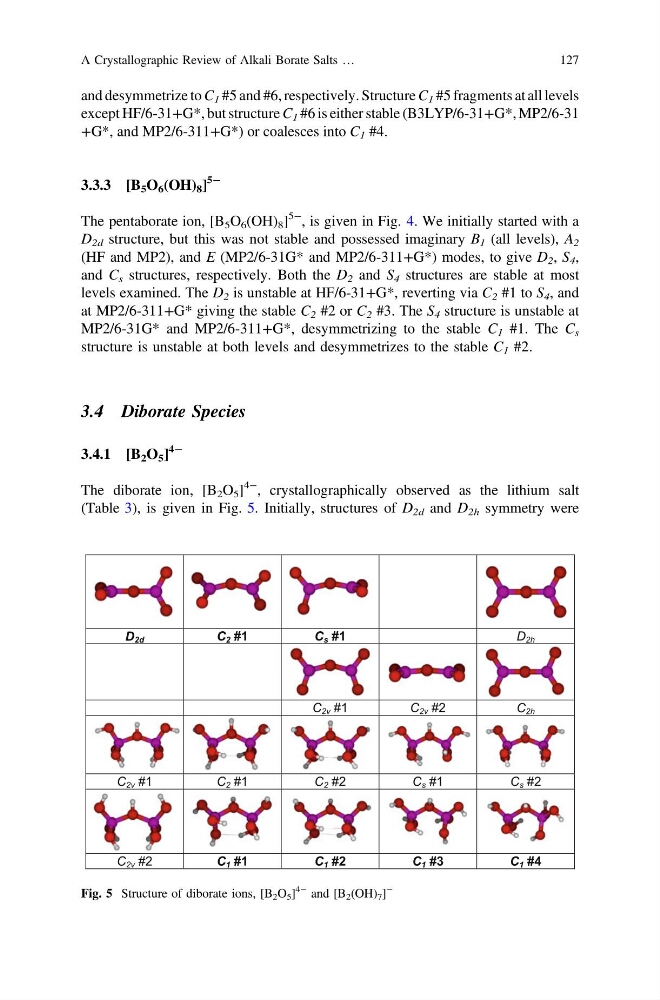
3.4.1 [B 2 O 5 ]
4−
The diborate ion, [B 2 O 5 ]
4− , crystallographically observed as the lithium salt
(Table 3), is given in Fig. 5. Initially, structures of D 2d and D 2h symmetry were
D 2d
C 2 #1
C s #1
D 2h
C 2v #1
C 2v #2
C 2h
C 2v #1
C 2 #1
C 2 #2
C s #1
C s #2
C 2v #2
C 1 #1
C 1 #2
C 1 #3
C 1 #4
Fig. 5 Structure of diborate ions, [B 2 O 5 ]
4− and [B 2 (OH) 7 ]
−
A Crystallographic Review of Alkali Borate Salts …
127
except HF/6-31+G*, but structure C 1 #6 is either stable (B3LYP/6-31+G*, MP2/6-31
+G*, and MP2/6-311+G*) or coalesces into C 1 #4.
3.3.3 [B 5 O 6 (OH) 8 ]
5−
The pentaborate ion, [B 5 O 6 (OH) 8 ]
5−
, is given in Fig. 4. We initially started with a
D 2d structure, but this was not stable and possessed imaginary B 1 (all levels), A 2
(HF and MP2), and E (MP2/6-31G* and MP2/6-311+G*) modes, to give D 2 , S 4 ,
and C s structures, respectively. Both the D 2 and S 4 structures are stable at most
levels examined. The D 2 is unstable at HF/6-31+G*, reverting via C 2 #1 to S 4 , and
at MP2/6-311+G* giving the stable C 2 #2 or C 2 #3. The S 4 structure is unstable at
MP2/6-31G* and MP2/6-311+G*, desymmetrizing to the stable C 1 #1. The C s
structure is unstable at both levels and desymmetrizes to the stable C 1 #2.
3.4 Diborate Species
3.4.1 [B 2 O 5 ]
4−
The diborate ion, [B 2 O 5 ]
4− , crystallographically observed as the lithium salt
(Table 3), is given in Fig. 5. Initially, structures of D 2d and D 2h symmetry were
D 2d
C 2 #1
C s #1
D 2h
C 2v #1
C 2v #2
C 2h
C 2v #1
C 2 #1
C 2 #2
C s #1
C s #2
C 2v #2
C 1 #1
C 1 #2
C 1 #3
C 1 #4
Fig. 5 Structure of diborate ions, [B 2 O 5 ]
4− and [B 2 (OH) 7 ]
−
A Crystallographic Review of Alkali Borate Salts …
127