

(OXPHOS) or via photophosphorylation. However, some organisms in anoxic
condition [26] and few aerobic cells such as matured red blood cells synthesize
ATP through substrate level phosphorylation.
The F 1 F 0 -ATP synthase is a multi-subunit two-domain membrane-bound
enzyme. The intracellular domain which is known as F 1 domain is hydrophilic,
and the F 0 domain is hydrophobic, and most of it is embedded in the membrane. The
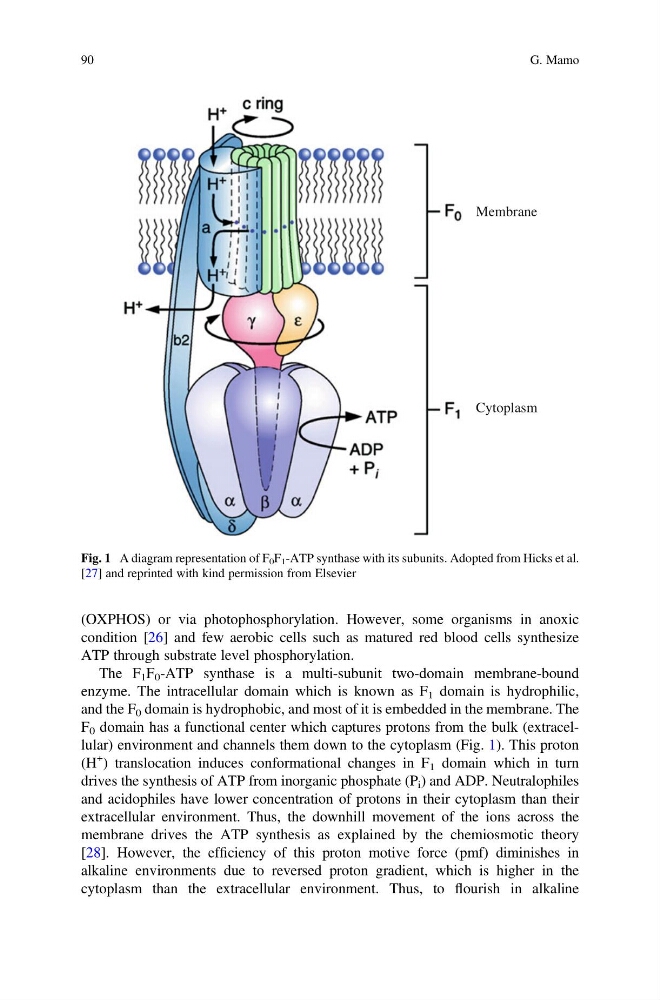
F 0 domain has a functional center which captures protons from the bulk (extracellular) environment and channels them down to the cytoplasm (Fig. 1). This proton
(H
+ ) translocation induces conformational changes in F 1 domain which in turn
drives the synthesis of ATP from inorganic phosphate (P i ) and ADP. Neutralophiles
and acidophiles have lower concentration of protons in their cytoplasm than their
extracellular environment. Thus, the downhill movement of the ions across the
membrane drives the ATP synthesis as explained by the chemiosmotic theory
[28]. However, the efficiency of this proton motive force (pmf) diminishes in
alkaline environments due to reversed proton gradient, which is higher in the
cytoplasm than the extracellular environment. Thus, to flourish in alkaline
Membrane
Cytoplasm
Fig. 1 A diagram representation of F 0 F 1 -ATP synthase with its subunits. Adopted from Hicks et al.
[27] and reprinted with kind permission from Elsevier
90
G. Mamo
condition [26] and few aerobic cells such as matured red blood cells synthesize
ATP through substrate level phosphorylation.
The F 1 F 0 -ATP synthase is a multi-subunit two-domain membrane-bound
enzyme. The intracellular domain which is known as F 1 domain is hydrophilic,
and the F 0 domain is hydrophobic, and most of it is embedded in the membrane. The
F 0 domain has a functional center which captures protons from the bulk (extracellular) environment and channels them down to the cytoplasm (Fig. 1). This proton
(H
+ ) translocation induces conformational changes in F 1 domain which in turn
drives the synthesis of ATP from inorganic phosphate (P i ) and ADP. Neutralophiles
and acidophiles have lower concentration of protons in their cytoplasm than their
extracellular environment. Thus, the downhill movement of the ions across the
membrane drives the ATP synthesis as explained by the chemiosmotic theory
[28]. However, the efficiency of this proton motive force (pmf) diminishes in
alkaline environments due to reversed proton gradient, which is higher in the
cytoplasm than the extracellular environment. Thus, to flourish in alkaline
Membrane
Cytoplasm
Fig. 1 A diagram representation of F 0 F 1 -ATP synthase with its subunits. Adopted from Hicks et al.
[27] and reprinted with kind permission from Elsevier
90
G. Mamo