

following theoretical prerequisites are possible. There are several microbiological
reactions carried out by “ordinary”, neutralophilic bacteria with a concomitant
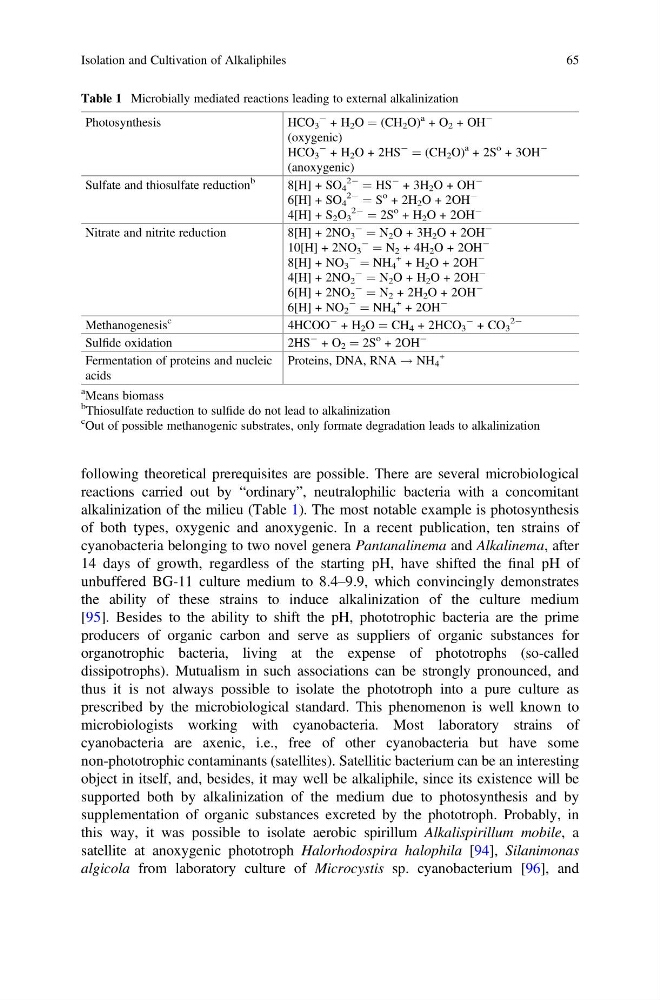
alkalinization of the milieu (Table 1). The most notable example is photosynthesis
of both types, oxygenic and anoxygenic. In a recent publication, ten strains of
cyanobacteria belonging to two novel genera Pantanalinema and Alkalinema, after
14 days of growth, regardless of the starting pH, have shifted the final pH of
unbuffered BG-11 culture medium to 8.4–9.9, which convincingly demonstrates
the ability of these strains to induce alkalinization of the culture medium
[95]. Besides to the ability to shift the pH, phototrophic bacteria are the prime
producers of organic carbon and serve as suppliers of organic substances for
organotrophic bacteria, living at the expense of phototrophs (so-called
dissipotrophs). Mutualism in such associations can be strongly pronounced, and
thus it is not always possible to isolate the phototroph into a pure culture as
prescribed by the microbiological standard. This phenomenon is well known to
microbiologists working with cyanobacteria. Most laboratory strains of
cyanobacteria are axenic, i.e., free of other cyanobacteria but have some
non-phototrophic contaminants (satellites). Satellitic bacterium can be an interesting
object in itself, and, besides, it may well be alkaliphile, since its existence will be
supported both by alkalinization of the medium due to photosynthesis and by
supplementation of organic substances excreted by the phototroph. Probably, in
this way, it was possible to isolate aerobic spirillum Alkalispirillum mobile, a
satellite at anoxygenic phototroph Halorhodospira halophila [94], Silanimonas
algicola from laboratory culture of Microcystis sp. cyanobacterium [96], and
Table 1 Microbially mediated reactions leading to external alkalinization
Photosynthesis
HCO 3
À + H 2 O ¼ (CH 2 O)
a + O 2 + OH
À
(oxygenic)
HCO 3
À + H 2 O + 2HS
À ¼ (CH 2 O)
a + 2S
o + 3OH
À
(anoxygenic)
Sulfate and thiosulfate reduction
b
8[H] + SO 4
2À ¼ HS
À + 3H 2 O + OH
À
6[H] + SO 4
2À ¼ S
o + 2H 2 O + 2OH
À
4[H] + S 2 O 3
2À ¼ 2S
o + H 2 O + 2OH
À
Nitrate and nitrite reduction
8[H] + 2NO 3
À ¼ N 2 O + 3H 2 O + 2OH
À
10[H] + 2NO 3
À ¼ N 2 + 4H 2 O + 2OH
À
8[H] + NO 3
À ¼ NH 4
+ + H 2 O + 2OH
À
4[H] + 2NO 2
À ¼ N 2 O + H 2 O + 2OH
À
6[H] + 2NO 2
À ¼ N 2 + 2H 2 O + 2OH
À
6[H] + NO 2
À ¼ NH 4
+ + 2OH
À
Methanogenesis
c
4HCOO
À + H 2 O ¼ CH 4 + 2HCO 3
À + CO 3
2À
Sulfide oxidation
2HS
À + O 2 ¼ 2S
o + 2OH
À
Fermentation of proteins and nucleic
acids
Proteins, DNA, RNA ! NH 4
+
a Means biomass
b
Thiosulfate reduction to sulfide do not lead to alkalinization
c Out of possible methanogenic substrates, only formate degradation leads to alkalinization
Isolation and Cultivation of Alkaliphiles
65
reactions carried out by “ordinary”, neutralophilic bacteria with a concomitant
alkalinization of the milieu (Table 1). The most notable example is photosynthesis
of both types, oxygenic and anoxygenic. In a recent publication, ten strains of
cyanobacteria belonging to two novel genera Pantanalinema and Alkalinema, after
14 days of growth, regardless of the starting pH, have shifted the final pH of
unbuffered BG-11 culture medium to 8.4–9.9, which convincingly demonstrates
the ability of these strains to induce alkalinization of the culture medium
[95]. Besides to the ability to shift the pH, phototrophic bacteria are the prime
producers of organic carbon and serve as suppliers of organic substances for
organotrophic bacteria, living at the expense of phototrophs (so-called
dissipotrophs). Mutualism in such associations can be strongly pronounced, and
thus it is not always possible to isolate the phototroph into a pure culture as
prescribed by the microbiological standard. This phenomenon is well known to
microbiologists working with cyanobacteria. Most laboratory strains of
cyanobacteria are axenic, i.e., free of other cyanobacteria but have some
non-phototrophic contaminants (satellites). Satellitic bacterium can be an interesting
object in itself, and, besides, it may well be alkaliphile, since its existence will be
supported both by alkalinization of the medium due to photosynthesis and by
supplementation of organic substances excreted by the phototroph. Probably, in
this way, it was possible to isolate aerobic spirillum Alkalispirillum mobile, a
satellite at anoxygenic phototroph Halorhodospira halophila [94], Silanimonas
algicola from laboratory culture of Microcystis sp. cyanobacterium [96], and
Table 1 Microbially mediated reactions leading to external alkalinization
Photosynthesis
HCO 3
À + H 2 O ¼ (CH 2 O)
a + O 2 + OH
À
(oxygenic)
HCO 3
À + H 2 O + 2HS
À ¼ (CH 2 O)
a + 2S
o + 3OH
À
(anoxygenic)
Sulfate and thiosulfate reduction
b
8[H] + SO 4
2À ¼ HS
À + 3H 2 O + OH
À
6[H] + SO 4
2À ¼ S
o + 2H 2 O + 2OH
À
4[H] + S 2 O 3
2À ¼ 2S
o + H 2 O + 2OH
À
Nitrate and nitrite reduction
8[H] + 2NO 3
À ¼ N 2 O + 3H 2 O + 2OH
À
10[H] + 2NO 3
À ¼ N 2 + 4H 2 O + 2OH
À
8[H] + NO 3
À ¼ NH 4
+ + H 2 O + 2OH
À
4[H] + 2NO 2
À ¼ N 2 O + H 2 O + 2OH
À
6[H] + 2NO 2
À ¼ N 2 + 2H 2 O + 2OH
À
6[H] + NO 2
À ¼ NH 4
+ + 2OH
À
Methanogenesis
c
4HCOO
À + H 2 O ¼ CH 4 + 2HCO 3
À + CO 3
2À
Sulfide oxidation
2HS
À + O 2 ¼ 2S
o + 2OH
À
Fermentation of proteins and nucleic
acids
Proteins, DNA, RNA ! NH 4
+
a Means biomass
b
Thiosulfate reduction to sulfide do not lead to alkalinization
c Out of possible methanogenic substrates, only formate degradation leads to alkalinization
Isolation and Cultivation of Alkaliphiles
65