

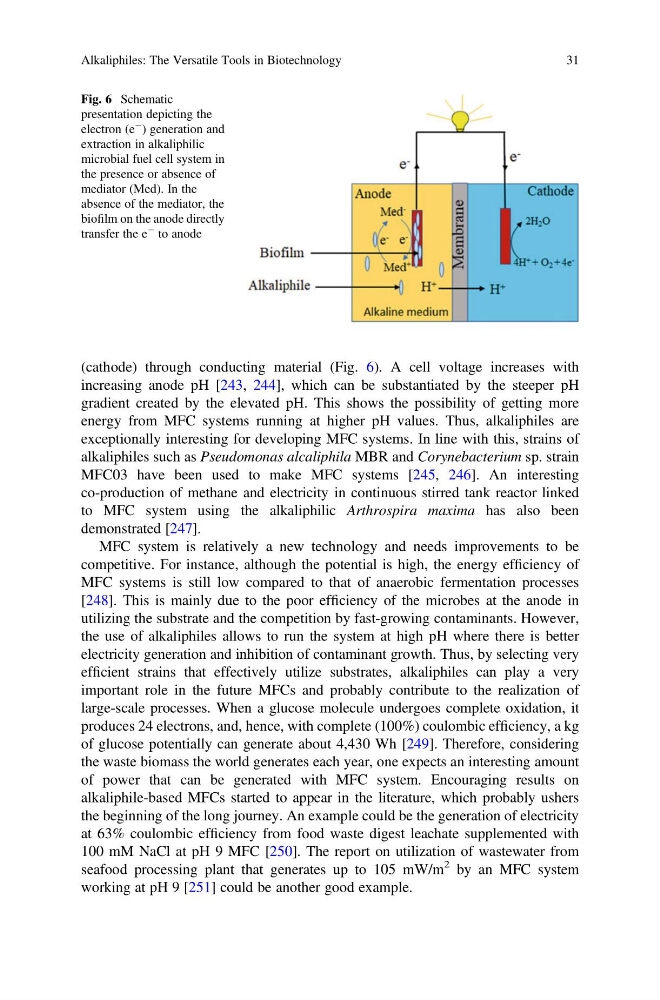
(cathode) through conducting material (Fig. 6). A cell voltage increases with
increasing anode pH [243, 244], which can be substantiated by the steeper pH
gradient created by the elevated pH. This shows the possibility of getting more
energy from MFC systems running at higher pH values. Thus, alkaliphiles are
exceptionally interesting for developing MFC systems. In line with this, strains of
alkaliphiles such as Pseudomonas alcaliphila MBR and Corynebacterium sp. strain
MFC03 have been used to make MFC systems [245, 246]. An interesting
co-production of methane and electricity in continuous stirred tank reactor linked
to MFC system using the alkaliphilic Arthrospira maxima has also been
demonstrated [247].
MFC system is relatively a new technology and needs improvements to be
competitive. For instance, although the potential is high, the energy efficiency of
MFC systems is still low compared to that of anaerobic fermentation processes
[248]. This is mainly due to the poor efficiency of the microbes at the anode in
utilizing the substrate and the competition by fast-growing contaminants. However,
the use of alkaliphiles allows to run the system at high pH where there is better
electricity generation and inhibition of contaminant growth. Thus, by selecting very
efficient strains that effectively utilize substrates, alkaliphiles can play a very
important role in the future MFCs and probably contribute to the realization of
large-scale processes. When a glucose molecule undergoes complete oxidation, it
produces 24 electrons, and, hence, with complete (100%) coulombic efficiency, a kg
of glucose potentially can generate about 4,430 Wh [249]. Therefore, considering
the waste biomass the world generates each year, one expects an interesting amount
of power that can be generated with MFC system. Encouraging results on
alkaliphile-based MFCs started to appear in the literature, which probably ushers
the beginning of the long journey. An example could be the generation of electricity
at 63% coulombic efficiency from food waste digest leachate supplemented with
100 mM NaCl at pH 9 MFC [250]. The report on utilization of wastewater from
seafood processing plant that generates up to 105 mW/m
2 by an MFC system
working at pH 9 [251] could be another good example.
Fig. 6 Schematic
presentation depicting the
electron (e
À
) generation and
extraction in alkaliphilic
microbial fuel cell system in
the presence or absence of
mediator (Med). In the
absence of the mediator, the
biofilm on the anode directly
transfer the e
À to anode
Alkaliphiles: The Versatile Tools in Biotechnology
31
increasing anode pH [243, 244], which can be substantiated by the steeper pH
gradient created by the elevated pH. This shows the possibility of getting more
energy from MFC systems running at higher pH values. Thus, alkaliphiles are
exceptionally interesting for developing MFC systems. In line with this, strains of
alkaliphiles such as Pseudomonas alcaliphila MBR and Corynebacterium sp. strain
MFC03 have been used to make MFC systems [245, 246]. An interesting
co-production of methane and electricity in continuous stirred tank reactor linked
to MFC system using the alkaliphilic Arthrospira maxima has also been
demonstrated [247].
MFC system is relatively a new technology and needs improvements to be
competitive. For instance, although the potential is high, the energy efficiency of
MFC systems is still low compared to that of anaerobic fermentation processes
[248]. This is mainly due to the poor efficiency of the microbes at the anode in
utilizing the substrate and the competition by fast-growing contaminants. However,
the use of alkaliphiles allows to run the system at high pH where there is better
electricity generation and inhibition of contaminant growth. Thus, by selecting very
efficient strains that effectively utilize substrates, alkaliphiles can play a very
important role in the future MFCs and probably contribute to the realization of
large-scale processes. When a glucose molecule undergoes complete oxidation, it
produces 24 electrons, and, hence, with complete (100%) coulombic efficiency, a kg
of glucose potentially can generate about 4,430 Wh [249]. Therefore, considering
the waste biomass the world generates each year, one expects an interesting amount
of power that can be generated with MFC system. Encouraging results on
alkaliphile-based MFCs started to appear in the literature, which probably ushers
the beginning of the long journey. An example could be the generation of electricity
at 63% coulombic efficiency from food waste digest leachate supplemented with
100 mM NaCl at pH 9 MFC [250]. The report on utilization of wastewater from
seafood processing plant that generates up to 105 mW/m
2 by an MFC system
working at pH 9 [251] could be another good example.
Fig. 6 Schematic
presentation depicting the
electron (e
À
) generation and
extraction in alkaliphilic
microbial fuel cell system in
the presence or absence of
mediator (Med). In the
absence of the mediator, the
biofilm on the anode directly
transfer the e
À to anode
Alkaliphiles: The Versatile Tools in Biotechnology
31