

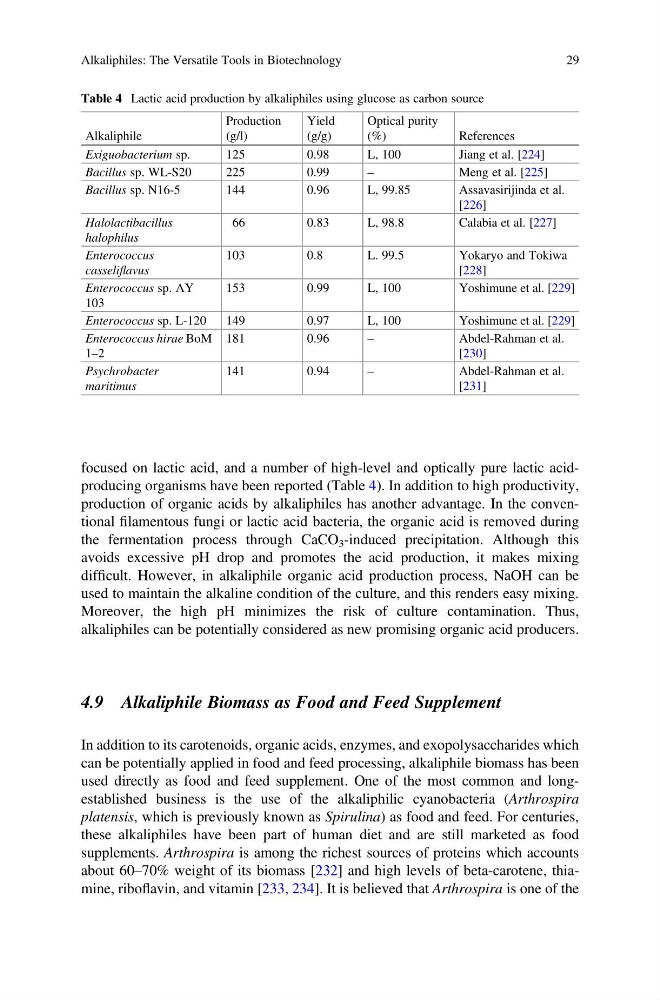
focused on lactic acid, and a number of high-level and optically pure lactic acidproducing organisms have been reported (Table 4). In addition to high productivity,
production of organic acids by alkaliphiles has another advantage. In the conventional filamentous fungi or lactic acid bacteria, the organic acid is removed during
the fermentation process through CaCO 3 -induced precipitation. Although this
avoids excessive pH drop and promotes the acid production, it makes mixing
difficult. However, in alkaliphile organic acid production process, NaOH can be
used to maintain the alkaline condition of the culture, and this renders easy mixing.
Moreover, the high pH minimizes the risk of culture contamination. Thus,
alkaliphiles can be potentially considered as new promising organic acid producers.
4.9 Alkaliphile Biomass as Food and Feed Supplement
In addition to its carotenoids, organic acids, enzymes, and exopolysaccharides which
can be potentially applied in food and feed processing, alkaliphile biomass has been
used directly as food and feed supplement. One of the most common and longestablished business is the use of the alkaliphilic cyanobacteria (Arthrospira
platensis, which is previously known as Spirulina) as food and feed. For centuries,
these alkaliphiles have been part of human diet and are still marketed as food
supplements. Arthrospira is among the richest sources of proteins which accounts
about 60–70% weight of its biomass [232] and high levels of beta-carotene, thiamine, riboflavin, and vitamin [233, 234]. It is believed that Arthrospira is one of the
Table 4 Lactic acid production by alkaliphiles using glucose as carbon source
Alkaliphile
Production
(g/l)
Yield
(g/g)
Optical purity
(%)
References
Exiguobacterium sp.
125
0.98
L, 100
Jiang et al. [224]
Bacillus sp. WL-S20
225
0.99
–
Meng et al. [225]
Bacillus sp. N16-5
144
0.96
L, 99.85
Assavasirijinda et al.
[226]
Halolactibacillus
halophilus
66
0.83
L, 98.8
Calabia et al. [227]
Enterococcus
casseliflavus
103
0.8
L. 99.5
Yokaryo and Tokiwa
[228]
Enterococcus sp. AY
103
153
0.99
L, 100
Yoshimune et al. [229]
Enterococcus sp. L-120
149
0.97
L, 100
Yoshimune et al. [229]
Enterococcus hirae BoM
1–2
181
0.96
–
Abdel-Rahman et al.
[230]
Psychrobacter
maritimus
141
0.94
–
Abdel-Rahman et al.
[231]
Alkaliphiles: The Versatile Tools in Biotechnology
29
production of organic acids by alkaliphiles has another advantage. In the conventional filamentous fungi or lactic acid bacteria, the organic acid is removed during
the fermentation process through CaCO 3 -induced precipitation. Although this
avoids excessive pH drop and promotes the acid production, it makes mixing
difficult. However, in alkaliphile organic acid production process, NaOH can be
used to maintain the alkaline condition of the culture, and this renders easy mixing.
Moreover, the high pH minimizes the risk of culture contamination. Thus,
alkaliphiles can be potentially considered as new promising organic acid producers.
4.9 Alkaliphile Biomass as Food and Feed Supplement
In addition to its carotenoids, organic acids, enzymes, and exopolysaccharides which
can be potentially applied in food and feed processing, alkaliphile biomass has been
used directly as food and feed supplement. One of the most common and longestablished business is the use of the alkaliphilic cyanobacteria (Arthrospira
platensis, which is previously known as Spirulina) as food and feed. For centuries,
these alkaliphiles have been part of human diet and are still marketed as food
supplements. Arthrospira is among the richest sources of proteins which accounts
about 60–70% weight of its biomass [232] and high levels of beta-carotene, thiamine, riboflavin, and vitamin [233, 234]. It is believed that Arthrospira is one of the
Table 4 Lactic acid production by alkaliphiles using glucose as carbon source
Alkaliphile
Production
(g/l)
Yield
(g/g)
Optical purity
(%)
References
Exiguobacterium sp.
125
0.98
L, 100
Jiang et al. [224]
Bacillus sp. WL-S20
225
0.99
–
Meng et al. [225]
Bacillus sp. N16-5
144
0.96
L, 99.85
Assavasirijinda et al.
[226]
Halolactibacillus
halophilus
66
0.83
L, 98.8
Calabia et al. [227]
Enterococcus
casseliflavus
103
0.8
L. 99.5
Yokaryo and Tokiwa
[228]
Enterococcus sp. AY
103
153
0.99
L, 100
Yoshimune et al. [229]
Enterococcus sp. L-120
149
0.97
L, 100
Yoshimune et al. [229]
Enterococcus hirae BoM
1–2
181
0.96
–
Abdel-Rahman et al.
[230]
Psychrobacter
maritimus
141
0.94
–
Abdel-Rahman et al.
[231]
Alkaliphiles: The Versatile Tools in Biotechnology
29