

contamination, and lack of efficient pentose and disaccharides (e.g., cellobiose)
fermenting commercial strains. To alleviate these problems, extremophiles such as
acidophiles [211, 212] and thermophiles [213] have been assessed. However, the
effort made so far on utilizing alkaliphiles is insignificant despite their great
potential.
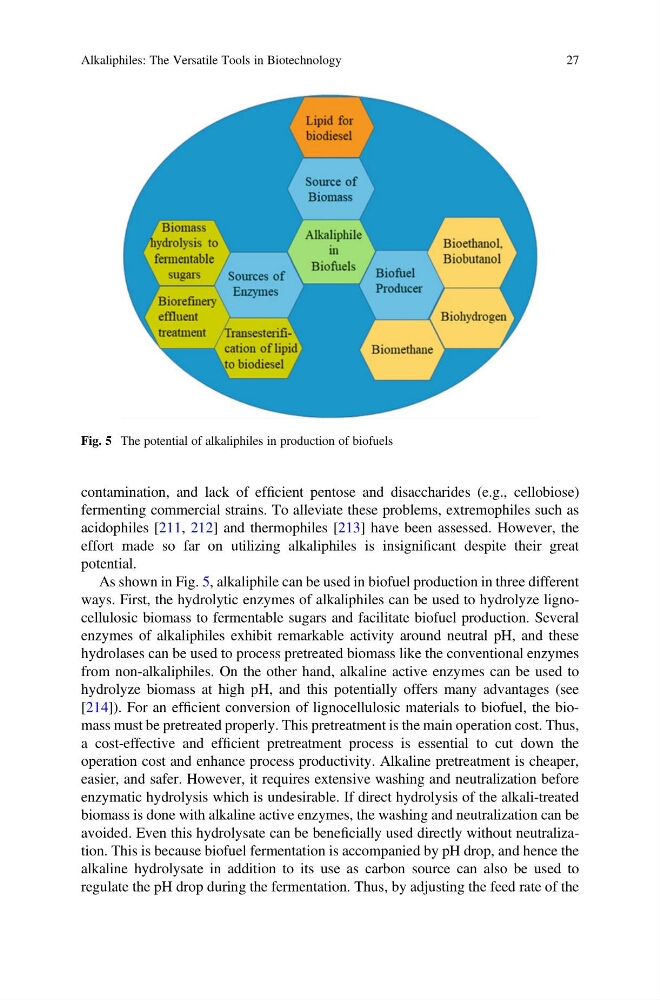
As shown in Fig. 5, alkaliphile can be used in biofuel production in three different
ways. First, the hydrolytic enzymes of alkaliphiles can be used to hydrolyze lignocellulosic biomass to fermentable sugars and facilitate biofuel production. Several
enzymes of alkaliphiles exhibit remarkable activity around neutral pH, and these
hydrolases can be used to process pretreated biomass like the conventional enzymes
from non-alkaliphiles. On the other hand, alkaline active enzymes can be used to
hydrolyze biomass at high pH, and this potentially offers many advantages (see
[214]). For an efficient conversion of lignocellulosic materials to biofuel, the biomass must be pretreated properly. This pretreatment is the main operation cost. Thus,
a cost-effective and efficient pretreatment process is essential to cut down the
operation cost and enhance process productivity. Alkaline pretreatment is cheaper,
easier, and safer. However, it requires extensive washing and neutralization before
enzymatic hydrolysis which is undesirable. If direct hydrolysis of the alkali-treated
biomass is done with alkaline active enzymes, the washing and neutralization can be
avoided. Even this hydrolysate can be beneficially used directly without neutralization. This is because biofuel fermentation is accompanied by pH drop, and hence the
alkaline hydrolysate in addition to its use as carbon source can also be used to
regulate the pH drop during the fermentation. Thus, by adjusting the feed rate of the
Fig. 5 The potential of alkaliphiles in production of biofuels
Alkaliphiles: The Versatile Tools in Biotechnology
27
fermenting commercial strains. To alleviate these problems, extremophiles such as
acidophiles [211, 212] and thermophiles [213] have been assessed. However, the
effort made so far on utilizing alkaliphiles is insignificant despite their great
potential.
As shown in Fig. 5, alkaliphile can be used in biofuel production in three different
ways. First, the hydrolytic enzymes of alkaliphiles can be used to hydrolyze lignocellulosic biomass to fermentable sugars and facilitate biofuel production. Several
enzymes of alkaliphiles exhibit remarkable activity around neutral pH, and these
hydrolases can be used to process pretreated biomass like the conventional enzymes
from non-alkaliphiles. On the other hand, alkaline active enzymes can be used to
hydrolyze biomass at high pH, and this potentially offers many advantages (see
[214]). For an efficient conversion of lignocellulosic materials to biofuel, the biomass must be pretreated properly. This pretreatment is the main operation cost. Thus,
a cost-effective and efficient pretreatment process is essential to cut down the
operation cost and enhance process productivity. Alkaline pretreatment is cheaper,
easier, and safer. However, it requires extensive washing and neutralization before
enzymatic hydrolysis which is undesirable. If direct hydrolysis of the alkali-treated
biomass is done with alkaline active enzymes, the washing and neutralization can be
avoided. Even this hydrolysate can be beneficially used directly without neutralization. This is because biofuel fermentation is accompanied by pH drop, and hence the
alkaline hydrolysate in addition to its use as carbon source can also be used to
regulate the pH drop during the fermentation. Thus, by adjusting the feed rate of the
Fig. 5 The potential of alkaliphiles in production of biofuels
Alkaliphiles: The Versatile Tools in Biotechnology
27