

been reported in the presence of 30 mM Ca
2+ [252]. On the other hand, a higher
concentration of calcium is inhibitory to urease [253].
A lot of concentration optimization studies have been done to identify the ideal
concentrations for efficient calcite precipitation. However, the results are quite
variable, and the optimum concentration of urea and Ca
2+ was in the range of
50–500 mM, while the best urea to Ca
2+ concentration ratio reported varies between
1:1 and 1:5 [18, 241, 254]. The contradicting optimal concentrations could be due to
the difference in the nature of the strains, temperature, and media composition.
Moreover, the optimal dosage of Ca
2+ and urea can vary not only on the type of
bacteria used but also on the amount of the microbial cells applied in the study. The
other factor that possibly contributes to the observed variation regarding concentrations is the type of the calcium source. Achal and Pan [235] studied the effect of Ca
2+
sources on carbonate precipitation using various calcium sources in urea – nutrient
broth medium – and found out that calcium chloride was the best to produce calcite.
However, due to the chloride ion undesirable effect, calcium chloride cannot be
considered for concrete application.
4.5 Calcium Carbonate Crystal Morphology
The literature in this field uses the term “precipitation” for CaCO 3 crystal formation.
A similar approach is adopted throughout this chapter. However, since this section
deals about crystal morphologies, the term crystal is used instead of precipitate in
this section for simplicity.
A relevant issue worth to mention in relation to microbially crystallized calcium
carbonate is the crystal morphology. CaCO 3 is a polymorphic material with three
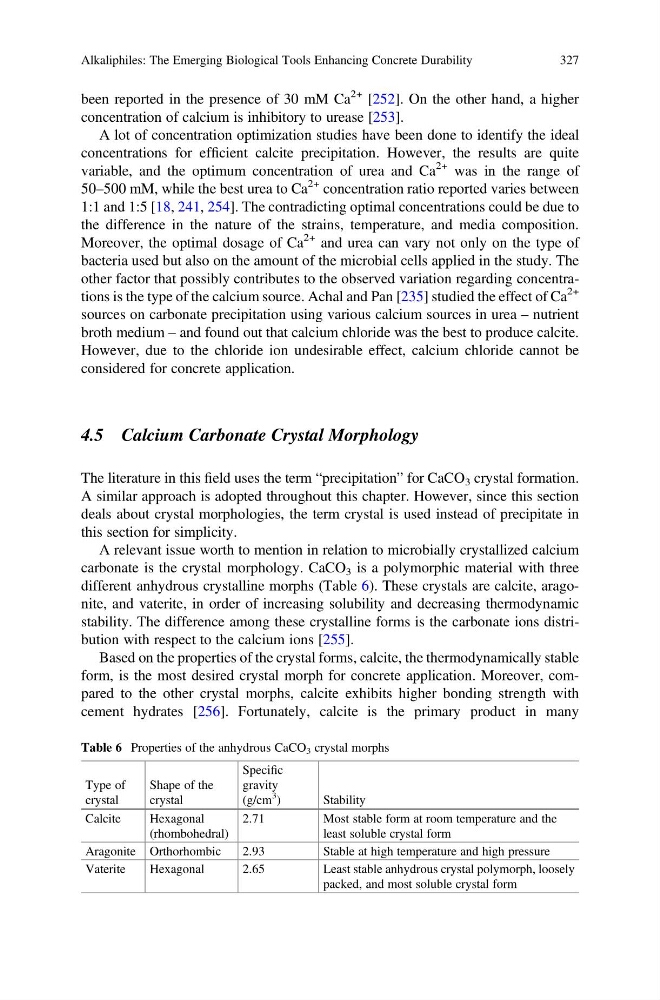
different anhydrous crystalline morphs (Table 6). These crystals are calcite, aragonite, and vaterite, in order of increasing solubility and decreasing thermodynamic
stability. The difference among these crystalline forms is the carbonate ions distribution with respect to the calcium ions [255].
Based on the properties of the crystal forms, calcite, the thermodynamically stable
form, is the most desired crystal morph for concrete application. Moreover, compared to the other crystal morphs, calcite exhibits higher bonding strength with
cement hydrates [256]. Fortunately, calcite is the primary product in many
Table 6 Properties of the anhydrous CaCO 3 crystal morphs
Type of
crystal
Shape of the
crystal
Specific
gravity
(g/cm
3
)
Stability
Calcite
Hexagonal
(rhombohedral)
2.71
Most stable form at room temperature and the
least soluble crystal form
Aragonite Orthorhombic
2.93
Stable at high temperature and high pressure
Vaterite
Hexagonal
2.65
Least stable anhydrous crystal polymorph, loosely
packed, and most soluble crystal form
Alkaliphiles: The Emerging Biological Tools Enhancing Concrete Durability
327
2+ [252]. On the other hand, a higher
concentration of calcium is inhibitory to urease [253].
A lot of concentration optimization studies have been done to identify the ideal
concentrations for efficient calcite precipitation. However, the results are quite
variable, and the optimum concentration of urea and Ca
2+ was in the range of
50–500 mM, while the best urea to Ca
2+ concentration ratio reported varies between
1:1 and 1:5 [18, 241, 254]. The contradicting optimal concentrations could be due to
the difference in the nature of the strains, temperature, and media composition.
Moreover, the optimal dosage of Ca
2+ and urea can vary not only on the type of
bacteria used but also on the amount of the microbial cells applied in the study. The
other factor that possibly contributes to the observed variation regarding concentrations is the type of the calcium source. Achal and Pan [235] studied the effect of Ca
2+
sources on carbonate precipitation using various calcium sources in urea – nutrient
broth medium – and found out that calcium chloride was the best to produce calcite.
However, due to the chloride ion undesirable effect, calcium chloride cannot be
considered for concrete application.
4.5 Calcium Carbonate Crystal Morphology
The literature in this field uses the term “precipitation” for CaCO 3 crystal formation.
A similar approach is adopted throughout this chapter. However, since this section
deals about crystal morphologies, the term crystal is used instead of precipitate in
this section for simplicity.
A relevant issue worth to mention in relation to microbially crystallized calcium
carbonate is the crystal morphology. CaCO 3 is a polymorphic material with three
different anhydrous crystalline morphs (Table 6). These crystals are calcite, aragonite, and vaterite, in order of increasing solubility and decreasing thermodynamic
stability. The difference among these crystalline forms is the carbonate ions distribution with respect to the calcium ions [255].
Based on the properties of the crystal forms, calcite, the thermodynamically stable
form, is the most desired crystal morph for concrete application. Moreover, compared to the other crystal morphs, calcite exhibits higher bonding strength with
cement hydrates [256]. Fortunately, calcite is the primary product in many
Table 6 Properties of the anhydrous CaCO 3 crystal morphs
Type of
crystal
Shape of the
crystal
Specific
gravity
(g/cm
3
)
Stability
Calcite
Hexagonal
(rhombohedral)
2.71
Most stable form at room temperature and the
least soluble crystal form
Aragonite Orthorhombic
2.93
Stable at high temperature and high pressure
Vaterite
Hexagonal
2.65
Least stable anhydrous crystal polymorph, loosely
packed, and most soluble crystal form
Alkaliphiles: The Emerging Biological Tools Enhancing Concrete Durability
327