

Unlike the other two systems, the ureolytic and oxidation of organic compounds, this
system is not dependent on oxygen. Thus, it offsets the limitation of the other two
systems that tend to heal the crack surfaces and leave the deeper part of the crack
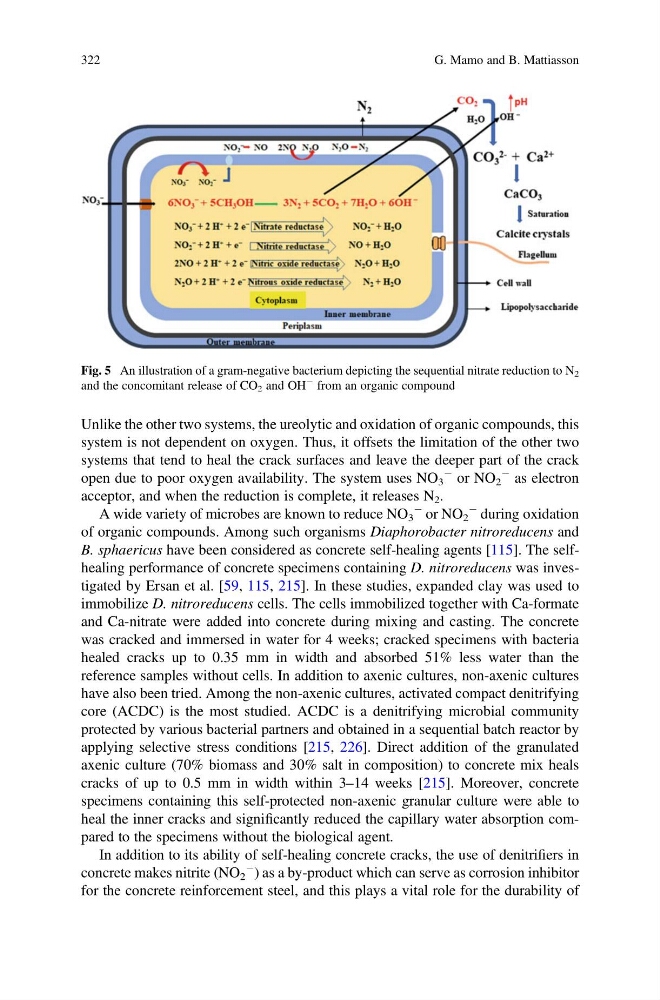
open due to poor oxygen availability. The system uses NO 3
À or NO 2
À as electron
acceptor, and when the reduction is complete, it releases N 2 .
A wide variety of microbes are known to reduce NO 3
À or NO 2
À during oxidation
of organic compounds. Among such organisms Diaphorobacter nitroreducens and
B. sphaericus have been considered as concrete self-healing agents [115]. The selfhealing performance of concrete specimens containing D. nitroreducens was investigated by Ersan et al. [59, 115, 215]. In these studies, expanded clay was used to
immobilize D. nitroreducens cells. The cells immobilized together with Ca-formate
and Ca-nitrate were added into concrete during mixing and casting. The concrete
was cracked and immersed in water for 4 weeks; cracked specimens with bacteria
healed cracks up to 0.35 mm in width and absorbed 51% less water than the
reference samples without cells. In addition to axenic cultures, non-axenic cultures
have also been tried. Among the non-axenic cultures, activated compact denitrifying
core (ACDC) is the most studied. ACDC is a denitrifying microbial community
protected by various bacterial partners and obtained in a sequential batch reactor by
applying selective stress conditions [215, 226]. Direct addition of the granulated
axenic culture (70% biomass and 30% salt in composition) to concrete mix heals
cracks of up to 0.5 mm in width within 3–14 weeks [215]. Moreover, concrete
specimens containing this self-protected non-axenic granular culture were able to
heal the inner cracks and significantly reduced the capillary water absorption compared to the specimens without the biological agent.
In addition to its ability of self-healing concrete cracks, the use of denitrifiers in
concrete makes nitrite (NO 2
À ) as a by-product which can serve as corrosion inhibitor
for the concrete reinforcement steel, and this plays a vital role for the durability of
Fig. 5 An illustration of a gram-negative bacterium depicting the sequential nitrate reduction to N 2
and the concomitant release of CO 2 and OH
À from an organic compound
322
G. Mamo and B. Mattiasson
system is not dependent on oxygen. Thus, it offsets the limitation of the other two
systems that tend to heal the crack surfaces and leave the deeper part of the crack
open due to poor oxygen availability. The system uses NO 3
À or NO 2
À as electron
acceptor, and when the reduction is complete, it releases N 2 .
A wide variety of microbes are known to reduce NO 3
À or NO 2
À during oxidation
of organic compounds. Among such organisms Diaphorobacter nitroreducens and
B. sphaericus have been considered as concrete self-healing agents [115]. The selfhealing performance of concrete specimens containing D. nitroreducens was investigated by Ersan et al. [59, 115, 215]. In these studies, expanded clay was used to
immobilize D. nitroreducens cells. The cells immobilized together with Ca-formate
and Ca-nitrate were added into concrete during mixing and casting. The concrete
was cracked and immersed in water for 4 weeks; cracked specimens with bacteria
healed cracks up to 0.35 mm in width and absorbed 51% less water than the
reference samples without cells. In addition to axenic cultures, non-axenic cultures
have also been tried. Among the non-axenic cultures, activated compact denitrifying
core (ACDC) is the most studied. ACDC is a denitrifying microbial community
protected by various bacterial partners and obtained in a sequential batch reactor by
applying selective stress conditions [215, 226]. Direct addition of the granulated
axenic culture (70% biomass and 30% salt in composition) to concrete mix heals
cracks of up to 0.5 mm in width within 3–14 weeks [215]. Moreover, concrete
specimens containing this self-protected non-axenic granular culture were able to
heal the inner cracks and significantly reduced the capillary water absorption compared to the specimens without the biological agent.
In addition to its ability of self-healing concrete cracks, the use of denitrifiers in
concrete makes nitrite (NO 2
À ) as a by-product which can serve as corrosion inhibitor
for the concrete reinforcement steel, and this plays a vital role for the durability of
Fig. 5 An illustration of a gram-negative bacterium depicting the sequential nitrate reduction to N 2
and the concomitant release of CO 2 and OH
À from an organic compound
322
G. Mamo and B. Mattiasson