

phosphates, oxides, sulfides, and silicates [36, 37]. Microbes are also involved in
mineralization of gold, copper, iron, uranium, etc., and in fact some of these
processes are being used at commercial level in a sector called microbial mining
[38]. In addition, siliceous sinter, diatomaceous earth, opal, pyrite, marcasite, travertine, etc. have also biogenic origin.
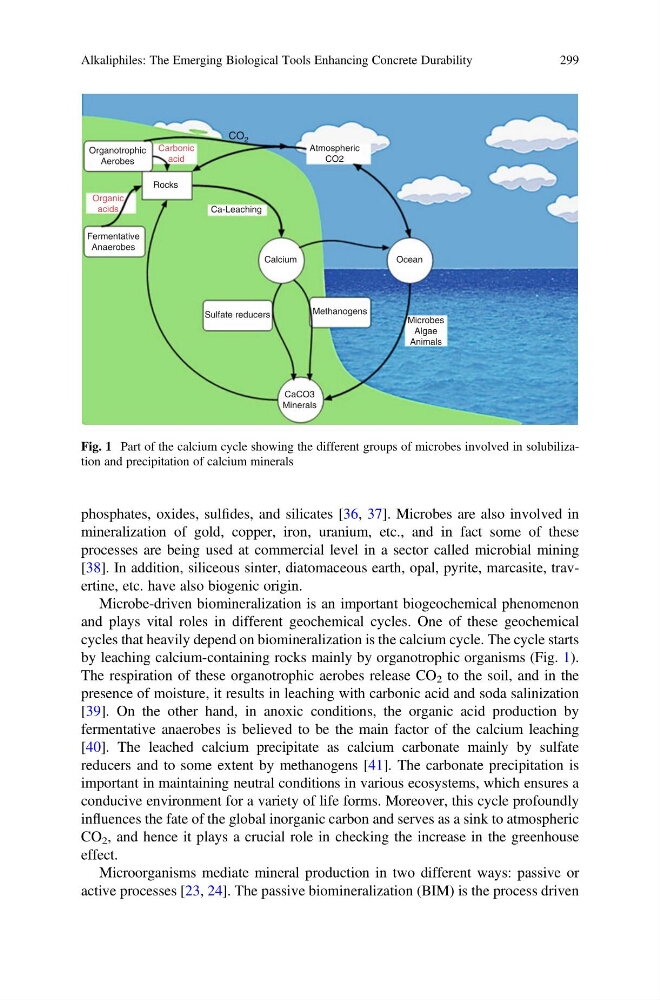
Microbe-driven biomineralization is an important biogeochemical phenomenon
and plays vital roles in different geochemical cycles. One of these geochemical
cycles that heavily depend on biomineralization is the calcium cycle. The cycle starts
by leaching calcium-containing rocks mainly by organotrophic organisms (Fig. 1).
The respiration of these organotrophic aerobes release CO 2 to the soil, and in the
presence of moisture, it results in leaching with carbonic acid and soda salinization
[39]. On the other hand, in anoxic conditions, the organic acid production by
fermentative anaerobes is believed to be the main factor of the calcium leaching
[40]. The leached calcium precipitate as calcium carbonate mainly by sulfate
reducers and to some extent by methanogens [41]. The carbonate precipitation is
important in maintaining neutral conditions in various ecosystems, which ensures a
conducive environment for a variety of life forms. Moreover, this cycle profoundly
influences the fate of the global inorganic carbon and serves as a sink to atmospheric
CO 2 , and hence it plays a crucial role in checking the increase in the greenhouse
effect.
Microorganisms mediate mineral production in two different ways: passive or
active processes [23, 24]. The passive biomineralization (BIM) is the process driven
Atmospheric
CO2
CO 2
Rocks
Carbonic
acid
Organic
acids
Ca-Leaching
Calcium
CaCO3
Minerals
Ocean
Microbes
Algae
Animals
Methanogens
Sulfate reducers
Organotrophic
Aerobes
Fermentative
Anaerobes
Fig. 1 Part of the calcium cycle showing the different groups of microbes involved in solubilization and precipitation of calcium minerals
Alkaliphiles: The Emerging Biological Tools Enhancing Concrete Durability
299
mineralization of gold, copper, iron, uranium, etc., and in fact some of these
processes are being used at commercial level in a sector called microbial mining
[38]. In addition, siliceous sinter, diatomaceous earth, opal, pyrite, marcasite, travertine, etc. have also biogenic origin.
Microbe-driven biomineralization is an important biogeochemical phenomenon
and plays vital roles in different geochemical cycles. One of these geochemical
cycles that heavily depend on biomineralization is the calcium cycle. The cycle starts
by leaching calcium-containing rocks mainly by organotrophic organisms (Fig. 1).
The respiration of these organotrophic aerobes release CO 2 to the soil, and in the
presence of moisture, it results in leaching with carbonic acid and soda salinization
[39]. On the other hand, in anoxic conditions, the organic acid production by
fermentative anaerobes is believed to be the main factor of the calcium leaching
[40]. The leached calcium precipitate as calcium carbonate mainly by sulfate
reducers and to some extent by methanogens [41]. The carbonate precipitation is
important in maintaining neutral conditions in various ecosystems, which ensures a
conducive environment for a variety of life forms. Moreover, this cycle profoundly
influences the fate of the global inorganic carbon and serves as a sink to atmospheric
CO 2 , and hence it plays a crucial role in checking the increase in the greenhouse
effect.
Microorganisms mediate mineral production in two different ways: passive or
active processes [23, 24]. The passive biomineralization (BIM) is the process driven
Atmospheric
CO2
CO 2
Rocks
Carbonic
acid
Organic
acids
Ca-Leaching
Calcium
CaCO3
Minerals
Ocean
Microbes
Algae
Animals
Methanogens
Sulfate reducers
Organotrophic
Aerobes
Fermentative
Anaerobes
Fig. 1 Part of the calcium cycle showing the different groups of microbes involved in solubilization and precipitation of calcium minerals
Alkaliphiles: The Emerging Biological Tools Enhancing Concrete Durability
299