

it results in chlorinated organic by-products which are reported to have highly
persistent toxic and mutagenic effects [153]. Because of the growing public concern
about environment and strict legislations regarding pollution, the search for alternative ways to reduce or avoid the release of chlorogenic compounds with Kraft mill
bleaching effluent has been promoted. Today, alternative environmentally benign
bleaching chemicals like H 2 O 2 , O 2 , and O 3 are substituting the toxic chlorine-based
bleaching chemicals.
Enzymatic treatment of Kraft pulp prior to bleaching hydrolyzes the xylan
component of wood, which in turn facilitates lignin removal, a phenomenon that
has shown a substantial reduction in the use of bleaching chemicals [70, 154,
155]. For instance, a ton of xylanase-treated pulp consumes 5–7 kg less chlorine
dioxide for bleaching [156]. Biobleaching of pulp with xylanase, in addition to
improving the quality of the pulp and reduce the environmental impact, downsizes
the process cost [157]. For example, the biobleaching of hardwood Kraft pulp to
89% ISO brightness reduces the bleaching cost by about 2.3 USD per ton of dried
pulp [158]. Thus, considering that the price of xylanase treatment is below 2 USD
per ton [159], the biobleaching has some economical gain. Thus, the use of
xylanases in pre-bleaching of Kraft pulp has been considered as one of the greatest
success stories of enzymes in pulp and paper industry, and today, there are more than
20 mills in North America and Scandinavia alone that employs xylanase treatment
[56]. Progress in enzyme production technology has significantly diminished the
production cost, which subsequently reduced the enzyme selling price. This cost
reduction is expected to attract more mills to consider using enzymes in Kraft pulp
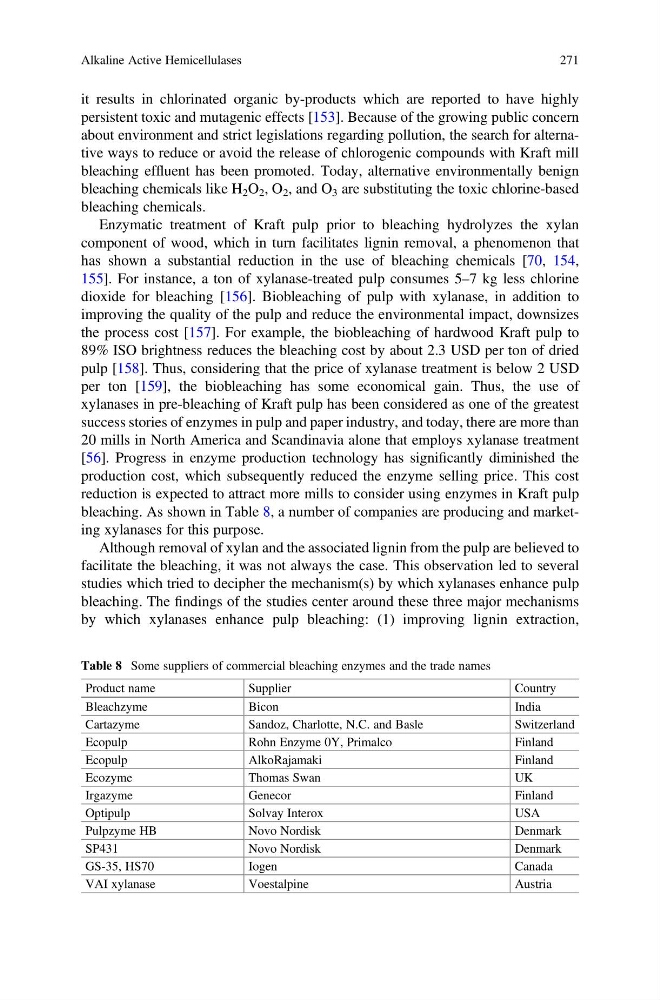
bleaching. As shown in Table 8, a number of companies are producing and marketing xylanases for this purpose.
Although removal of xylan and the associated lignin from the pulp are believed to
facilitate the bleaching, it was not always the case. This observation led to several
studies which tried to decipher the mechanism(s) by which xylanases enhance pulp
bleaching. The findings of the studies center around these three major mechanisms
by which xylanases enhance pulp bleaching: (1) improving lignin extraction,
Table 8 Some suppliers of commercial bleaching enzymes and the trade names
Product name
Supplier
Country
Bleachzyme
Bicon
India
Cartazyme
Sandoz, Charlotte, N.C. and Basle
Switzerland
Ecopulp
Rohn Enzyme 0Y, Primalco
Finland
Ecopulp
AlkoRajamaki
Finland
Ecozyme
Thomas Swan
UK
Irgazyme
Genecor
Finland
Optipulp
Solvay Interox
USA
Pulpzyme HB
Novo Nordisk
Denmark
SP431
Novo Nordisk
Denmark
GS-35, HS70
Iogen
Canada
VAI xylanase
Voestalpine
Austria
Alkaline Active Hemicellulases
271
persistent toxic and mutagenic effects [153]. Because of the growing public concern
about environment and strict legislations regarding pollution, the search for alternative ways to reduce or avoid the release of chlorogenic compounds with Kraft mill
bleaching effluent has been promoted. Today, alternative environmentally benign
bleaching chemicals like H 2 O 2 , O 2 , and O 3 are substituting the toxic chlorine-based
bleaching chemicals.
Enzymatic treatment of Kraft pulp prior to bleaching hydrolyzes the xylan
component of wood, which in turn facilitates lignin removal, a phenomenon that
has shown a substantial reduction in the use of bleaching chemicals [70, 154,
155]. For instance, a ton of xylanase-treated pulp consumes 5–7 kg less chlorine
dioxide for bleaching [156]. Biobleaching of pulp with xylanase, in addition to
improving the quality of the pulp and reduce the environmental impact, downsizes
the process cost [157]. For example, the biobleaching of hardwood Kraft pulp to
89% ISO brightness reduces the bleaching cost by about 2.3 USD per ton of dried
pulp [158]. Thus, considering that the price of xylanase treatment is below 2 USD
per ton [159], the biobleaching has some economical gain. Thus, the use of
xylanases in pre-bleaching of Kraft pulp has been considered as one of the greatest
success stories of enzymes in pulp and paper industry, and today, there are more than
20 mills in North America and Scandinavia alone that employs xylanase treatment
[56]. Progress in enzyme production technology has significantly diminished the
production cost, which subsequently reduced the enzyme selling price. This cost
reduction is expected to attract more mills to consider using enzymes in Kraft pulp
bleaching. As shown in Table 8, a number of companies are producing and marketing xylanases for this purpose.
Although removal of xylan and the associated lignin from the pulp are believed to
facilitate the bleaching, it was not always the case. This observation led to several
studies which tried to decipher the mechanism(s) by which xylanases enhance pulp
bleaching. The findings of the studies center around these three major mechanisms
by which xylanases enhance pulp bleaching: (1) improving lignin extraction,
Table 8 Some suppliers of commercial bleaching enzymes and the trade names
Product name
Supplier
Country
Bleachzyme
Bicon
India
Cartazyme
Sandoz, Charlotte, N.C. and Basle
Switzerland
Ecopulp
Rohn Enzyme 0Y, Primalco
Finland
Ecopulp
AlkoRajamaki
Finland
Ecozyme
Thomas Swan
UK
Irgazyme
Genecor
Finland
Optipulp
Solvay Interox
USA
Pulpzyme HB
Novo Nordisk
Denmark
SP431
Novo Nordisk
Denmark
GS-35, HS70
Iogen
Canada
VAI xylanase
Voestalpine
Austria
Alkaline Active Hemicellulases
271