

distance between the two catalytic carboxylic acid residues is about 9.5 Ǻ [12]. In
retaining mechanism, the two carboxylic acid residues of the catalytic amino acids
are positioned approximately 5.5 Ǻ apart. These carboxylic acids are involved in
intermediate formation. In the first step of the catalysis, one of the carboxylates
protonates the substrate and acts as a general acid catalyst, while the other carboxylic
acid performs a nucleophilic attack which results in the departure of the leaving
group and the formation of glycosyl-enzyme intermediate. In the second step, the
first carboxylate group now functions as a general base, taking a proton from a
nucleophilic water molecule which attacks the anomeric carbon. This leads to a
second substitution in which the anomeric carbon again passes via a transition state
to give rise to a product with β configuration. Thus, the overall result is retention of
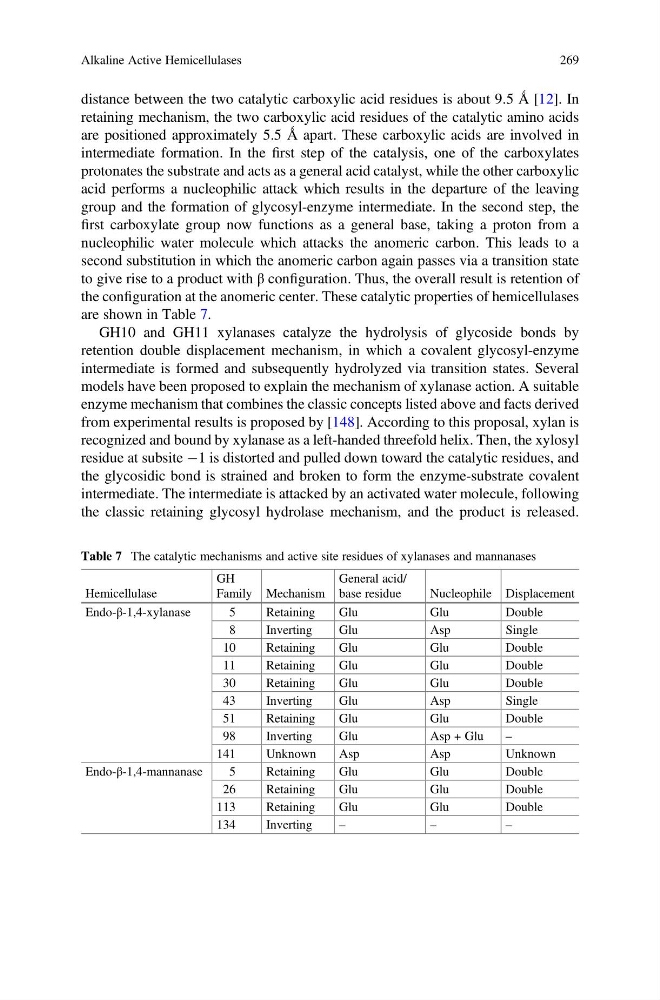
the configuration at the anomeric center. These catalytic properties of hemicellulases
are shown in Table 7.
GH10 and GH11 xylanases catalyze the hydrolysis of glycoside bonds by
retention double displacement mechanism, in which a covalent glycosyl-enzyme
intermediate is formed and subsequently hydrolyzed via transition states. Several
models have been proposed to explain the mechanism of xylanase action. A suitable
enzyme mechanism that combines the classic concepts listed above and facts derived
from experimental results is proposed by [148]. According to this proposal, xylan is
recognized and bound by xylanase as a left-handed threefold helix. Then, the xylosyl
residue at subsite À1 is distorted and pulled down toward the catalytic residues, and
the glycosidic bond is strained and broken to form the enzyme-substrate covalent
intermediate. The intermediate is attacked by an activated water molecule, following
the classic retaining glycosyl hydrolase mechanism, and the product is released.
Table 7 The catalytic mechanisms and active site residues of xylanases and mannanases
Hemicellulase
GH
Family Mechanism
General acid/
base residue
Nucleophile Displacement
Endo-β-1,4-xylanase
5
Retaining
Glu
Glu
Double
8
Inverting
Glu
Asp
Single
10
Retaining
Glu
Glu
Double
11
Retaining
Glu
Glu
Double
30
Retaining
Glu
Glu
Double
43
Inverting
Glu
Asp
Single
51
Retaining
Glu
Glu
Double
98
Inverting
Glu
Asp + Glu
–
141
Unknown
Asp
Asp
Unknown
Endo-β-1,4-mannanase
5
Retaining
Glu
Glu
Double
26
Retaining
Glu
Glu
Double
113
Retaining
Glu
Glu
Double
134
Inverting
–
–
–
Alkaline Active Hemicellulases
269
retaining mechanism, the two carboxylic acid residues of the catalytic amino acids
are positioned approximately 5.5 Ǻ apart. These carboxylic acids are involved in
intermediate formation. In the first step of the catalysis, one of the carboxylates
protonates the substrate and acts as a general acid catalyst, while the other carboxylic
acid performs a nucleophilic attack which results in the departure of the leaving
group and the formation of glycosyl-enzyme intermediate. In the second step, the
first carboxylate group now functions as a general base, taking a proton from a
nucleophilic water molecule which attacks the anomeric carbon. This leads to a
second substitution in which the anomeric carbon again passes via a transition state
to give rise to a product with β configuration. Thus, the overall result is retention of
the configuration at the anomeric center. These catalytic properties of hemicellulases
are shown in Table 7.
GH10 and GH11 xylanases catalyze the hydrolysis of glycoside bonds by
retention double displacement mechanism, in which a covalent glycosyl-enzyme
intermediate is formed and subsequently hydrolyzed via transition states. Several
models have been proposed to explain the mechanism of xylanase action. A suitable
enzyme mechanism that combines the classic concepts listed above and facts derived
from experimental results is proposed by [148]. According to this proposal, xylan is
recognized and bound by xylanase as a left-handed threefold helix. Then, the xylosyl
residue at subsite À1 is distorted and pulled down toward the catalytic residues, and
the glycosidic bond is strained and broken to form the enzyme-substrate covalent
intermediate. The intermediate is attacked by an activated water molecule, following
the classic retaining glycosyl hydrolase mechanism, and the product is released.
Table 7 The catalytic mechanisms and active site residues of xylanases and mannanases
Hemicellulase
GH
Family Mechanism
General acid/
base residue
Nucleophile Displacement
Endo-β-1,4-xylanase
5
Retaining
Glu
Glu
Double
8
Inverting
Glu
Asp
Single
10
Retaining
Glu
Glu
Double
11
Retaining
Glu
Glu
Double
30
Retaining
Glu
Glu
Double
43
Inverting
Glu
Asp
Single
51
Retaining
Glu
Glu
Double
98
Inverting
Glu
Asp + Glu
–
141
Unknown
Asp
Asp
Unknown
Endo-β-1,4-mannanase
5
Retaining
Glu
Glu
Double
26
Retaining
Glu
Glu
Double
113
Retaining
Glu
Glu
Double
134
Inverting
–
–
–
Alkaline Active Hemicellulases
269