

conditions at which the organism able to grow. For instance, an organism may be
adapted to grow in a pH range of 7–11. In this case, the organism either produce an
enzyme (e.g., mannanase) that work effectively at pH 7–11 or produce two different
enzymes (e.g., mannanases), which are optimally active in neutral or alkaline range.
This can be exemplified by B. halodurans xylanases. However, it may be relevant to
have a glance at the different families to which xylanases and mannanases belong to
before discussing the example.
Based on the catalytic domain amino acid sequence homology, carbohydratemodifying enzymes are grouped into families. The most informative and updated
classification of hemicellulases and other carbohydrate active enzymes is available
on the Carbohydrate-Active Enzymes (CAZy) server (http://afmb.cnrs-mrs.fr/
CAZy). The great majority of xylanases are confined to glycoside hydrolase family
10 (GH10) and family 11 (GH11). Thus, there had been a notion that xylanases are
restricted to GH10 and GH11 families. However, at the time of writing this review,
xylan-degrading enzymes are also found in GH families 5, 8, 30, 43, 51, 198, and
141. Unlike xylanases that are distributed in 9 families, mannanases, at least at the
moment, are restricted into 4 families, GH families 5, 26, 113, and 134. GH5 and
GH26 are the two families where most of the mannanases belong to. The alkaline
β-mannanases from the alkaliphilic microorganisms Bacillus sp. N16-5 and Bacillus
sp. JAMB-602 belong to family 5, and the enzymes from Bacillus sp. strain JAMB750 are categorized with family 26.
The enzymes that belong to a family may have distinct properties. For instance,
the GH11 xylanases are smaller in size (<30 kDa) compared to the GH10 xylanases
which characteristically have a molecular weight of over 30 kDa. Moreover, GH11
xylanases are more specific than GH10 xylanases. Substrate specificity studies on
GH10 xylanases show that they are versatile and even can act on cellulosic substrates. However, xylan-specific GH10 xylanases have also been reported
[69, 127]. Such differences in physical and catalytic properties among
hemicellulases that belong to different families can contribute to the efficiency of
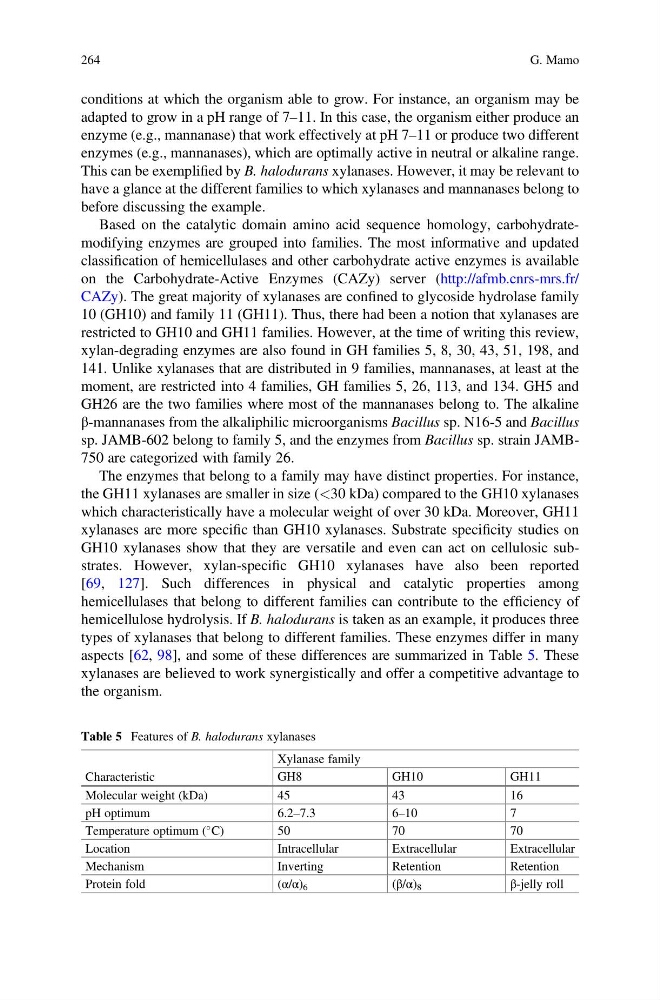
hemicellulose hydrolysis. If B. halodurans is taken as an example, it produces three
types of xylanases that belong to different families. These enzymes differ in many
aspects [62, 98], and some of these differences are summarized in Table 5. These
xylanases are believed to work synergistically and offer a competitive advantage to
the organism.
Table 5 Features of B. halodurans xylanases
Characteristic
Xylanase family
GH8
GH10
GH11
Molecular weight (kDa)
45
43
16
pH optimum
6.2–7.3
6–10
7
Temperature optimum (
C)
50
70
70
Location
Intracellular
Extracellular
Extracellular
Mechanism
Inverting
Retention
Retention
Protein fold
(α/α) 6
(β/α) 8
β-jelly roll
264
G. Mamo
adapted to grow in a pH range of 7–11. In this case, the organism either produce an
enzyme (e.g., mannanase) that work effectively at pH 7–11 or produce two different
enzymes (e.g., mannanases), which are optimally active in neutral or alkaline range.
This can be exemplified by B. halodurans xylanases. However, it may be relevant to
have a glance at the different families to which xylanases and mannanases belong to
before discussing the example.
Based on the catalytic domain amino acid sequence homology, carbohydratemodifying enzymes are grouped into families. The most informative and updated
classification of hemicellulases and other carbohydrate active enzymes is available
on the Carbohydrate-Active Enzymes (CAZy) server (http://afmb.cnrs-mrs.fr/
CAZy). The great majority of xylanases are confined to glycoside hydrolase family
10 (GH10) and family 11 (GH11). Thus, there had been a notion that xylanases are
restricted to GH10 and GH11 families. However, at the time of writing this review,
xylan-degrading enzymes are also found in GH families 5, 8, 30, 43, 51, 198, and
141. Unlike xylanases that are distributed in 9 families, mannanases, at least at the
moment, are restricted into 4 families, GH families 5, 26, 113, and 134. GH5 and
GH26 are the two families where most of the mannanases belong to. The alkaline
β-mannanases from the alkaliphilic microorganisms Bacillus sp. N16-5 and Bacillus
sp. JAMB-602 belong to family 5, and the enzymes from Bacillus sp. strain JAMB750 are categorized with family 26.
The enzymes that belong to a family may have distinct properties. For instance,
the GH11 xylanases are smaller in size (<30 kDa) compared to the GH10 xylanases
which characteristically have a molecular weight of over 30 kDa. Moreover, GH11
xylanases are more specific than GH10 xylanases. Substrate specificity studies on
GH10 xylanases show that they are versatile and even can act on cellulosic substrates. However, xylan-specific GH10 xylanases have also been reported
[69, 127]. Such differences in physical and catalytic properties among
hemicellulases that belong to different families can contribute to the efficiency of
hemicellulose hydrolysis. If B. halodurans is taken as an example, it produces three
types of xylanases that belong to different families. These enzymes differ in many
aspects [62, 98], and some of these differences are summarized in Table 5. These
xylanases are believed to work synergistically and offer a competitive advantage to
the organism.
Table 5 Features of B. halodurans xylanases
Characteristic
Xylanase family
GH8
GH10
GH11
Molecular weight (kDa)
45
43
16
pH optimum
6.2–7.3
6–10
7
Temperature optimum (
C)
50
70
70
Location
Intracellular
Extracellular
Extracellular
Mechanism
Inverting
Retention
Retention
Protein fold
(α/α) 6
(β/α) 8
β-jelly roll
264
G. Mamo