

lower temperature (37
C), the B. halodurans PPKS-2 xylanase displayed optimum
activity at pH 11 making it the second most alkaline active xylanase so far
[86]. However, the pH optima of glycosyl hydrolases are often affected by the
assay temperature [89, 99], and hence, the B. halodurans PPKS-2 enzyme might
not display the same pH profile if assayed at higher temperature. Other alkaline
active xylanases of B. halodurans strain are known to be optimally active around
pH 9–9.5 [69, 98]. On the other hand, based on the molecular weight, the
B. halodurans xylanases which are optimally active around pH 9.5 belong to family
10 xylanases, while the low molecular weight (24 kDa) of the B. halodurans PPKS-2
xylanase suggests that it belongs to family 11 xylanase.
Most alkaline active xylanases are optimally active in the temperature range of
40–75
C. The highest optimal temperature for activity of an alkaline active
xylanases, 100
C, is reported for Arthrobacter [74] and Enterobacter [76] strains.
The size of these extremozymes are in the range of 20–149 kDa, the majority are
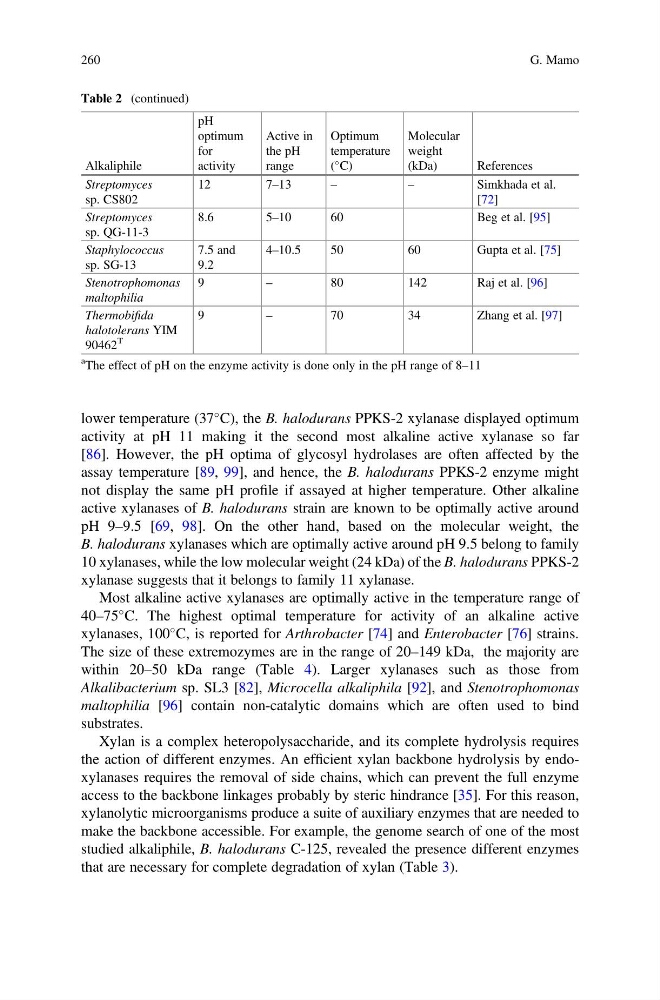
within 20–50 kDa range (Table 4). Larger xylanases such as those from
Alkalibacterium sp. SL3 [82], Microcella alkaliphila [92], and Stenotrophomonas
maltophilia [96] contain non-catalytic domains which are often used to bind
substrates.
Xylan is a complex heteropolysaccharide, and its complete hydrolysis requires
the action of different enzymes. An efficient xylan backbone hydrolysis by endoxylanases requires the removal of side chains, which can prevent the full enzyme
access to the backbone linkages probably by steric hindrance [35]. For this reason,
xylanolytic microorganisms produce a suite of auxiliary enzymes that are needed to
make the backbone accessible. For example, the genome search of one of the most
studied alkaliphile, B. halodurans C-125, revealed the presence different enzymes
that are necessary for complete degradation of xylan (Table 3).
Table 2 (continued)
Alkaliphile
pH
optimum
for
activity
Active in
the pH
range
Optimum
temperature
(
C)
Molecular
weight
(kDa)
References
Streptomyces
sp. CS802
12
7–13
–
–
Simkhada et al.
[72]
Streptomyces
sp. QG-11-3
8.6
5–10
60
Beg et al. [95]
Staphylococcus
sp. SG-13
7.5 and
9.2
4–10.5
50
60
Gupta et al. [75]
Stenotrophomonas
maltophilia
9
–
80
142
Raj et al. [96]
Thermobifida
halotolerans YIM
90462
T
9
–
70
34
Zhang et al. [97]
a The effect of pH on the enzyme activity is done only in the pH range of 8–11
260
G. Mamo
C), the B. halodurans PPKS-2 xylanase displayed optimum
activity at pH 11 making it the second most alkaline active xylanase so far
[86]. However, the pH optima of glycosyl hydrolases are often affected by the
assay temperature [89, 99], and hence, the B. halodurans PPKS-2 enzyme might
not display the same pH profile if assayed at higher temperature. Other alkaline
active xylanases of B. halodurans strain are known to be optimally active around
pH 9–9.5 [69, 98]. On the other hand, based on the molecular weight, the
B. halodurans xylanases which are optimally active around pH 9.5 belong to family
10 xylanases, while the low molecular weight (24 kDa) of the B. halodurans PPKS-2
xylanase suggests that it belongs to family 11 xylanase.
Most alkaline active xylanases are optimally active in the temperature range of
40–75
C. The highest optimal temperature for activity of an alkaline active
xylanases, 100
C, is reported for Arthrobacter [74] and Enterobacter [76] strains.
The size of these extremozymes are in the range of 20–149 kDa, the majority are
within 20–50 kDa range (Table 4). Larger xylanases such as those from
Alkalibacterium sp. SL3 [82], Microcella alkaliphila [92], and Stenotrophomonas
maltophilia [96] contain non-catalytic domains which are often used to bind
substrates.
Xylan is a complex heteropolysaccharide, and its complete hydrolysis requires
the action of different enzymes. An efficient xylan backbone hydrolysis by endoxylanases requires the removal of side chains, which can prevent the full enzyme
access to the backbone linkages probably by steric hindrance [35]. For this reason,
xylanolytic microorganisms produce a suite of auxiliary enzymes that are needed to
make the backbone accessible. For example, the genome search of one of the most
studied alkaliphile, B. halodurans C-125, revealed the presence different enzymes
that are necessary for complete degradation of xylan (Table 3).
Table 2 (continued)
Alkaliphile
pH
optimum
for
activity
Active in
the pH
range
Optimum
temperature
(
C)
Molecular
weight
(kDa)
References
Streptomyces
sp. CS802
12
7–13
–
–
Simkhada et al.
[72]
Streptomyces
sp. QG-11-3
8.6
5–10
60
Beg et al. [95]
Staphylococcus
sp. SG-13
7.5 and
9.2
4–10.5
50
60
Gupta et al. [75]
Stenotrophomonas
maltophilia
9
–
80
142
Raj et al. [96]
Thermobifida
halotolerans YIM
90462
T
9
–
70
34
Zhang et al. [97]
a The effect of pH on the enzyme activity is done only in the pH range of 8–11
260
G. Mamo