

definition is generic and it does not clearly define hemicellulose. In this chapter,
hemicellulases are defined as cell wall polysaccharides which are neither cellulose
nor pectin and are composed of equatorially configured β-(1-4 and/or 1-3) xylose,
glucose, and/or mannose backbones.
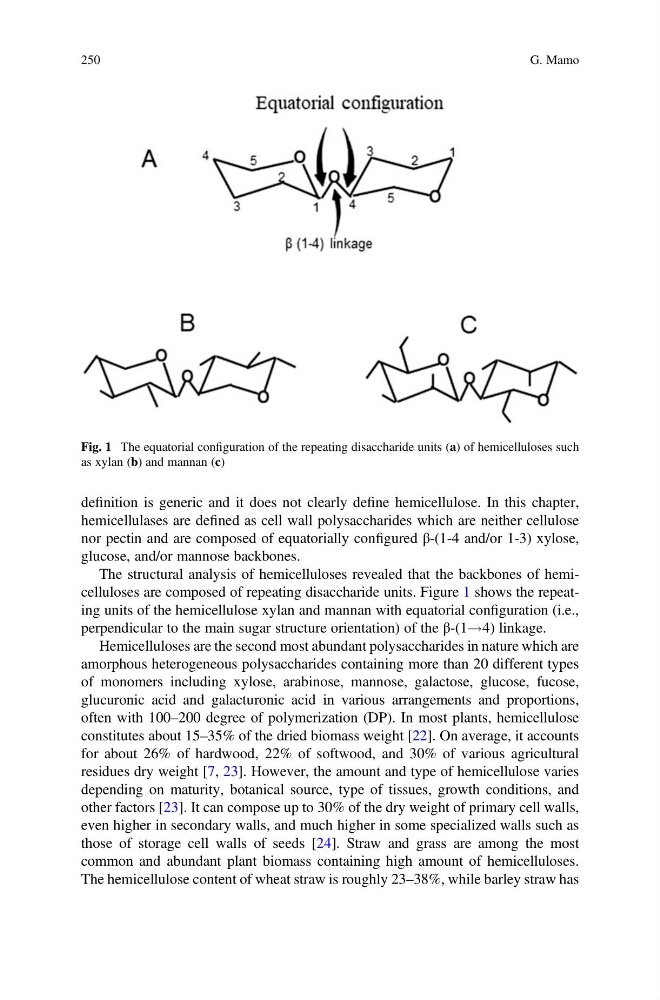
The structural analysis of hemicelluloses revealed that the backbones of hemicelluloses are composed of repeating disaccharide units. Figure 1 shows the repeating units of the hemicellulose xylan and mannan with equatorial configuration (i.e.,
perpendicular to the main sugar structure orientation) of the β-(1!4) linkage.
Hemicelluloses are the second most abundant polysaccharides in nature which are
amorphous heterogeneous polysaccharides containing more than 20 different types
of monomers including xylose, arabinose, mannose, galactose, glucose, fucose,
glucuronic acid and galacturonic acid in various arrangements and proportions,
often with 100–200 degree of polymerization (DP). In most plants, hemicellulose
constitutes about 15–35% of the dried biomass weight [22]. On average, it accounts
for about 26% of hardwood, 22% of softwood, and 30% of various agricultural
residues dry weight [7, 23]. However, the amount and type of hemicellulose varies
depending on maturity, botanical source, type of tissues, growth conditions, and
other factors [23]. It can compose up to 30% of the dry weight of primary cell walls,
even higher in secondary walls, and much higher in some specialized walls such as
those of storage cell walls of seeds [24]. Straw and grass are among the most
common and abundant plant biomass containing high amount of hemicelluloses.
The hemicellulose content of wheat straw is roughly 23–38%, while barley straw has
Fig. 1 The equatorial configuration of the repeating disaccharide units (a) of hemicelluloses such
as xylan (b) and mannan (c)
250
G. Mamo
hemicellulases are defined as cell wall polysaccharides which are neither cellulose
nor pectin and are composed of equatorially configured β-(1-4 and/or 1-3) xylose,
glucose, and/or mannose backbones.
The structural analysis of hemicelluloses revealed that the backbones of hemicelluloses are composed of repeating disaccharide units. Figure 1 shows the repeating units of the hemicellulose xylan and mannan with equatorial configuration (i.e.,
perpendicular to the main sugar structure orientation) of the β-(1!4) linkage.
Hemicelluloses are the second most abundant polysaccharides in nature which are
amorphous heterogeneous polysaccharides containing more than 20 different types
of monomers including xylose, arabinose, mannose, galactose, glucose, fucose,
glucuronic acid and galacturonic acid in various arrangements and proportions,
often with 100–200 degree of polymerization (DP). In most plants, hemicellulose
constitutes about 15–35% of the dried biomass weight [22]. On average, it accounts
for about 26% of hardwood, 22% of softwood, and 30% of various agricultural
residues dry weight [7, 23]. However, the amount and type of hemicellulose varies
depending on maturity, botanical source, type of tissues, growth conditions, and
other factors [23]. It can compose up to 30% of the dry weight of primary cell walls,
even higher in secondary walls, and much higher in some specialized walls such as
those of storage cell walls of seeds [24]. Straw and grass are among the most
common and abundant plant biomass containing high amount of hemicelluloses.
The hemicellulose content of wheat straw is roughly 23–38%, while barley straw has
Fig. 1 The equatorial configuration of the repeating disaccharide units (a) of hemicelluloses such
as xylan (b) and mannan (c)
250
G. Mamo