

European Commission, and other organizations as the best available technology for
pulp bleaching. Thus, due to its economic and environmental benefits, more than
90% of the current global pulp bleaching depend on it. Although chlorine dioxide is
not making the chlorogenic compounds, dioxins and furans, it is not risk-free. It is
highly unstable, extremely toxic, and explosive. Thus, any green approach that helps
in bleaching or any of the processes that allow to minimize the chemical and energy
consumption of the bleaching process can be considered as environmentally benign.
One of the success stories in this line is the use of enzymes as pre-bleaching aids
which avoids or reduces the use of bleaching chemicals. Xylanases, mannanases,
cellulases, lipases, laccases, and peroxidases have shown promising results in
processing of pulp and paper and reduce the chemical load [93–98], and some of
these enzymes are already applied by different mills [99]. The most important roles
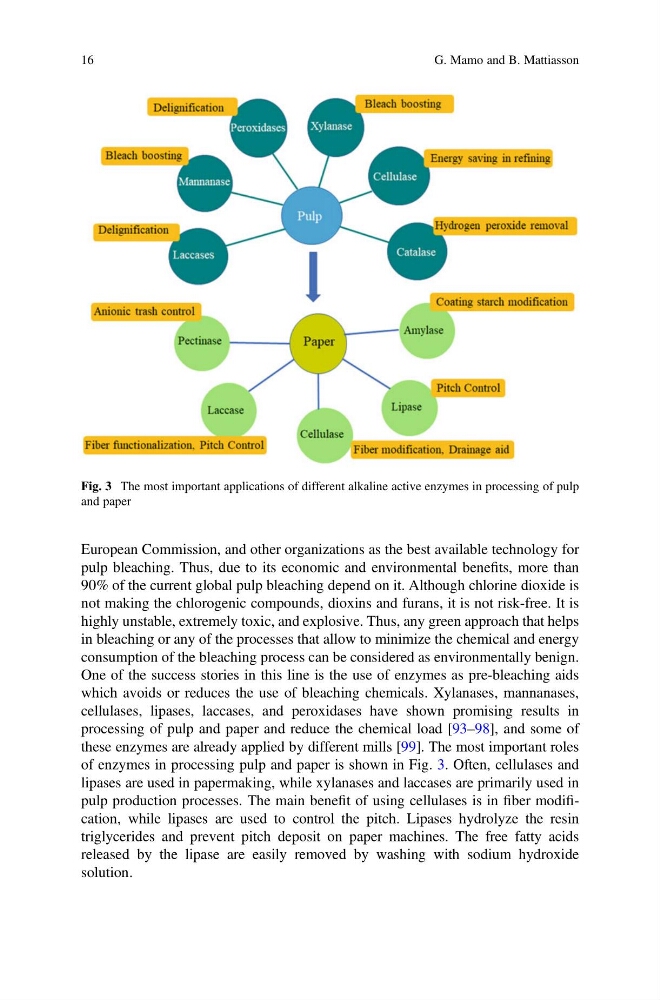
of enzymes in processing pulp and paper is shown in Fig. 3. Often, cellulases and
lipases are used in papermaking, while xylanases and laccases are primarily used in
pulp production processes. The main benefit of using cellulases is in fiber modification, while lipases are used to control the pitch. Lipases hydrolyze the resin
triglycerides and prevent pitch deposit on paper machines. The free fatty acids
released by the lipase are easily removed by washing with sodium hydroxide
solution.
Fig. 3 The most important applications of different alkaline active enzymes in processing of pulp
and paper
16
G. Mamo and B. Mattiasson
pulp bleaching. Thus, due to its economic and environmental benefits, more than
90% of the current global pulp bleaching depend on it. Although chlorine dioxide is
not making the chlorogenic compounds, dioxins and furans, it is not risk-free. It is
highly unstable, extremely toxic, and explosive. Thus, any green approach that helps
in bleaching or any of the processes that allow to minimize the chemical and energy
consumption of the bleaching process can be considered as environmentally benign.
One of the success stories in this line is the use of enzymes as pre-bleaching aids
which avoids or reduces the use of bleaching chemicals. Xylanases, mannanases,
cellulases, lipases, laccases, and peroxidases have shown promising results in
processing of pulp and paper and reduce the chemical load [93–98], and some of
these enzymes are already applied by different mills [99]. The most important roles
of enzymes in processing pulp and paper is shown in Fig. 3. Often, cellulases and
lipases are used in papermaking, while xylanases and laccases are primarily used in
pulp production processes. The main benefit of using cellulases is in fiber modification, while lipases are used to control the pitch. Lipases hydrolyze the resin
triglycerides and prevent pitch deposit on paper machines. The free fatty acids
released by the lipase are easily removed by washing with sodium hydroxide
solution.
Fig. 3 The most important applications of different alkaline active enzymes in processing of pulp
and paper
16
G. Mamo and B. Mattiasson