

• Workers’ health is put at risk due to exposure to severe alkaline condition and
toxic sulphide.
• The process consumes huge quantities of water and energy and generates a lot of
wastewaters. Water polluted with these chemicals and the solubilized hair leads to
an increase in alkalinity, organic nitrogen, BOD, TDS, COD and air pollution by
hydrogen sulphide [15].
• Generate large quantities of solid wastes and obnoxious odour.
Enzymatic dehairing is suggested as being eco-friendly, more efficient and
superior to chemical process. Dehairing, descaling and dewooling are the prominent
stages where proteolytic enzymes can effectively be used in the leather processing
and cut over 80% of the pollution load in the industry. Proteolytic enzymes can be
used in dehairing to circumvent use of sodium sulphide and its negative environmental effect. Proteolytic enzymes are more efficient in dehairing and offer an
environmentally friendly alternative to the conventional chemical process. Research
by Wanyonyi et al. [15] demonstrated the technical and economic feasibility of
enzymatic hair removal, in which the lime and sulphide chemicals were completely
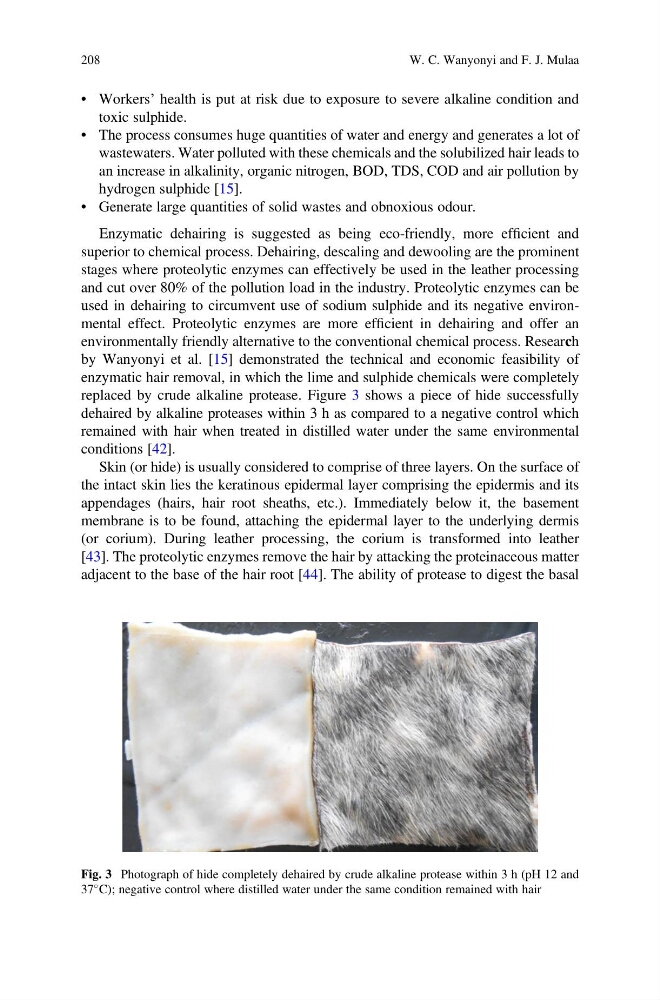
replaced by crude alkaline protease. Figure 3 shows a piece of hide successfully
dehaired by alkaline proteases within 3 h as compared to a negative control which
remained with hair when treated in distilled water under the same environmental
conditions [42].
Skin (or hide) is usually considered to comprise of three layers. On the surface of
the intact skin lies the keratinous epidermal layer comprising the epidermis and its
appendages (hairs, hair root sheaths, etc.). Immediately below it, the basement
membrane is to be found, attaching the epidermal layer to the underlying dermis
(or corium). During leather processing, the corium is transformed into leather
[43]. The proteolytic enzymes remove the hair by attacking the proteinaceous matter
adjacent to the base of the hair root [44]. The ability of protease to digest the basal
Fig. 3 Photograph of hide completely dehaired by crude alkaline protease within 3 h (pH 12 and
37
C); negative control where distilled water under the same condition remained with hair
208
W. C. Wanyonyi and F. J. Mulaa
toxic sulphide.
• The process consumes huge quantities of water and energy and generates a lot of
wastewaters. Water polluted with these chemicals and the solubilized hair leads to
an increase in alkalinity, organic nitrogen, BOD, TDS, COD and air pollution by
hydrogen sulphide [15].
• Generate large quantities of solid wastes and obnoxious odour.
Enzymatic dehairing is suggested as being eco-friendly, more efficient and
superior to chemical process. Dehairing, descaling and dewooling are the prominent
stages where proteolytic enzymes can effectively be used in the leather processing
and cut over 80% of the pollution load in the industry. Proteolytic enzymes can be
used in dehairing to circumvent use of sodium sulphide and its negative environmental effect. Proteolytic enzymes are more efficient in dehairing and offer an
environmentally friendly alternative to the conventional chemical process. Research
by Wanyonyi et al. [15] demonstrated the technical and economic feasibility of
enzymatic hair removal, in which the lime and sulphide chemicals were completely
replaced by crude alkaline protease. Figure 3 shows a piece of hide successfully
dehaired by alkaline proteases within 3 h as compared to a negative control which
remained with hair when treated in distilled water under the same environmental
conditions [42].
Skin (or hide) is usually considered to comprise of three layers. On the surface of
the intact skin lies the keratinous epidermal layer comprising the epidermis and its
appendages (hairs, hair root sheaths, etc.). Immediately below it, the basement
membrane is to be found, attaching the epidermal layer to the underlying dermis
(or corium). During leather processing, the corium is transformed into leather
[43]. The proteolytic enzymes remove the hair by attacking the proteinaceous matter
adjacent to the base of the hair root [44]. The ability of protease to digest the basal
Fig. 3 Photograph of hide completely dehaired by crude alkaline protease within 3 h (pH 12 and
37
C); negative control where distilled water under the same condition remained with hair
208
W. C. Wanyonyi and F. J. Mulaa