

2 Basic Sugar Metabolism
Whereas alkaliphilic microbes are studied rather extensively for their extracellular
enzymes and bioenergetics, their physiology and intracellular enzymes have been
neglected. Features of the intermediary metabolism are valuable to know, since they
aid in characterizing the microbe, the enzyme composition, the metabolic stage of
the cell, and the possibilities for metabolic engineering. A question remains also
whether there are any fundamental differences in the basic metabolism of
alkaliphiles as compared to neutralophiles. In spite of protection of the cell from
the extracellular pH, the intracellular pH is still 1–2.5 units higher than that of the
neutral-growing microbes, and hence, there could differences in the basic metabolism between these organisms.
One research theme in the studies of alkaliphiles is to understand what kind of
metabolic pathways alkaliphiles are exploiting. Is there any adaptation of those
pathways compared to neutralophiles? Rather, few studies have been conducted to
study the intermediary metabolism of alkaliphiles.
The majority of studied alkaliphiles belong to genus Bacillus, which consists of
aerobes and facultative anaerobes. Utilization of sugars by Bacillus circulans var.
alkalophilus was studied in comparable growth conditions [2]. Based on measurement of several enzyme activities, the alkaliphile employed EMP (glycolysis) and
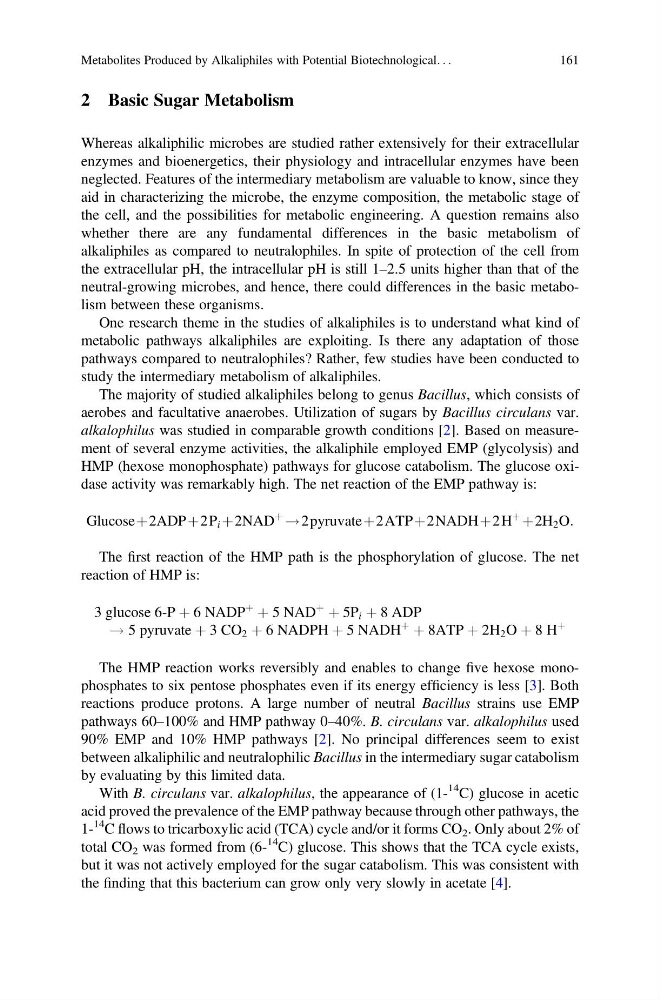
HMP (hexose monophosphate) pathways for glucose catabolism. The glucose oxidase activity was remarkably high. The net reaction of the EMP pathway is:
Glucoseþ2ADPþ2P i þ2NAD
þ
!2pyruvateþ2ATPþ2NADHþ2H
þ
þ2H 2 O:
The first reaction of the HMP path is the phosphorylation of glucose. The net
reaction of HMP is:
3 glucose 6-P þ 6 NADP
þ
þ 5 NAD
þ
þ 5P i þ 8 ADP
! 5 pyruvate þ 3 CO 2 þ 6 NADPH þ 5 NADH
þ
þ 8ATP þ 2H 2 O þ 8 H
þ
The HMP reaction works reversibly and enables to change five hexose monophosphates to six pentose phosphates even if its energy efficiency is less [3]. Both
reactions produce protons. A large number of neutral Bacillus strains use EMP
pathways 60–100% and HMP pathway 0–40%. B. circulans var. alkalophilus used
90% EMP and 10% HMP pathways [2]. No principal differences seem to exist
between alkaliphilic and neutralophilic Bacillus in the intermediary sugar catabolism
by evaluating by this limited data.
With B. circulans var. alkalophilus, the appearance of (114 C) glucose in acetic
acid proved the prevalence of the EMP pathway because through other pathways, the
114 C flows to tricarboxylic acid (TCA) cycle and/or it forms CO 2 . Only about 2% of
total CO 2 was formed from (614
C) glucose. This shows that the TCA cycle exists,
but it was not actively employed for the sugar catabolism. This was consistent with
the finding that this bacterium can grow only very slowly in acetate [4].
Metabolites Produced by Alkaliphiles with Potential Biotechnological. . .
161
Whereas alkaliphilic microbes are studied rather extensively for their extracellular
enzymes and bioenergetics, their physiology and intracellular enzymes have been
neglected. Features of the intermediary metabolism are valuable to know, since they
aid in characterizing the microbe, the enzyme composition, the metabolic stage of
the cell, and the possibilities for metabolic engineering. A question remains also
whether there are any fundamental differences in the basic metabolism of
alkaliphiles as compared to neutralophiles. In spite of protection of the cell from
the extracellular pH, the intracellular pH is still 1–2.5 units higher than that of the
neutral-growing microbes, and hence, there could differences in the basic metabolism between these organisms.
One research theme in the studies of alkaliphiles is to understand what kind of
metabolic pathways alkaliphiles are exploiting. Is there any adaptation of those
pathways compared to neutralophiles? Rather, few studies have been conducted to
study the intermediary metabolism of alkaliphiles.
The majority of studied alkaliphiles belong to genus Bacillus, which consists of
aerobes and facultative anaerobes. Utilization of sugars by Bacillus circulans var.
alkalophilus was studied in comparable growth conditions [2]. Based on measurement of several enzyme activities, the alkaliphile employed EMP (glycolysis) and
HMP (hexose monophosphate) pathways for glucose catabolism. The glucose oxidase activity was remarkably high. The net reaction of the EMP pathway is:
Glucoseþ2ADPþ2P i þ2NAD
þ
!2pyruvateþ2ATPþ2NADHþ2H
þ
þ2H 2 O:
The first reaction of the HMP path is the phosphorylation of glucose. The net
reaction of HMP is:
3 glucose 6-P þ 6 NADP
þ
þ 5 NAD
þ
þ 5P i þ 8 ADP
! 5 pyruvate þ 3 CO 2 þ 6 NADPH þ 5 NADH
þ
þ 8ATP þ 2H 2 O þ 8 H
þ
The HMP reaction works reversibly and enables to change five hexose monophosphates to six pentose phosphates even if its energy efficiency is less [3]. Both
reactions produce protons. A large number of neutral Bacillus strains use EMP
pathways 60–100% and HMP pathway 0–40%. B. circulans var. alkalophilus used
90% EMP and 10% HMP pathways [2]. No principal differences seem to exist
between alkaliphilic and neutralophilic Bacillus in the intermediary sugar catabolism
by evaluating by this limited data.
With B. circulans var. alkalophilus, the appearance of (114 C) glucose in acetic
acid proved the prevalence of the EMP pathway because through other pathways, the
114 C flows to tricarboxylic acid (TCA) cycle and/or it forms CO 2 . Only about 2% of
total CO 2 was formed from (614
C) glucose. This shows that the TCA cycle exists,
but it was not actively employed for the sugar catabolism. This was consistent with
the finding that this bacterium can grow only very slowly in acetate [4].
Metabolites Produced by Alkaliphiles with Potential Biotechnological. . .
161