

This organism contains a 3.6 Mb circular genome with 35.7% GC content, with a
similar tRNA arrangement to B. subtilis and no prophages, and encoding 3,496
CDSs. O. iheyensis and B. halodurans share 243 putative genes. Five of these genes
encode branched-chain amino acid transporters, which are thought to be important in
alkaliphiles due to their conversion to negatively charged glutamic acid, which in
turn leads to the acidification of the cytoplasm [16]. This idea is further re-enforced
by a recent transcriptomics study that shows the upregulation of branched-chain
amino acid transporters in Halomonas sp. Y2 under alkaline stress [17].
The obligately haloalkaliphile Natrialba magadii is an archaeon that requires a
high salt concentration (3.5 M NaCl) and pH (9.5) for optimal growth. The genome
consists of four replicons, the largest of which is 3.7 Mb in size and has a high GC
content (61.42%). Of the 4,212 genes coded by the combined genome, 2,387 shared
orthologues with the halophilic archaeon Haloterrigena turkmenica, which has been
isolated from a sulphate saline soil in Turkmenistan [18]. The genome of Natrialba
magadii bears specific features that may be linked to its adaptation to its natural
environment. These include the presence of genes coding for proteins involved in the
intake and synthesis of osmoprotectant compounds such as trehalose and
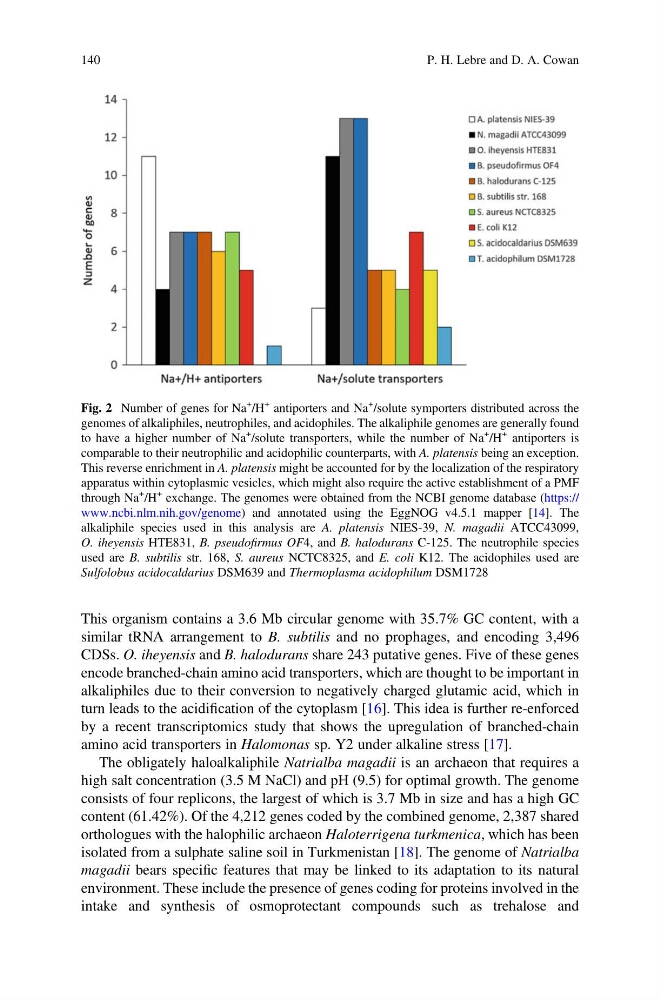
Fig. 2 Number of genes for Na
+ /H
+ antiporters and Na
+ /solute symporters distributed across the
genomes of alkaliphiles, neutrophiles, and acidophiles. The alkaliphile genomes are generally found
to have a higher number of Na
+ /solute transporters, while the number of Na
+ /H
+ antiporters is
comparable to their neutrophilic and acidophilic counterparts, with A. platensis being an exception.
This reverse enrichment in A. platensis might be accounted for by the localization of the respiratory
apparatus within cytoplasmic vesicles, which might also require the active establishment of a PMF
through Na
+ /H
+ exchange. The genomes were obtained from the NCBI genome database (https://
www.ncbi.nlm.nih.gov/genome) and annotated using the EggNOG v4.5.1 mapper [14]. The
alkaliphile species used in this analysis are A. platensis NIES-39, N. magadii ATCC43099,
O. iheyensis HTE831, B. pseudofirmus OF4, and B. halodurans C-125. The neutrophile species
used are B. subtilis str. 168, S. aureus NCTC8325, and E. coli K12. The acidophiles used are
Sulfolobus acidocaldarius DSM639 and Thermoplasma acidophilum DSM1728
140
P. H. Lebre and D. A. Cowan
similar tRNA arrangement to B. subtilis and no prophages, and encoding 3,496
CDSs. O. iheyensis and B. halodurans share 243 putative genes. Five of these genes
encode branched-chain amino acid transporters, which are thought to be important in
alkaliphiles due to their conversion to negatively charged glutamic acid, which in
turn leads to the acidification of the cytoplasm [16]. This idea is further re-enforced
by a recent transcriptomics study that shows the upregulation of branched-chain
amino acid transporters in Halomonas sp. Y2 under alkaline stress [17].
The obligately haloalkaliphile Natrialba magadii is an archaeon that requires a
high salt concentration (3.5 M NaCl) and pH (9.5) for optimal growth. The genome
consists of four replicons, the largest of which is 3.7 Mb in size and has a high GC
content (61.42%). Of the 4,212 genes coded by the combined genome, 2,387 shared
orthologues with the halophilic archaeon Haloterrigena turkmenica, which has been
isolated from a sulphate saline soil in Turkmenistan [18]. The genome of Natrialba
magadii bears specific features that may be linked to its adaptation to its natural
environment. These include the presence of genes coding for proteins involved in the
intake and synthesis of osmoprotectant compounds such as trehalose and
Fig. 2 Number of genes for Na
+ /H
+ antiporters and Na
+ /solute symporters distributed across the
genomes of alkaliphiles, neutrophiles, and acidophiles. The alkaliphile genomes are generally found
to have a higher number of Na
+ /solute transporters, while the number of Na
+ /H
+ antiporters is
comparable to their neutrophilic and acidophilic counterparts, with A. platensis being an exception.
This reverse enrichment in A. platensis might be accounted for by the localization of the respiratory
apparatus within cytoplasmic vesicles, which might also require the active establishment of a PMF
through Na
+ /H
+ exchange. The genomes were obtained from the NCBI genome database (https://
www.ncbi.nlm.nih.gov/genome) and annotated using the EggNOG v4.5.1 mapper [14]. The
alkaliphile species used in this analysis are A. platensis NIES-39, N. magadii ATCC43099,
O. iheyensis HTE831, B. pseudofirmus OF4, and B. halodurans C-125. The neutrophile species
used are B. subtilis str. 168, S. aureus NCTC8325, and E. coli K12. The acidophiles used are
Sulfolobus acidocaldarius DSM639 and Thermoplasma acidophilum DSM1728
140
P. H. Lebre and D. A. Cowan