

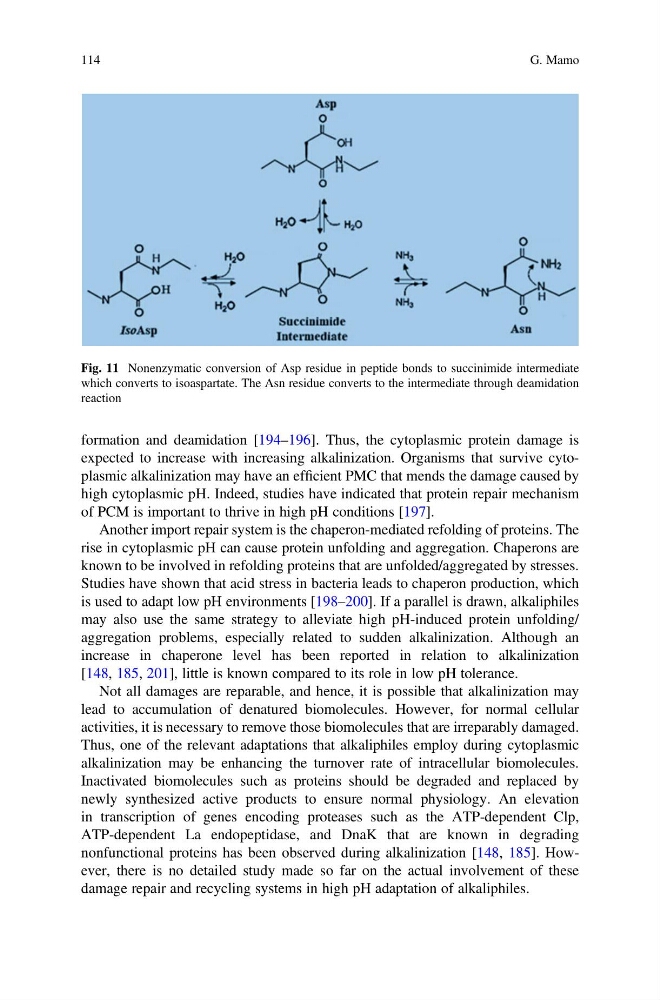
formation and deamidation [194–196]. Thus, the cytoplasmic protein damage is
expected to increase with increasing alkalinization. Organisms that survive cytoplasmic alkalinization may have an efficient PMC that mends the damage caused by
high cytoplasmic pH. Indeed, studies have indicated that protein repair mechanism
of PCM is important to thrive in high pH conditions [197].
Another import repair system is the chaperon-mediated refolding of proteins. The
rise in cytoplasmic pH can cause protein unfolding and aggregation. Chaperons are
known to be involved in refolding proteins that are unfolded/aggregated by stresses.
Studies have shown that acid stress in bacteria leads to chaperon production, which
is used to adapt low pH environments [198–200]. If a parallel is drawn, alkaliphiles
may also use the same strategy to alleviate high pH-induced protein unfolding/
aggregation problems, especially related to sudden alkalinization. Although an
increase in chaperone level has been reported in relation to alkalinization
[148, 185, 201], little is known compared to its role in low pH tolerance.
Not all damages are reparable, and hence, it is possible that alkalinization may
lead to accumulation of denatured biomolecules. However, for normal cellular
activities, it is necessary to remove those biomolecules that are irreparably damaged.
Thus, one of the relevant adaptations that alkaliphiles employ during cytoplasmic
alkalinization may be enhancing the turnover rate of intracellular biomolecules.
Inactivated biomolecules such as proteins should be degraded and replaced by
newly synthesized active products to ensure normal physiology. An elevation
in transcription of genes encoding proteases such as the ATP-dependent Clp,
ATP-dependent La endopeptidase, and DnaK that are known in degrading
nonfunctional proteins has been observed during alkalinization [148, 185]. However, there is no detailed study made so far on the actual involvement of these
damage repair and recycling systems in high pH adaptation of alkaliphiles.
Fig. 11 Nonenzymatic conversion of Asp residue in peptide bonds to succinimide intermediate
which converts to isoaspartate. The Asn residue converts to the intermediate through deamidation
reaction
114
G. Mamo
expected to increase with increasing alkalinization. Organisms that survive cytoplasmic alkalinization may have an efficient PMC that mends the damage caused by
high cytoplasmic pH. Indeed, studies have indicated that protein repair mechanism
of PCM is important to thrive in high pH conditions [197].
Another import repair system is the chaperon-mediated refolding of proteins. The
rise in cytoplasmic pH can cause protein unfolding and aggregation. Chaperons are
known to be involved in refolding proteins that are unfolded/aggregated by stresses.
Studies have shown that acid stress in bacteria leads to chaperon production, which
is used to adapt low pH environments [198–200]. If a parallel is drawn, alkaliphiles
may also use the same strategy to alleviate high pH-induced protein unfolding/
aggregation problems, especially related to sudden alkalinization. Although an
increase in chaperone level has been reported in relation to alkalinization
[148, 185, 201], little is known compared to its role in low pH tolerance.
Not all damages are reparable, and hence, it is possible that alkalinization may
lead to accumulation of denatured biomolecules. However, for normal cellular
activities, it is necessary to remove those biomolecules that are irreparably damaged.
Thus, one of the relevant adaptations that alkaliphiles employ during cytoplasmic
alkalinization may be enhancing the turnover rate of intracellular biomolecules.
Inactivated biomolecules such as proteins should be degraded and replaced by
newly synthesized active products to ensure normal physiology. An elevation
in transcription of genes encoding proteases such as the ATP-dependent Clp,
ATP-dependent La endopeptidase, and DnaK that are known in degrading
nonfunctional proteins has been observed during alkalinization [148, 185]. However, there is no detailed study made so far on the actual involvement of these
damage repair and recycling systems in high pH adaptation of alkaliphiles.
Fig. 11 Nonenzymatic conversion of Asp residue in peptide bonds to succinimide intermediate
which converts to isoaspartate. The Asn residue converts to the intermediate through deamidation
reaction
114
G. Mamo