

1. cardiolipin which aggregates the respiratory system together with the ATP
synthase. It also restricts the H
+ coming from the respiratory complex close to
ATP synthase and facilitate the H
+ transfer to the synthase [144],
2. cytochromes that pump out H
+ much faster than the normal pace of nonalkaliphilic organisms [161, 175] and cytochromes like cytochrome c-550 with
high electron retention capacity [174, 177], and
3. ATP synthase which is efficient in translocating H
+ to its catalytic core (i.e.
inhibition of H
+ leakage) [95, 170, 173].
The rapid pumping of H
+ by the respiratory complex and the restriction of these
H
+ close to the surface of the aggregate create a microenvironment with high pmf
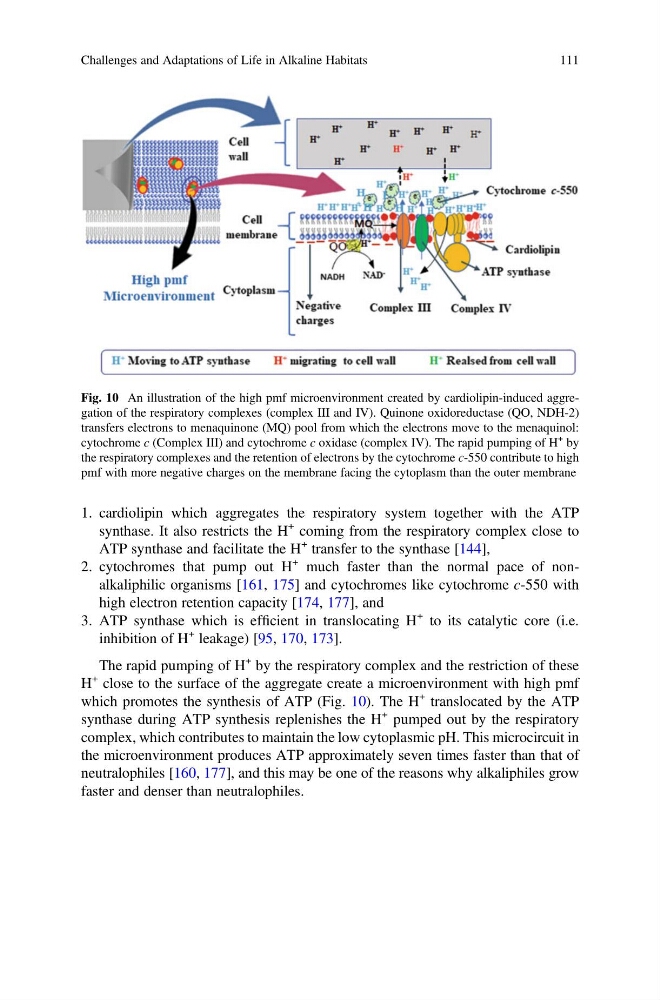
which promotes the synthesis of ATP (Fig. 10). The H
+ translocated by the ATP
synthase during ATP synthesis replenishes the H
+ pumped out by the respiratory
complex, which contributes to maintain the low cytoplasmic pH. This microcircuit in
the microenvironment produces ATP approximately seven times faster than that of
neutralophiles [160, 177], and this may be one of the reasons why alkaliphiles grow
faster and denser than neutralophiles.
Fig. 10 An illustration of the high pmf microenvironment created by cardiolipin-induced aggregation of the respiratory complexes (complex III and IV). Quinone oxidoreductase (QO, NDH-2)
transfers electrons to menaquinone (MQ) pool from which the electrons move to the menaquinol:
cytochrome c (Complex III) and cytochrome c oxidase (complex IV). The rapid pumping of H
+ by
the respiratory complexes and the retention of electrons by the cytochrome c-550 contribute to high
pmf with more negative charges on the membrane facing the cytoplasm than the outer membrane
Challenges and Adaptations of Life in Alkaline Habitats
111
synthase. It also restricts the H
+ coming from the respiratory complex close to
ATP synthase and facilitate the H
+ transfer to the synthase [144],
2. cytochromes that pump out H
+ much faster than the normal pace of nonalkaliphilic organisms [161, 175] and cytochromes like cytochrome c-550 with
high electron retention capacity [174, 177], and
3. ATP synthase which is efficient in translocating H
+ to its catalytic core (i.e.
inhibition of H
+ leakage) [95, 170, 173].
The rapid pumping of H
+ by the respiratory complex and the restriction of these
H
+ close to the surface of the aggregate create a microenvironment with high pmf
which promotes the synthesis of ATP (Fig. 10). The H
+ translocated by the ATP
synthase during ATP synthesis replenishes the H
+ pumped out by the respiratory
complex, which contributes to maintain the low cytoplasmic pH. This microcircuit in
the microenvironment produces ATP approximately seven times faster than that of
neutralophiles [160, 177], and this may be one of the reasons why alkaliphiles grow
faster and denser than neutralophiles.
Fig. 10 An illustration of the high pmf microenvironment created by cardiolipin-induced aggregation of the respiratory complexes (complex III and IV). Quinone oxidoreductase (QO, NDH-2)
transfers electrons to menaquinone (MQ) pool from which the electrons move to the menaquinol:
cytochrome c (Complex III) and cytochrome c oxidase (complex IV). The rapid pumping of H
+ by
the respiratory complexes and the retention of electrons by the cytochrome c-550 contribute to high
pmf with more negative charges on the membrane facing the cytoplasm than the outer membrane
Challenges and Adaptations of Life in Alkaline Habitats
111