

secondary role in cell wall function and hence referred to as “secondary” cell wall
polymers (SCWPs). SCWP analysis of one of the most studied alkaliphiles,
B. halodurans C-125, revealed that it is rich in negatively charged residues such
as aspartic acid, galacturonic acid, glutamic acid, and phosphoric acid
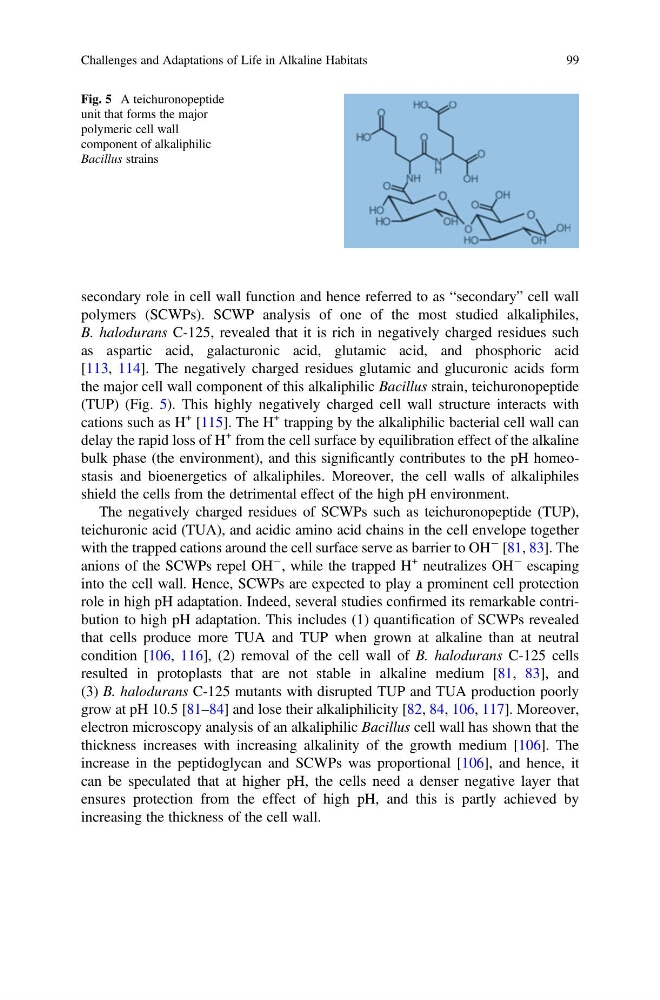
[113, 114]. The negatively charged residues glutamic and glucuronic acids form
the major cell wall component of this alkaliphilic Bacillus strain, teichuronopeptide
(TUP) (Fig. 5). This highly negatively charged cell wall structure interacts with
cations such as H
+ [115]. The H
+ trapping by the alkaliphilic bacterial cell wall can
delay the rapid loss of H
+ from the cell surface by equilibration effect of the alkaline
bulk phase (the environment), and this significantly contributes to the pH homeostasis and bioenergetics of alkaliphiles. Moreover, the cell walls of alkaliphiles
shield the cells from the detrimental effect of the high pH environment.
The negatively charged residues of SCWPs such as teichuronopeptide (TUP),
teichuronic acid (TUA), and acidic amino acid chains in the cell envelope together
with the trapped cations around the cell surface serve as barrier to OH
À [81, 83]. The
anions of the SCWPs repel OH
À , while the trapped H
+ neutralizes OH
À escaping
into the cell wall. Hence, SCWPs are expected to play a prominent cell protection
role in high pH adaptation. Indeed, several studies confirmed its remarkable contribution to high pH adaptation. This includes (1) quantification of SCWPs revealed
that cells produce more TUA and TUP when grown at alkaline than at neutral
condition [106, 116], (2) removal of the cell wall of B. halodurans C-125 cells
resulted in protoplasts that are not stable in alkaline medium [81, 83], and
(3) B. halodurans C-125 mutants with disrupted TUP and TUA production poorly
grow at pH 10.5 [81–84] and lose their alkaliphilicity [82, 84, 106, 117]. Moreover,
electron microscopy analysis of an alkaliphilic Bacillus cell wall has shown that the
thickness increases with increasing alkalinity of the growth medium [106]. The
increase in the peptidoglycan and SCWPs was proportional [106], and hence, it
can be speculated that at higher pH, the cells need a denser negative layer that
ensures protection from the effect of high pH, and this is partly achieved by
increasing the thickness of the cell wall.
Fig. 5 A teichuronopeptide
unit that forms the major
polymeric cell wall
component of alkaliphilic
Bacillus strains
Challenges and Adaptations of Life in Alkaline Habitats
99
polymers (SCWPs). SCWP analysis of one of the most studied alkaliphiles,
B. halodurans C-125, revealed that it is rich in negatively charged residues such
as aspartic acid, galacturonic acid, glutamic acid, and phosphoric acid
[113, 114]. The negatively charged residues glutamic and glucuronic acids form
the major cell wall component of this alkaliphilic Bacillus strain, teichuronopeptide
(TUP) (Fig. 5). This highly negatively charged cell wall structure interacts with
cations such as H
+ [115]. The H
+ trapping by the alkaliphilic bacterial cell wall can
delay the rapid loss of H
+ from the cell surface by equilibration effect of the alkaline
bulk phase (the environment), and this significantly contributes to the pH homeostasis and bioenergetics of alkaliphiles. Moreover, the cell walls of alkaliphiles
shield the cells from the detrimental effect of the high pH environment.
The negatively charged residues of SCWPs such as teichuronopeptide (TUP),
teichuronic acid (TUA), and acidic amino acid chains in the cell envelope together
with the trapped cations around the cell surface serve as barrier to OH
À [81, 83]. The
anions of the SCWPs repel OH
À , while the trapped H
+ neutralizes OH
À escaping
into the cell wall. Hence, SCWPs are expected to play a prominent cell protection
role in high pH adaptation. Indeed, several studies confirmed its remarkable contribution to high pH adaptation. This includes (1) quantification of SCWPs revealed
that cells produce more TUA and TUP when grown at alkaline than at neutral
condition [106, 116], (2) removal of the cell wall of B. halodurans C-125 cells
resulted in protoplasts that are not stable in alkaline medium [81, 83], and
(3) B. halodurans C-125 mutants with disrupted TUP and TUA production poorly
grow at pH 10.5 [81–84] and lose their alkaliphilicity [82, 84, 106, 117]. Moreover,
electron microscopy analysis of an alkaliphilic Bacillus cell wall has shown that the
thickness increases with increasing alkalinity of the growth medium [106]. The
increase in the peptidoglycan and SCWPs was proportional [106], and hence, it
can be speculated that at higher pH, the cells need a denser negative layer that
ensures protection from the effect of high pH, and this is partly achieved by
increasing the thickness of the cell wall.
Fig. 5 A teichuronopeptide
unit that forms the major
polymeric cell wall
component of alkaliphilic
Bacillus strains
Challenges and Adaptations of Life in Alkaline Habitats
99