

94
Strain-Engineered MOSFETs
3. k.p method: The main feature of the k.p method is to capture the
deformation of the shape of the energy bands under strain [16].
4. Empirical pseudopotential method (EPM): Includes nonlocal effects.
Spin-orbit coupling is frequently used to calculate the band structure of semiconductors [17–20].
4.5 Silicon Conduction Band
The minimum of the band of conduction is on the way Γ-X, which corresponds to direction <100>. Silicon being a cubic crystal, the directions <100>,
<010>, <001>, <100>, <010>, and <001> are equivalent and give us six equivalent minima, also called valleys, Δ. Figure 4.4 shows isoenergy surfaces
around each of the six minimum conduction valleys. Six ellipsoidal surfaces
are arranged according to the six directions equivalent to <100>.
The wave functions are solutions of plane waves reflecting the decentralised
nature of the particles. Relation dispersions are parabolic and written as
( ) 2
2 2
E k
k
m
=
(4.13)
By breaking up this equation along the three axes, we obtain a relation of
the type of a general equation of an ellipsoid:
( ) 2
2
0
2
2
2
E k
m
k
m
k
m
k
m
x
x
y
y
z
z
=
+
+
(4.14)
K Z
K X
X
K
L
∆
W
K Y
X
X
W
Γ
Λ
Σ
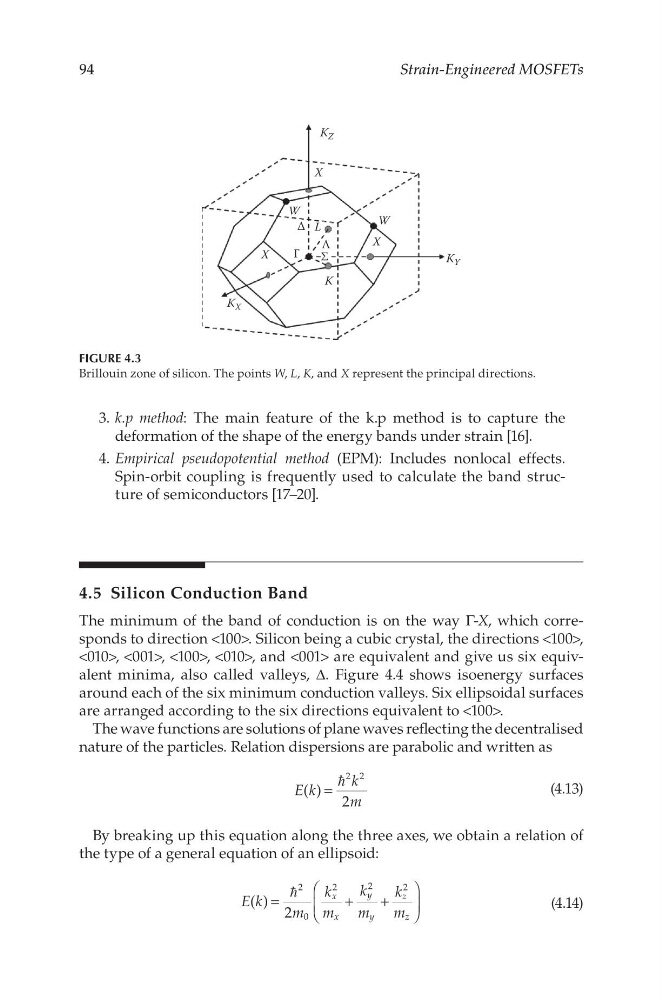
FIGURE 4.3
Brillouin zone of silicon. The points W, L, K, and X represent the principal directions.
Strain-Engineered MOSFETs
3. k.p method: The main feature of the k.p method is to capture the
deformation of the shape of the energy bands under strain [16].
4. Empirical pseudopotential method (EPM): Includes nonlocal effects.
Spin-orbit coupling is frequently used to calculate the band structure of semiconductors [17–20].
4.5 Silicon Conduction Band
The minimum of the band of conduction is on the way Γ-X, which corresponds to direction <100>. Silicon being a cubic crystal, the directions <100>,
<010>, <001>, <100>, <010>, and <001> are equivalent and give us six equivalent minima, also called valleys, Δ. Figure 4.4 shows isoenergy surfaces
around each of the six minimum conduction valleys. Six ellipsoidal surfaces
are arranged according to the six directions equivalent to <100>.
The wave functions are solutions of plane waves reflecting the decentralised
nature of the particles. Relation dispersions are parabolic and written as
( ) 2
2 2
E k
k
m
=
(4.13)
By breaking up this equation along the three axes, we obtain a relation of
the type of a general equation of an ellipsoid:
( ) 2
2
0
2
2
2
E k
m
k
m
k
m
k
m
x
x
y
y
z
z
=
+
+
(4.14)
K Z
K X
X
K
L
∆
W
K Y
X
X
W
Γ
Λ
Σ
FIGURE 4.3
Brillouin zone of silicon. The points W, L, K, and X represent the principal directions.