

Theor Chem Acc (2015) 134:117
1 3
adjacent minima in radial density (numerical values found
in Table S1). The outermost shell is the valence shell, while
any remaining inner shells are termed core shells. The number of electrons, N e , found within each shell can be determined by integrating the electron density in the spherical
regions between two adjacent radial minima, r 1 and r 2 , as
shown in Eq. 10 . It has been shown that a realistic number
of electrons is found within each shell [ 12 , 13 ]. For example, a neutral chlorine atom has approximately two, eight,
and seven electrons in the fi rst, second, and third shells,
respectively. The topology, shell structure, and electron distribution of atomic radial density motivated us to defi ne a
molecular equivalent for use in the ABIM model.
3.1.2 Molecular radial density
The central idea in ABIM is when atoms bond, it is primarily the valence electron density of the bonding atoms that
undergoes distortion and overlap to form a bond, while
the core electron density remains mostly unaffected [ 1 ].
Therefore, the core region of each molecular atom should
maintain the same shell structure and electron density as
(10)
N e = 4π
r 2
r 1
r
2
ρ(r)dr
its free-atom counterpart, whereas the distorted valence
shell can be investigated to defi ne bonding and nonbonding
regions. This makes it possible to determine the number of
electrons in each region.
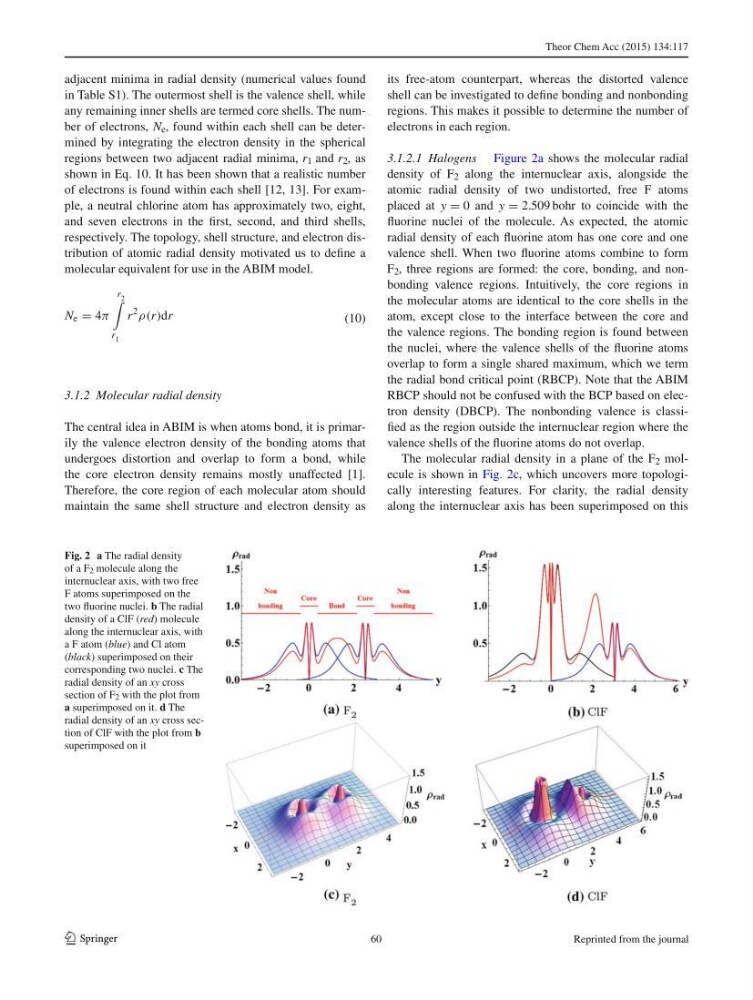
3.1.2.1 Halogens Figure 2 a shows the molecular radial
density of F 2 along the internuclear axis, alongside the
atomic radial density of two undistorted, free F atoms
placed at y = 0 and y = 2.509 bohr to coincide with the
fl uorine nuclei of the molecule. As expected, the atomic
radial density of each fl uorine atom has one core and one
valence shell. When two fl uorine atoms combine to form
F 2 , three regions are formed: the core, bonding, and nonbonding valence regions. Intuitively, the core regions in
the molecular atoms are identical to the core shells in the
atom, except close to the interface between the core and
the valence regions. The bonding region is found between
the nuclei, where the valence shells of the fl uorine atoms
overlap to form a single shared maximum, which we term
the radial bond critical point (RBCP). Note that the ABIM
RBCP should not be confused with the BCP based on electron density (DBCP). The nonbonding valence is classifi ed as the region outside the internuclear region where the
valence shells of the fl uorine atoms do not overlap.
The molecular radial density in a plane of the F 2 molecule is shown in Fig. 2 c, which uncovers more topologically interesting features. For clarity, the radial density
along the internuclear axis has been superimposed on this
Fig. 2 a The radial density
of a F 2 molecule along the
internuclear axis, with two free
F atoms superimposed on the
two fl uorine nuclei. b The radial
density of a ClF ( red ) molecule
along the internuclear axis, with
a F atom ( blue ) and Cl atom
( black ) superimposed on their
corresponding two nuclei. c The
radial density of an xy cross
section of F 2 with the plot from
a superimposed on it. d The
radial density of an xy cross section of ClF with the plot from b
superimposed on it
60
Reprinted from the journal
1 3
adjacent minima in radial density (numerical values found
in Table S1). The outermost shell is the valence shell, while
any remaining inner shells are termed core shells. The number of electrons, N e , found within each shell can be determined by integrating the electron density in the spherical
regions between two adjacent radial minima, r 1 and r 2 , as
shown in Eq. 10 . It has been shown that a realistic number
of electrons is found within each shell [ 12 , 13 ]. For example, a neutral chlorine atom has approximately two, eight,
and seven electrons in the fi rst, second, and third shells,
respectively. The topology, shell structure, and electron distribution of atomic radial density motivated us to defi ne a
molecular equivalent for use in the ABIM model.
3.1.2 Molecular radial density
The central idea in ABIM is when atoms bond, it is primarily the valence electron density of the bonding atoms that
undergoes distortion and overlap to form a bond, while
the core electron density remains mostly unaffected [ 1 ].
Therefore, the core region of each molecular atom should
maintain the same shell structure and electron density as
(10)
N e = 4π
r 2
r 1
r
2
ρ(r)dr
its free-atom counterpart, whereas the distorted valence
shell can be investigated to defi ne bonding and nonbonding
regions. This makes it possible to determine the number of
electrons in each region.
3.1.2.1 Halogens Figure 2 a shows the molecular radial
density of F 2 along the internuclear axis, alongside the
atomic radial density of two undistorted, free F atoms
placed at y = 0 and y = 2.509 bohr to coincide with the
fl uorine nuclei of the molecule. As expected, the atomic
radial density of each fl uorine atom has one core and one
valence shell. When two fl uorine atoms combine to form
F 2 , three regions are formed: the core, bonding, and nonbonding valence regions. Intuitively, the core regions in
the molecular atoms are identical to the core shells in the
atom, except close to the interface between the core and
the valence regions. The bonding region is found between
the nuclei, where the valence shells of the fl uorine atoms
overlap to form a single shared maximum, which we term
the radial bond critical point (RBCP). Note that the ABIM
RBCP should not be confused with the BCP based on electron density (DBCP). The nonbonding valence is classifi ed as the region outside the internuclear region where the
valence shells of the fl uorine atoms do not overlap.
The molecular radial density in a plane of the F 2 molecule is shown in Fig. 2 c, which uncovers more topologically interesting features. For clarity, the radial density
along the internuclear axis has been superimposed on this
Fig. 2 a The radial density
of a F 2 molecule along the
internuclear axis, with two free
F atoms superimposed on the
two fl uorine nuclei. b The radial
density of a ClF ( red ) molecule
along the internuclear axis, with
a F atom ( blue ) and Cl atom
( black ) superimposed on their
corresponding two nuclei. c The
radial density of an xy cross
section of F 2 with the plot from
a superimposed on it. d The
radial density of an xy cross section of ClF with the plot from b
superimposed on it
60
Reprinted from the journal