

Theor Chem Acc (2015) 134:134
1 3
After subtracting 0.5 E e (N 2 ) from both sides, we get
that is,
for every common bond length, that is, for the entire electronic potential energy curves.
We might note that the same result can also be obtained,
not through the above extrapolation, but considering the triple of FB, N 2 , and BF.
These two simple examples also can serve as illustrations of the reference cluster concept. For both CO and BF,
the reference cluster is in fact the molecule N 2 , since in
each of these systems the average nuclear charge is 7.
For many molecular families, the reference cluster, having identical nuclei with the average nuclear charge present
in the family, is a chemically viable system, which happens
to have integer nuclear charges, just as in the above example. For example, for all carbohydrates, such as those with
the formula [C(H 2 O)] 6 , the reference cluster is made up by
Be atoms: Be 24 , or in general, for carbohydrates [C(H 2 O)] m ,
the reference cluster is Be 4 m .
Similarly, for both methanol, CH 3 OH, and hydrazine,
H 2 NNH 2 , the reference cluster is Li 6 , again, a chemically
viable entity, with integer nuclear charges.
The advantage of such reference clusters is the fact that
their potential energy surfaces typically show the highest symmetry, as well as the most elaborate distribution
of 3D symmetries along the usually multidimensional
energy surface, an important advantage in the analysis of
such potential surfaces. This has consequences also for the
lower symmetry cases represented by the molecules which
generate the actual reference cluster, for example, methanol, CH 3 OH, and hydrazine, H 2 NNH 2 , in the Li 6 , reference
cluster case (a problem discussed from a different perspective in Ref. [ 22 ]).
We call these integer-charge cases the “realizable reference clusters.”
However, it is far more common to obtain a reference
cluster with non-integer formal nuclear charge, that is, a
“non-realizable reference cluster,” but even in such cases,
the principle of continuous nuclear charge variations
can lead to new results, for actual, existing molecular
systems.
As an example, consider some four-atom clusters composed from some of the metal atoms from the sequence
where the atomic numbers are given in the parentheses.
One such example:
E e (N 2 ) ≥ 0.5E e (N 2 ) + 0.5E e (BF).
0.5E e (N 2 ) ≥ 0.5E e (BF),
E e (N 2 ) ≥ E e (BF),
Re(75), Os(76), Ir(77), Pt(78), Au(79),
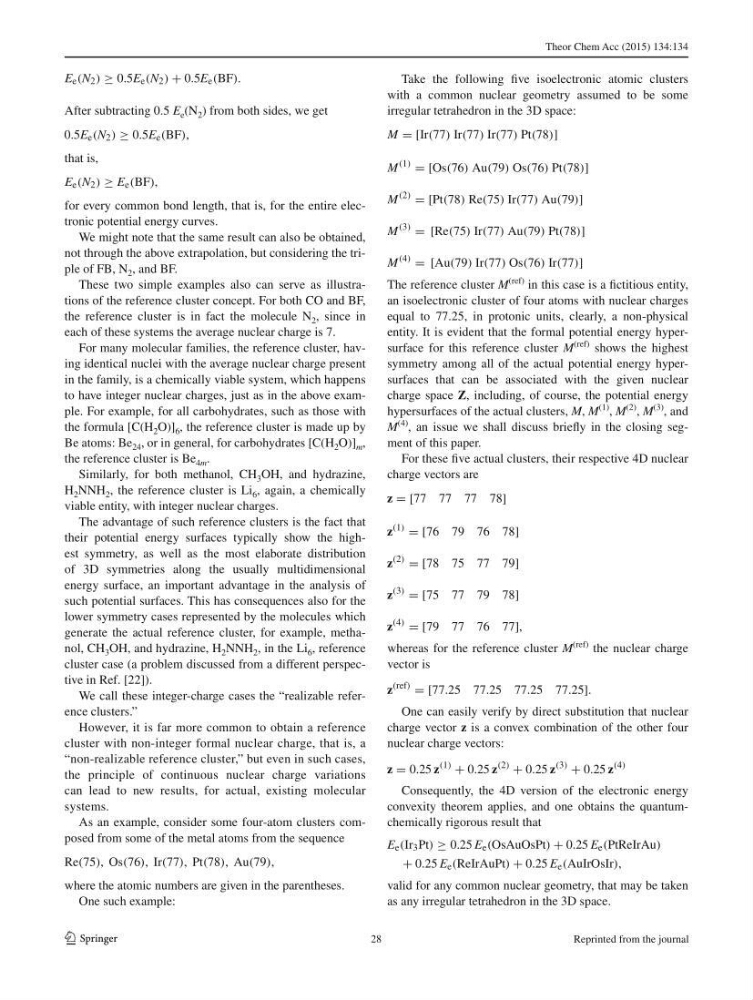
Take the following fi ve isoelectronic atomic clusters
with a common nuclear geometry assumed to be some
irregular tetrahedron in the 3D space:
The reference cluster M
(ref) in this case is a fi ctitious entity,
an isoelectronic cluster of four atoms with nuclear charges
equal to 77.25, in protonic units, clearly, a non-physical
entity. It is evident that the formal potential energy hypersurface for this reference cluster M
(ref) shows the highest
symmetry among all of the actual potential energy hypersurfaces that can be associated with the given nuclear
charge space Z , including, of course, the potential energy
hypersurfaces of the actual clusters, M , M
(1)
, M
(2) , M
(3)
, and
M
(4) , an issue we shall discuss briefl y in the closing segment of this paper.
For these fi ve actual clusters, their respective 4D nuclear
charge vectors are
whereas for the reference cluster M
(ref) the nuclear charge
vector is
One can easily verify by direct substitution that nuclear
charge vector z is a convex combination of the other four
nuclear charge vectors:
Consequently, the 4D version of the electronic energy
convexity theorem applies, and one obtains the quantumchemically rigorous result that
valid for any common nuclear geometry, that may be taken
as any irregular tetrahedron in the 3D space.
M = [Ir(77) Ir(77) Ir(77) Pt(78)]
M
(1)
= [Os(76) Au(79) Os(76) Pt(78)]
M
(2)
= [Pt(78) Re(75) Ir(77) Au(79)]
M
(3)
= [Re(75) Ir(77) Au(79) Pt(78)]
M
(4)
= [Au(79) Ir(77) Os(76) Ir(77)]
z = [77 77 77 78]
z
(1)
= [76 79 76 78]
z
(2)
= [78 75 77 79]
z
(3)
= [75 77 79 78]
z
(4)
= [79 77 76 77],
z
(ref)
= [77.25 77.25 77.25 77.25].
z = 0.25 z
(1)
+ 0.25 z
(2)
+ 0.25 z
(3)
+ 0.25 z
(4)
E e (Ir 3 Pt) ≥ 0.25 E e (OsAuOsPt) + 0.25 E e (PtReIrAu)
+ 0.25 E e (ReIrAuPt) + 0.25 E e (AuIrOsIr),
28
Reprinted from the journal
1 3
After subtracting 0.5 E e (N 2 ) from both sides, we get
that is,
for every common bond length, that is, for the entire electronic potential energy curves.
We might note that the same result can also be obtained,
not through the above extrapolation, but considering the triple of FB, N 2 , and BF.
These two simple examples also can serve as illustrations of the reference cluster concept. For both CO and BF,
the reference cluster is in fact the molecule N 2 , since in
each of these systems the average nuclear charge is 7.
For many molecular families, the reference cluster, having identical nuclei with the average nuclear charge present
in the family, is a chemically viable system, which happens
to have integer nuclear charges, just as in the above example. For example, for all carbohydrates, such as those with
the formula [C(H 2 O)] 6 , the reference cluster is made up by
Be atoms: Be 24 , or in general, for carbohydrates [C(H 2 O)] m ,
the reference cluster is Be 4 m .
Similarly, for both methanol, CH 3 OH, and hydrazine,
H 2 NNH 2 , the reference cluster is Li 6 , again, a chemically
viable entity, with integer nuclear charges.
The advantage of such reference clusters is the fact that
their potential energy surfaces typically show the highest symmetry, as well as the most elaborate distribution
of 3D symmetries along the usually multidimensional
energy surface, an important advantage in the analysis of
such potential surfaces. This has consequences also for the
lower symmetry cases represented by the molecules which
generate the actual reference cluster, for example, methanol, CH 3 OH, and hydrazine, H 2 NNH 2 , in the Li 6 , reference
cluster case (a problem discussed from a different perspective in Ref. [ 22 ]).
We call these integer-charge cases the “realizable reference clusters.”
However, it is far more common to obtain a reference
cluster with non-integer formal nuclear charge, that is, a
“non-realizable reference cluster,” but even in such cases,
the principle of continuous nuclear charge variations
can lead to new results, for actual, existing molecular
systems.
As an example, consider some four-atom clusters composed from some of the metal atoms from the sequence
where the atomic numbers are given in the parentheses.
One such example:
E e (N 2 ) ≥ 0.5E e (N 2 ) + 0.5E e (BF).
0.5E e (N 2 ) ≥ 0.5E e (BF),
E e (N 2 ) ≥ E e (BF),
Re(75), Os(76), Ir(77), Pt(78), Au(79),
Take the following fi ve isoelectronic atomic clusters
with a common nuclear geometry assumed to be some
irregular tetrahedron in the 3D space:
The reference cluster M
(ref) in this case is a fi ctitious entity,
an isoelectronic cluster of four atoms with nuclear charges
equal to 77.25, in protonic units, clearly, a non-physical
entity. It is evident that the formal potential energy hypersurface for this reference cluster M
(ref) shows the highest
symmetry among all of the actual potential energy hypersurfaces that can be associated with the given nuclear
charge space Z , including, of course, the potential energy
hypersurfaces of the actual clusters, M , M
(1)
, M
(2) , M
(3)
, and
M
(4) , an issue we shall discuss briefl y in the closing segment of this paper.
For these fi ve actual clusters, their respective 4D nuclear
charge vectors are
whereas for the reference cluster M
(ref) the nuclear charge
vector is
One can easily verify by direct substitution that nuclear
charge vector z is a convex combination of the other four
nuclear charge vectors:
Consequently, the 4D version of the electronic energy
convexity theorem applies, and one obtains the quantumchemically rigorous result that
valid for any common nuclear geometry, that may be taken
as any irregular tetrahedron in the 3D space.
M = [Ir(77) Ir(77) Ir(77) Pt(78)]
M
(1)
= [Os(76) Au(79) Os(76) Pt(78)]
M
(2)
= [Pt(78) Re(75) Ir(77) Au(79)]
M
(3)
= [Re(75) Ir(77) Au(79) Pt(78)]
M
(4)
= [Au(79) Ir(77) Os(76) Ir(77)]
z = [77 77 77 78]
z
(1)
= [76 79 76 78]
z
(2)
= [78 75 77 79]
z
(3)
= [75 77 79 78]
z
(4)
= [79 77 76 77],
z
(ref)
= [77.25 77.25 77.25 77.25].
z = 0.25 z
(1)
+ 0.25 z
(2)
+ 0.25 z
(3)
+ 0.25 z
(4)
E e (Ir 3 Pt) ≥ 0.25 E e (OsAuOsPt) + 0.25 E e (PtReIrAu)
+ 0.25 E e (ReIrAuPt) + 0.25 E e (AuIrOsIr),
28
Reprinted from the journal