

Theor Chem Acc (2015) 134:102
1 3
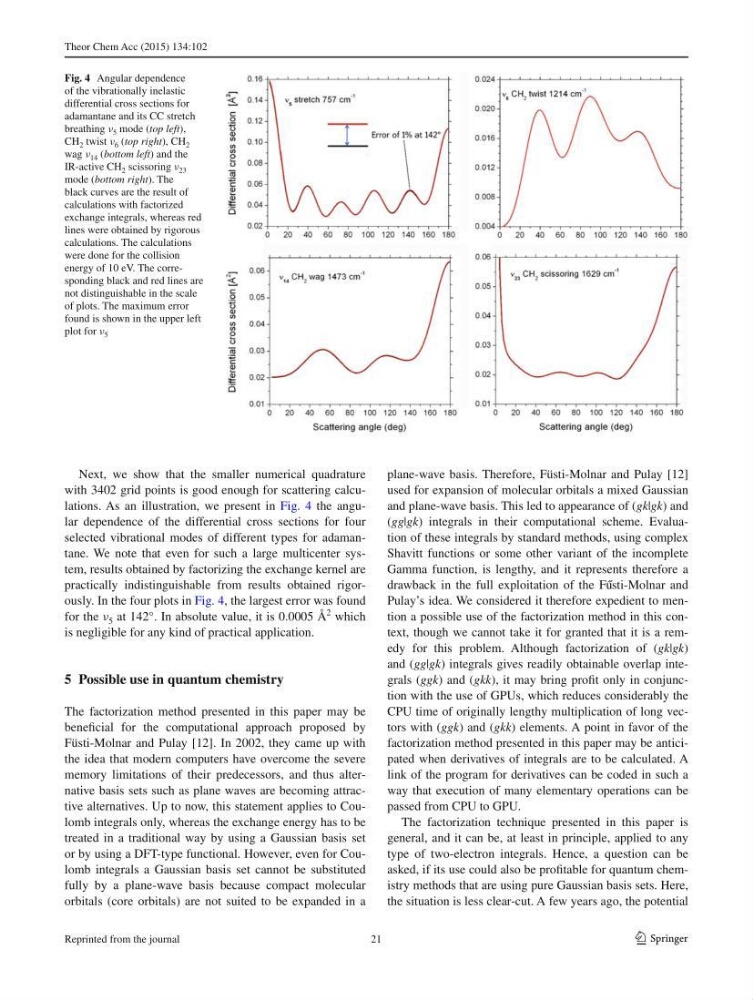
Next, we show that the smaller numerical quadrature
with 3402 grid points is good enough for scattering calculations. As an illustration, we present in Fig. 4 the angular dependence of the differential cross sections for four
selected vibrational modes of different types for adamantane. We note that even for such a large multicenter system, results obtained by factorizing the exchange kernel are
practically indistinguishable from results obtained rigorously. In the four plots in Fig. 4 , the largest error was found
for the ν 5 at 142°. In absolute value, it is 0.0005 Å
2 which
is negligible for any kind of practical application.
5 Possible use in quantum chemistry
The factorization method presented in this paper may be
benefi cial for the computational approach proposed by
Füsti-Molnar and Pulay [ 12 ]. In 2002, they came up with
the idea that modern computers have overcome the severe
memory limitations of their predecessors, and thus alternative basis sets such as plane waves are becoming attractive alternatives. Up to now, this statement applies to Coulomb integrals only, whereas the exchange energy has to be
treated in a traditional way by using a Gaussian basis set
or by using a DFT-type functional. However, even for Coulomb integrals a Gaussian basis set cannot be substituted
fully by a plane-wave basis because compact molecular
orbitals (core orbitals) are not suited to be expanded in a
plane-wave basis. Therefore, Füsti-Molnar and Pulay [ 12 ]
used for expansion of molecular orbitals a mixed Gaussian
and plane-wave basis. This led to appearance of ( gk | gk ) and
( gg | gk ) integrals in their computational scheme. Evaluation of these integrals by standard methods, using complex
Shavitt functions or some other variant of the incomplete
Gamma function, is lengthy, and it represents therefore a
drawback in the full exploitation of the F u ˝ sti-Molnar and
Pulay’s idea. We considered it therefore expedient to mention a possible use of the factorization method in this context, though we cannot take it for granted that it is a remedy for this problem. Although factorization of ( gk | gk )
and ( gg | gk ) integrals gives readily obtainable overlap integrals ( ggk ) and ( gkk ), it may bring profi t only in conjunction with the use of GPUs, which reduces considerably the
CPU time of originally lengthy multiplication of long vectors with ( ggk ) and ( gkk ) elements. A point in favor of the
factorization method presented in this paper may be anticipated when derivatives of integrals are to be calculated. A
link of the program for derivatives can be coded in such a
way that execution of many elementary operations can be
passed from CPU to GPU.
The factorization technique presented in this paper is
general, and it can be, at least in principle, applied to any
type of two-electron integrals. Hence, a question can be
asked, if its use could also be profi table for quantum chemistry methods that are using pure Gaussian basis sets. Here,
the situation is less clear-cut. A few years ago, the potential
Fig. 4 Angular dependence
of the vibrationally inelastic
differential cross sections for
adamantane and its CC stretch
breathing ν 5 mode ( top left ),
CH 2 twist ν 6 ( top right ), CH 2
wag ν 14 ( bottom left ) and the
IR-active CH 2 scissoring ν 23
mode ( bottom right ). The
black curves are the result of
calculations with factorized
exchange integrals, whereas red
lines were obtained by rigorous
calculations. The calculations
were done for the collision
energy of 10 eV. The corresponding black and red lines are
not distinguishable in the scale
of plots. The maximum error
found is shown in the upper left
plot for ν 5
21
Reprinted from the journal
1 3
Next, we show that the smaller numerical quadrature
with 3402 grid points is good enough for scattering calculations. As an illustration, we present in Fig. 4 the angular dependence of the differential cross sections for four
selected vibrational modes of different types for adamantane. We note that even for such a large multicenter system, results obtained by factorizing the exchange kernel are
practically indistinguishable from results obtained rigorously. In the four plots in Fig. 4 , the largest error was found
for the ν 5 at 142°. In absolute value, it is 0.0005 Å
2 which
is negligible for any kind of practical application.
5 Possible use in quantum chemistry
The factorization method presented in this paper may be
benefi cial for the computational approach proposed by
Füsti-Molnar and Pulay [ 12 ]. In 2002, they came up with
the idea that modern computers have overcome the severe
memory limitations of their predecessors, and thus alternative basis sets such as plane waves are becoming attractive alternatives. Up to now, this statement applies to Coulomb integrals only, whereas the exchange energy has to be
treated in a traditional way by using a Gaussian basis set
or by using a DFT-type functional. However, even for Coulomb integrals a Gaussian basis set cannot be substituted
fully by a plane-wave basis because compact molecular
orbitals (core orbitals) are not suited to be expanded in a
plane-wave basis. Therefore, Füsti-Molnar and Pulay [ 12 ]
used for expansion of molecular orbitals a mixed Gaussian
and plane-wave basis. This led to appearance of ( gk | gk ) and
( gg | gk ) integrals in their computational scheme. Evaluation of these integrals by standard methods, using complex
Shavitt functions or some other variant of the incomplete
Gamma function, is lengthy, and it represents therefore a
drawback in the full exploitation of the F u ˝ sti-Molnar and
Pulay’s idea. We considered it therefore expedient to mention a possible use of the factorization method in this context, though we cannot take it for granted that it is a remedy for this problem. Although factorization of ( gk | gk )
and ( gg | gk ) integrals gives readily obtainable overlap integrals ( ggk ) and ( gkk ), it may bring profi t only in conjunction with the use of GPUs, which reduces considerably the
CPU time of originally lengthy multiplication of long vectors with ( ggk ) and ( gkk ) elements. A point in favor of the
factorization method presented in this paper may be anticipated when derivatives of integrals are to be calculated. A
link of the program for derivatives can be coded in such a
way that execution of many elementary operations can be
passed from CPU to GPU.
The factorization technique presented in this paper is
general, and it can be, at least in principle, applied to any
type of two-electron integrals. Hence, a question can be
asked, if its use could also be profi table for quantum chemistry methods that are using pure Gaussian basis sets. Here,
the situation is less clear-cut. A few years ago, the potential
Fig. 4 Angular dependence
of the vibrationally inelastic
differential cross sections for
adamantane and its CC stretch
breathing ν 5 mode ( top left ),
CH 2 twist ν 6 ( top right ), CH 2
wag ν 14 ( bottom left ) and the
IR-active CH 2 scissoring ν 23
mode ( bottom right ). The
black curves are the result of
calculations with factorized
exchange integrals, whereas red
lines were obtained by rigorous
calculations. The calculations
were done for the collision
energy of 10 eV. The corresponding black and red lines are
not distinguishable in the scale
of plots. The maximum error
found is shown in the upper left
plot for ν 5
21
Reprinted from the journal