

Theor Chem Acc (2015) 134:143
1 3
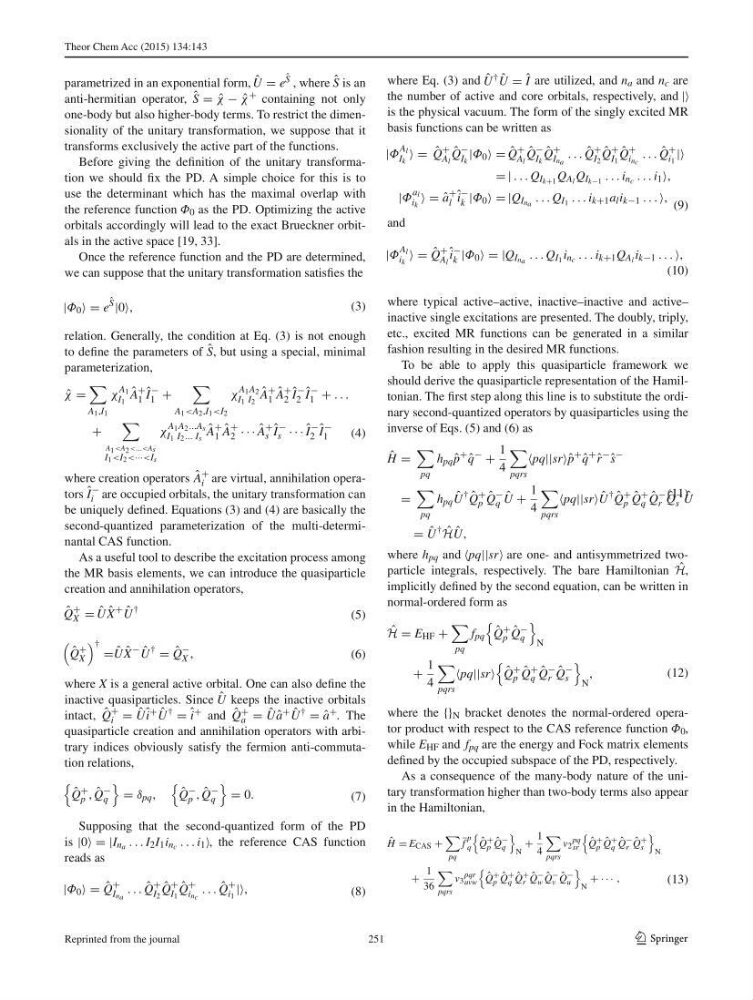
parametrized in an exponential form, ˆ
U = e
ˆ
S , where ˆ
S is an
anti-hermitian operator, ˆ
S = ˆ
χ − ˆ
χ + containing not only
one-body but also higher-body terms. To restrict the dimensionality of the unitary transformation, we suppose that it
transforms exclusively the active part of the functions.
Before giving the defi nition of the unitary transformation we should fi x the PD. A simple choice for this is to
use the determinant which has the maximal overlap with
the reference function Φ 0 as the PD. Optimizing the active
orbitals accordingly will lead to the exact Brueckner orbitals in the active space [ 19 , 33 ].
Once the reference function and the PD are determined,
we can suppose that the unitary transformation satisfi es the
relation. Generally, the condition at Eq. ( 3 ) is not enough
to defi ne the parameters of ˆ
S , but using a special, minimal
parameterization,
where creation operators ˆ
A
+
i are virtual, annihilation operators ˆ
I
−
i are occupied orbitals, the unitary transformation can
be uniquely defi ned. Equations ( 3 ) and ( 4 ) are basically the
second-quantized parameterization of the multi-determinantal CAS function.
As a useful tool to describe the excitation process among
the MR basis elements, we can introduce the quasiparticle
creation and annihilation operators,
where X is a general active orbital. One can also defi ne the
inactive quasiparticles. Since ˆ
U keeps the inactive orbitals
intact, ˆ
Q
+
i = ˆ
U ˆ i + ˆ
U † = ˆ i + and ˆ
Q +
a = ˆ
U ˆ
a + ˆ
U † = ˆ
a + . The
quasiparticle creation and annihilation operators with arbitrary indices obviously satisfy the fermion anti-commutation relations,
Supposing that the second-quantized form of the PD
is |0 = |I n a . . . I 2 I 1 i n c . . . i 1 , the reference CAS function
reads as
(3)
|Φ 0 = e
ˆ
S
|0,
(4)
ˆ
χ =
A 1 ,I 1
χ
A 1
I 1
ˆ
A
+
1
ˆ
I
−
1 +
A 1 χ
A 1 A 2
I 1 I 2
ˆ
A
+
1
ˆ
A
+
2
ˆ
I
−
2
ˆ
I
−
1 + . . .
+
A 1 I 1 χ
A 1 A 2 ...A s
I 1 I 2 ... I s
ˆ
A
+
1
ˆ
A
+
2 · · · ˆ
A
+
s
ˆ
I
−
s · · · ˆ
I
−
2
ˆ
I
−
1
(5)
ˆ
Q
+
X = ˆ
U ˆ
X
+ ˆ
U
†
(6)
ˆ
Q
+
X
† = ˆ
U ˆ
X
− ˆ
U
†
= ˆ
Q
−
X ,
(7)
ˆ
Q
+
p , ˆ
Q
−
q
= δ pq ,
ˆ
Q
−
p , ˆ
Q
−
q
= 0.
(8)
|Φ 0 = ˆ
Q
+
I na
. . . ˆ
Q
+
I 2
ˆ
Q
+
I 1
ˆ
Q
+
i nc
. . . ˆ
Q
+
i 1
||,
where Eq. ( 3 ) and ˆ
U † ˆ
U = ˆ
I are utilized, and n a and n c are
the number of active and core orbitals, respectively, and ||
is the physical vacuum. The form of the singly excited MR
basis functions can be written as
and
where typical active–active, inactive–inactive and active–
inactive single excitations are presented. The doubly, triply,
etc., excited MR functions can be generated in a similar
fashion resulting in the desired MR functions.
To be able to apply this quasiparticle framework we
should derive the quasiparticle representation of the Hamiltonian. The fi rst step along this line is to substitute the ordinary second-quantized operators by quasiparticles using the
inverse of Eqs. ( 5 ) and ( 6 ) as
where h pq and pq||sr are one- and antisymmetrized twoparticle integrals, respectively. The bare Hamiltonian ˆ
H ,
implicitly defi ned by the second equation, can be written in
normal-ordered form as
where the {} N bracket denotes the normal-ordered operator product with respect to the CAS reference function Φ 0 ,
while E HF and f pq are the energy and Fock matrix elements
defi ned by the occupied subspace of the PD, respectively.
As a consequence of the many-body nature of the unitary transformation higher than two-body terms also appear
in the Hamiltonian,
(9)
|Φ
A l
I k
= ˆ
Q
+
A l
ˆ
Q
−
I k
|Φ 0 = ˆ
Q
+
A l
ˆ
Q
−
I k
ˆ
Q
+
I na
. . . ˆ
Q
+
I 2
ˆ
Q
+
I 1
ˆ
Q
+
i nc
. . . ˆ
Q
+
i 1
||
= | . . . Q I k+1 Q A l Q I k−1 . . . i n c . . . i 1 ,
|Φ
a l
i k
= ˆ
a
+
l
ˆ i
−
k |Φ 0 = |Q I na . . . Q I 1 . . . i k+1 a l i k−1 . . . ,
(10)
|Φ
A l
i k
= ˆ
Q
+
A l
ˆ i
−
k |Φ 0 = |Q I na . . . Q I 1 i n c . . . i k+1 Q A l i k−1 . . . ,
(11)
ˆ
H =
pq
h pq ˆ
p
+
ˆ
q
−
+
1
4
pqrs
pq||srˆ p
+
ˆ
q
+
ˆ
r
−
ˆ
s
−
=
pq
h pq ˆ
U
† ˆ
Q
+
p
ˆ
Q
−
q
ˆ
U +
1
4
pqrs
pq||sr ˆ
U
† ˆ
Q
+
p
ˆ
Q
+
q
ˆ
Q
−
r
ˆ
Q
−
s
ˆ
U
= ˆ
U
† ˆ
H ˆ
U,
(12)
ˆ
H = E HF +
pq
f pq
ˆ
Q
+
p
ˆ
Q
−
q
N
+
1
4
횾
pqrs
pq||sr
ˆ
Q
+
p
ˆ
Q
+
q
ˆ
Q
−
r
ˆ
Q
−
s
N
,
(13)
ˆ
H = E CAS +
pq
f
p
q
ˆ
Q
+
p
ˆ
Q
−
q
N
+
1
4
pqrs
v 2
pq
sr
ˆ
Q
+
p
ˆ
Q
+
q
ˆ
Q
−
r
ˆ
Q
+
s
N
+
1
36
pqrs
v 3
pqr
uvw
ˆ
Q
+
p
ˆ
Q
+
q
ˆ
Q
+
r
ˆ
Q
−
w
ˆ
Q
−
v
ˆ
Q
−
u
N
+ · · · ,
251
Reprinted from the journal
1 3
parametrized in an exponential form, ˆ
U = e
ˆ
S , where ˆ
S is an
anti-hermitian operator, ˆ
S = ˆ
χ − ˆ
χ + containing not only
one-body but also higher-body terms. To restrict the dimensionality of the unitary transformation, we suppose that it
transforms exclusively the active part of the functions.
Before giving the defi nition of the unitary transformation we should fi x the PD. A simple choice for this is to
use the determinant which has the maximal overlap with
the reference function Φ 0 as the PD. Optimizing the active
orbitals accordingly will lead to the exact Brueckner orbitals in the active space [ 19 , 33 ].
Once the reference function and the PD are determined,
we can suppose that the unitary transformation satisfi es the
relation. Generally, the condition at Eq. ( 3 ) is not enough
to defi ne the parameters of ˆ
S , but using a special, minimal
parameterization,
where creation operators ˆ
A
+
i are virtual, annihilation operators ˆ
I
−
i are occupied orbitals, the unitary transformation can
be uniquely defi ned. Equations ( 3 ) and ( 4 ) are basically the
second-quantized parameterization of the multi-determinantal CAS function.
As a useful tool to describe the excitation process among
the MR basis elements, we can introduce the quasiparticle
creation and annihilation operators,
where X is a general active orbital. One can also defi ne the
inactive quasiparticles. Since ˆ
U keeps the inactive orbitals
intact, ˆ
Q
+
i = ˆ
U ˆ i + ˆ
U † = ˆ i + and ˆ
Q +
a = ˆ
U ˆ
a + ˆ
U † = ˆ
a + . The
quasiparticle creation and annihilation operators with arbitrary indices obviously satisfy the fermion anti-commutation relations,
Supposing that the second-quantized form of the PD
is |0 = |I n a . . . I 2 I 1 i n c . . . i 1 , the reference CAS function
reads as
(3)
|Φ 0 = e
ˆ
S
|0,
(4)
ˆ
χ =
A 1 ,I 1
χ
A 1
I 1
ˆ
A
+
1
ˆ
I
−
1 +
A 1 χ
A 1 A 2
I 1 I 2
ˆ
A
+
1
ˆ
A
+
2
ˆ
I
−
2
ˆ
I
−
1 + . . .
+
A 1 I 1 χ
A 1 A 2 ...A s
I 1 I 2 ... I s
ˆ
A
+
1
ˆ
A
+
2 · · · ˆ
A
+
s
ˆ
I
−
s · · · ˆ
I
−
2
ˆ
I
−
1
(5)
ˆ
Q
+
X = ˆ
U ˆ
X
+ ˆ
U
†
(6)
ˆ
Q
+
X
† = ˆ
U ˆ
X
− ˆ
U
†
= ˆ
Q
−
X ,
(7)
ˆ
Q
+
p , ˆ
Q
−
q
= δ pq ,
ˆ
Q
−
p , ˆ
Q
−
q
= 0.
(8)
|Φ 0 = ˆ
Q
+
I na
. . . ˆ
Q
+
I 2
ˆ
Q
+
I 1
ˆ
Q
+
i nc
. . . ˆ
Q
+
i 1
||,
where Eq. ( 3 ) and ˆ
U † ˆ
U = ˆ
I are utilized, and n a and n c are
the number of active and core orbitals, respectively, and ||
is the physical vacuum. The form of the singly excited MR
basis functions can be written as
and
where typical active–active, inactive–inactive and active–
inactive single excitations are presented. The doubly, triply,
etc., excited MR functions can be generated in a similar
fashion resulting in the desired MR functions.
To be able to apply this quasiparticle framework we
should derive the quasiparticle representation of the Hamiltonian. The fi rst step along this line is to substitute the ordinary second-quantized operators by quasiparticles using the
inverse of Eqs. ( 5 ) and ( 6 ) as
where h pq and pq||sr are one- and antisymmetrized twoparticle integrals, respectively. The bare Hamiltonian ˆ
H ,
implicitly defi ned by the second equation, can be written in
normal-ordered form as
where the {} N bracket denotes the normal-ordered operator product with respect to the CAS reference function Φ 0 ,
while E HF and f pq are the energy and Fock matrix elements
defi ned by the occupied subspace of the PD, respectively.
As a consequence of the many-body nature of the unitary transformation higher than two-body terms also appear
in the Hamiltonian,
(9)
|Φ
A l
I k
= ˆ
Q
+
A l
ˆ
Q
−
I k
|Φ 0 = ˆ
Q
+
A l
ˆ
Q
−
I k
ˆ
Q
+
I na
. . . ˆ
Q
+
I 2
ˆ
Q
+
I 1
ˆ
Q
+
i nc
. . . ˆ
Q
+
i 1
||
= | . . . Q I k+1 Q A l Q I k−1 . . . i n c . . . i 1 ,
|Φ
a l
i k
= ˆ
a
+
l
ˆ i
−
k |Φ 0 = |Q I na . . . Q I 1 . . . i k+1 a l i k−1 . . . ,
(10)
|Φ
A l
i k
= ˆ
Q
+
A l
ˆ i
−
k |Φ 0 = |Q I na . . . Q I 1 i n c . . . i k+1 Q A l i k−1 . . . ,
(11)
ˆ
H =
pq
h pq ˆ
p
+
ˆ
q
−
+
1
4
pqrs
pq||srˆ p
+
ˆ
q
+
ˆ
r
−
ˆ
s
−
=
pq
h pq ˆ
U
† ˆ
Q
+
p
ˆ
Q
−
q
ˆ
U +
1
4
pqrs
pq||sr ˆ
U
† ˆ
Q
+
p
ˆ
Q
+
q
ˆ
Q
−
r
ˆ
Q
−
s
ˆ
U
= ˆ
U
† ˆ
H ˆ
U,
(12)
ˆ
H = E HF +
pq
f pq
ˆ
Q
+
p
ˆ
Q
−
q
N
+
1
4
횾
pqrs
pq||sr
ˆ
Q
+
p
ˆ
Q
+
q
ˆ
Q
−
r
ˆ
Q
−
s
N
,
(13)
ˆ
H = E CAS +
pq
f
p
q
ˆ
Q
+
p
ˆ
Q
−
q
N
+
1
4
pqrs
v 2
pq
sr
ˆ
Q
+
p
ˆ
Q
+
q
ˆ
Q
−
r
ˆ
Q
+
s
N
+
1
36
pqrs
v 3
pqr
uvw
ˆ
Q
+
p
ˆ
Q
+
q
ˆ
Q
+
r
ˆ
Q
−
w
ˆ
Q
−
v
ˆ
Q
−
u
N
+ · · · ,
251
Reprinted from the journal