

Theor Chem Acc (2015) 134:102
1 3
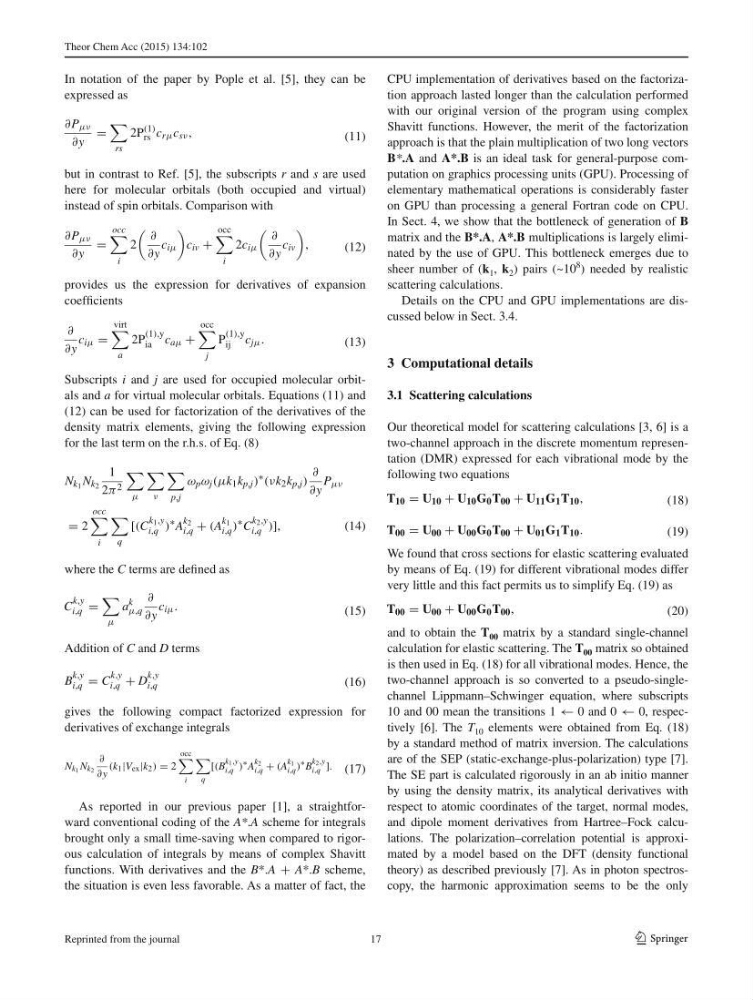
In notation of the paper by Pople et al. [ 5 ], they can be
expressed as
but in contrast to Ref. [ 5 ], the subscripts r and s are used
here for molecular orbitals (both occupied and virtual)
instead of spin orbitals. Comparison with
provides us the expression for derivatives of expansion
coeffi cients
Subscripts i and j are used for occupied molecular orbitals and a for virtual molecular orbitals. Equations ( 11 ) and
( 12 ) can be used for factorization of the derivatives of the
density matrix elements, giving the following expression
for the last term on the r.h.s. of Eq. ( 8 )
where the C terms are defi ned as
Addition of C and D terms
gives the following compact factorized expression for
derivatives of exchange integrals
As reported in our previous paper [ 1 ], a straightforward conventional coding of the A* . A scheme for integrals
brought only a small time-saving when compared to rigorous calculation of integrals by means of complex Shavitt
functions. With derivatives and the B *. A + A *. B scheme,
the situation is even less favorable. As a matter of fact, the
(11)
∂P μν
∂y
=
rs
2P
(1)
rs c rμ c sν ,
(12)
∂P μν
∂y
=
occ
i
2
∂
∂y
c iμ
c iv +
occ
i
2c iμ
∂
∂y
c iv
,
(13)
∂
∂y
c iμ =
virt
a
2P
(1),y
ia c aμ +
occ
j
P
(1),y
ij
c jμ .
(14)
N k 1 N k 2
1
2π 2
μ
ν
p,j
ω p ω j (μk 1 k p,j )
∗
(νk 2 k p,j )
∂
∂y
P μν
= 2
occ
i
q
[(C
k 1 ,y
i,q )
∗ A
k 2
i,q + (A
k 1
i,q )
∗ C
k 2 ,y
i,q )],
(15)
C
k,y
i,q =
μ
a
k
μ,q
∂
∂y
c iμ .
(16)
B
k,y
i,q = C
k,y
i,q + D
k,y
i,q
(17)
N k 1 N k 2
∂
∂y
(k 1 |V ex |k 2 ) = 2
occ
i
q
[(B
k 1 ,y
i,q )
∗ A
k 2
i,q + (A
k 1
i,q )
∗ B
k 2 ,y
i,q ].
CPU implementation of derivatives based on the factorization approach lasted longer than the calculation performed
with our original version of the program using complex
Shavitt functions. However, the merit of the factorization
approach is that the plain multiplication of two long vectors
B * .A and A*.B is an ideal task for general-purpose computation on graphics processing units (GPU). Processing of
elementary mathematical operations is considerably faster
on GPU than processing a general Fortran code on CPU.
In Sect. 4 , we show that the bottleneck of generation of B
matrix and the B*.A , A*.B multiplications is largely eliminated by the use of GPU. This bottleneck emerges due to
sheer number of ( k 1 , k 2 ) pairs (~10
8 ) needed by realistic
scattering calculations.
Details on the CPU and GPU implementations are discussed below in Sect. 3.4 .
3 Computational details
3.1 Scattering calculations
Our theoretical model for scattering calculations [ 3 , 6 ] is a
two-channel approach in the discrete momentum representation (DMR) expressed for each vibrational mode by the
following two equations
We found that cross sections for elastic scattering evaluated
by means of Eq. ( 19 ) for different vibrational modes differ
very little and this fact permits us to simplify Eq. ( 19 ) as
and to obtain the T 00 matrix by a standard single-channel
calculation for elastic scattering. The T 00 matrix so obtained
is then used in Eq. ( 18 ) for all vibrational modes. Hence, the
two-channel approach is so converted to a pseudo-singlechannel Lippmann–Schwinger equation, where subscripts
10 and 00 mean the transitions 1 ← 0 and 0 ← 0, respectively [ 6 ]. The T 10 elements were obtained from Eq. ( 18 )
by a standard method of matrix inversion. The calculations
are of the SEP (static-exchange-plus-polarization) type [ 7 ].
The SE part is calculated rigorously in an ab initio manner
by using the density matrix, its analytical derivatives with
respect to atomic coordinates of the target, normal modes,
and dipole moment derivatives from Hartree–Fock calculations. The polarization–correlation potential is approximated by a model based on the DFT (density functional
theory) as described previously [ 7 ]. As in photon spectroscopy, the harmonic approximation seems to be the only
(18)
T 10 = U 10 + U 10 G 0 T 00 + U 11 G 1 T 10 ,
(19)
T 00 = U 00 + U 00 G 0 T 00 + U 01 G 1 T 10 .
(20)
T 00 = U 00 + U 00 G 0 T 00 ,
17
Reprinted from the journal
1 3
In notation of the paper by Pople et al. [ 5 ], they can be
expressed as
but in contrast to Ref. [ 5 ], the subscripts r and s are used
here for molecular orbitals (both occupied and virtual)
instead of spin orbitals. Comparison with
provides us the expression for derivatives of expansion
coeffi cients
Subscripts i and j are used for occupied molecular orbitals and a for virtual molecular orbitals. Equations ( 11 ) and
( 12 ) can be used for factorization of the derivatives of the
density matrix elements, giving the following expression
for the last term on the r.h.s. of Eq. ( 8 )
where the C terms are defi ned as
Addition of C and D terms
gives the following compact factorized expression for
derivatives of exchange integrals
As reported in our previous paper [ 1 ], a straightforward conventional coding of the A* . A scheme for integrals
brought only a small time-saving when compared to rigorous calculation of integrals by means of complex Shavitt
functions. With derivatives and the B *. A + A *. B scheme,
the situation is even less favorable. As a matter of fact, the
(11)
∂P μν
∂y
=
rs
2P
(1)
rs c rμ c sν ,
(12)
∂P μν
∂y
=
occ
i
2
∂
∂y
c iμ
c iv +
occ
i
2c iμ
∂
∂y
c iv
,
(13)
∂
∂y
c iμ =
virt
a
2P
(1),y
ia c aμ +
occ
j
P
(1),y
ij
c jμ .
(14)
N k 1 N k 2
1
2π 2
μ
ν
p,j
ω p ω j (μk 1 k p,j )
∗
(νk 2 k p,j )
∂
∂y
P μν
= 2
occ
i
q
[(C
k 1 ,y
i,q )
∗ A
k 2
i,q + (A
k 1
i,q )
∗ C
k 2 ,y
i,q )],
(15)
C
k,y
i,q =
μ
a
k
μ,q
∂
∂y
c iμ .
(16)
B
k,y
i,q = C
k,y
i,q + D
k,y
i,q
(17)
N k 1 N k 2
∂
∂y
(k 1 |V ex |k 2 ) = 2
occ
i
q
[(B
k 1 ,y
i,q )
∗ A
k 2
i,q + (A
k 1
i,q )
∗ B
k 2 ,y
i,q ].
CPU implementation of derivatives based on the factorization approach lasted longer than the calculation performed
with our original version of the program using complex
Shavitt functions. However, the merit of the factorization
approach is that the plain multiplication of two long vectors
B * .A and A*.B is an ideal task for general-purpose computation on graphics processing units (GPU). Processing of
elementary mathematical operations is considerably faster
on GPU than processing a general Fortran code on CPU.
In Sect. 4 , we show that the bottleneck of generation of B
matrix and the B*.A , A*.B multiplications is largely eliminated by the use of GPU. This bottleneck emerges due to
sheer number of ( k 1 , k 2 ) pairs (~10
8 ) needed by realistic
scattering calculations.
Details on the CPU and GPU implementations are discussed below in Sect. 3.4 .
3 Computational details
3.1 Scattering calculations
Our theoretical model for scattering calculations [ 3 , 6 ] is a
two-channel approach in the discrete momentum representation (DMR) expressed for each vibrational mode by the
following two equations
We found that cross sections for elastic scattering evaluated
by means of Eq. ( 19 ) for different vibrational modes differ
very little and this fact permits us to simplify Eq. ( 19 ) as
and to obtain the T 00 matrix by a standard single-channel
calculation for elastic scattering. The T 00 matrix so obtained
is then used in Eq. ( 18 ) for all vibrational modes. Hence, the
two-channel approach is so converted to a pseudo-singlechannel Lippmann–Schwinger equation, where subscripts
10 and 00 mean the transitions 1 ← 0 and 0 ← 0, respectively [ 6 ]. The T 10 elements were obtained from Eq. ( 18 )
by a standard method of matrix inversion. The calculations
are of the SEP (static-exchange-plus-polarization) type [ 7 ].
The SE part is calculated rigorously in an ab initio manner
by using the density matrix, its analytical derivatives with
respect to atomic coordinates of the target, normal modes,
and dipole moment derivatives from Hartree–Fock calculations. The polarization–correlation potential is approximated by a model based on the DFT (density functional
theory) as described previously [ 7 ]. As in photon spectroscopy, the harmonic approximation seems to be the only
(18)
T 10 = U 10 + U 10 G 0 T 00 + U 11 G 1 T 10 ,
(19)
T 00 = U 00 + U 00 G 0 T 00 + U 01 G 1 T 10 .
(20)
T 00 = U 00 + U 00 G 0 T 00 ,
17
Reprinted from the journal