

Theor Chem Acc (2015) 134:118
1 3
dissociation limit (R → ∞) the natural occupation numbers of the two occupied orbitals predicted by the GVBPP method achieve the value 1/2. In this limit, all but two
APSG orbitals become virtual (their occupation numbers
go to zero). Thus, asymptotically the GVB-PP and APSG
methods become equivalent, yielding the same groundstate density matrices and ground-state energies. In the
TD-APSG, eigenequations contributions to a given excitation energy from transitions between virtual orbitals and
from the elements of the ˜
W vector corresponding to virtual
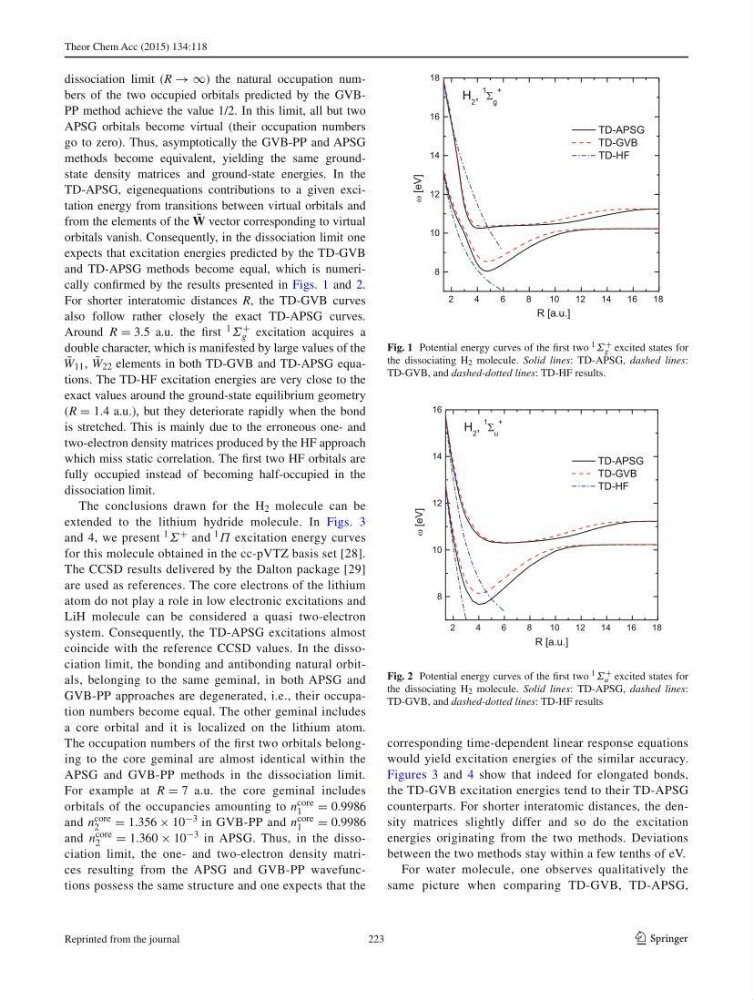
orbitals vanish. Consequently, in the dissociation limit one
expects that excitation energies predicted by the TD-GVB
and TD-APSG methods become equal, which is numerically confi rmed by the results presented in Figs. 1 and 2 .
For shorter interatomic distances R , the TD-GVB curves
also follow rather closely the exact TD-APSG curves.
Around R = 3.5 a.u. the fi rst 1 Σ +
g excitation acquires a
double character, which is manifested by large values of the
˜
W 11 , ˜
W 22 elements in both TD-GVB and TD-APSG equations. The TD-HF excitation energies are very close to the
exact values around the ground-state equilibrium geometry
( R = 1.4 a.u.), but they deteriorate rapidly when the bond
is stretched. This is mainly due to the erroneous one- and
two-electron density matrices produced by the HF approach
which miss static correlation. The fi rst two HF orbitals are
fully occupied instead of becoming half-occupied in the
dissociation limit.
The conclusions drawn for the H 2 molecule can be
extended to the lithium hydride molecule. In Figs. 3
and 4 , we present 1 Σ + and 1 Π excitation energy curves
for this molecule obtained in the cc-pVTZ basis set [ 28 ].
The CCSD results delivered by the Dalton package [ 29 ]
are used as references. The core electrons of the lithium
atom do not play a role in low electronic excitations and
LiH molecule can be considered a quasi two-electron
system. Consequently, the TD-APSG excitations almost
coincide with the reference CCSD values. In the dissociation limit, the bonding and antibonding natural orbitals, belonging to the same geminal, in both APSG and
GVB-PP approaches are degenerated, i.e., their occupation numbers become equal. The other geminal includes
a core orbital and it is localized on the lithium atom.
The occupation numbers of the fi rst two orbitals belonging to the core geminal are almost identical within the
APSG and GVB-PP methods in the dissociation limit.
For example at R = 7 a.u. the core geminal includes
orbitals of the occupancies amounting to n core
1
= 0.9986
and n core
2
= 1.356 × 10 −3 in GVB-PP and n core
1
= 0.9986
and n core
2
= 1.360 × 10 −3 in APSG. Thus, in the dissociation limit, the one- and two-electron density matrices resulting from the APSG and GVB-PP wavefunctions possess the same structure and one expects that the
corresponding time-dependent linear response equations
would yield excitation energies of the similar accuracy.
Figures 3 and 4 show that indeed for elongated bonds,
the TD-GVB excitation energies tend to their TD-APSG
counterparts. For shorter interatomic distances, the density matrices slightly differ and so do the excitation
energies originating from the two methods. Deviations
between the two methods stay within a few tenths of eV.
For water molecule, one observes qualitatively the
same picture when comparing TD-GVB, TD-APSG,
2
4
6
8
10
12
14
16
18
8
10
12
14
16
18
TD-APSG
TD-GVB
TD-HF
H 2 ,
1
g
+
[eV]
R [a.u.]
Fig. 1 Potential energy curves of the fi rst two 1 Σ +
g excited states for
the dissociating H 2 molecule. Solid lines : TD-APSG, dashed lines :
TD-GVB, and dashed-dotted lines : TD-HF results.
2
4
6
8
10
12
14
16
18
8
10
12
14
16
TD-APSG
TD-GVB
TD-HF
H 2 ,
1
u
+
[eV]
R [a.u.]
Fig. 2 Potential energy curves of the fi rst two 1 Σ +
u excited states for
the dissociating H 2 molecule. Solid lines : TD-APSG, dashed lines :
TD-GVB, and dashed-dotted lines : TD-HF results
223
Reprinted from the journal
1 3
dissociation limit (R → ∞) the natural occupation numbers of the two occupied orbitals predicted by the GVBPP method achieve the value 1/2. In this limit, all but two
APSG orbitals become virtual (their occupation numbers
go to zero). Thus, asymptotically the GVB-PP and APSG
methods become equivalent, yielding the same groundstate density matrices and ground-state energies. In the
TD-APSG, eigenequations contributions to a given excitation energy from transitions between virtual orbitals and
from the elements of the ˜
W vector corresponding to virtual
orbitals vanish. Consequently, in the dissociation limit one
expects that excitation energies predicted by the TD-GVB
and TD-APSG methods become equal, which is numerically confi rmed by the results presented in Figs. 1 and 2 .
For shorter interatomic distances R , the TD-GVB curves
also follow rather closely the exact TD-APSG curves.
Around R = 3.5 a.u. the fi rst 1 Σ +
g excitation acquires a
double character, which is manifested by large values of the
˜
W 11 , ˜
W 22 elements in both TD-GVB and TD-APSG equations. The TD-HF excitation energies are very close to the
exact values around the ground-state equilibrium geometry
( R = 1.4 a.u.), but they deteriorate rapidly when the bond
is stretched. This is mainly due to the erroneous one- and
two-electron density matrices produced by the HF approach
which miss static correlation. The fi rst two HF orbitals are
fully occupied instead of becoming half-occupied in the
dissociation limit.
The conclusions drawn for the H 2 molecule can be
extended to the lithium hydride molecule. In Figs. 3
and 4 , we present 1 Σ + and 1 Π excitation energy curves
for this molecule obtained in the cc-pVTZ basis set [ 28 ].
The CCSD results delivered by the Dalton package [ 29 ]
are used as references. The core electrons of the lithium
atom do not play a role in low electronic excitations and
LiH molecule can be considered a quasi two-electron
system. Consequently, the TD-APSG excitations almost
coincide with the reference CCSD values. In the dissociation limit, the bonding and antibonding natural orbitals, belonging to the same geminal, in both APSG and
GVB-PP approaches are degenerated, i.e., their occupation numbers become equal. The other geminal includes
a core orbital and it is localized on the lithium atom.
The occupation numbers of the fi rst two orbitals belonging to the core geminal are almost identical within the
APSG and GVB-PP methods in the dissociation limit.
For example at R = 7 a.u. the core geminal includes
orbitals of the occupancies amounting to n core
1
= 0.9986
and n core
2
= 1.356 × 10 −3 in GVB-PP and n core
1
= 0.9986
and n core
2
= 1.360 × 10 −3 in APSG. Thus, in the dissociation limit, the one- and two-electron density matrices resulting from the APSG and GVB-PP wavefunctions possess the same structure and one expects that the
corresponding time-dependent linear response equations
would yield excitation energies of the similar accuracy.
Figures 3 and 4 show that indeed for elongated bonds,
the TD-GVB excitation energies tend to their TD-APSG
counterparts. For shorter interatomic distances, the density matrices slightly differ and so do the excitation
energies originating from the two methods. Deviations
between the two methods stay within a few tenths of eV.
For water molecule, one observes qualitatively the
same picture when comparing TD-GVB, TD-APSG,
2
4
6
8
10
12
14
16
18
8
10
12
14
16
18
TD-APSG
TD-GVB
TD-HF
H 2 ,
1
g
+
[eV]
R [a.u.]
Fig. 1 Potential energy curves of the fi rst two 1 Σ +
g excited states for
the dissociating H 2 molecule. Solid lines : TD-APSG, dashed lines :
TD-GVB, and dashed-dotted lines : TD-HF results.
2
4
6
8
10
12
14
16
18
8
10
12
14
16
TD-APSG
TD-GVB
TD-HF
H 2 ,
1
u
+
[eV]
R [a.u.]
Fig. 2 Potential energy curves of the fi rst two 1 Σ +
u excited states for
the dissociating H 2 molecule. Solid lines : TD-APSG, dashed lines :
TD-GVB, and dashed-dotted lines : TD-HF results
223
Reprinted from the journal