

Theor Chem Acc (2015) 134:151
1 3
will limit ourselves to the simplest formulation of the functional, i.e., we consider N g = 1. Besides, in the present
paper we will fi x the n associated with core orbitals to 1.
2.2 The “fragment energy method” (FEM)
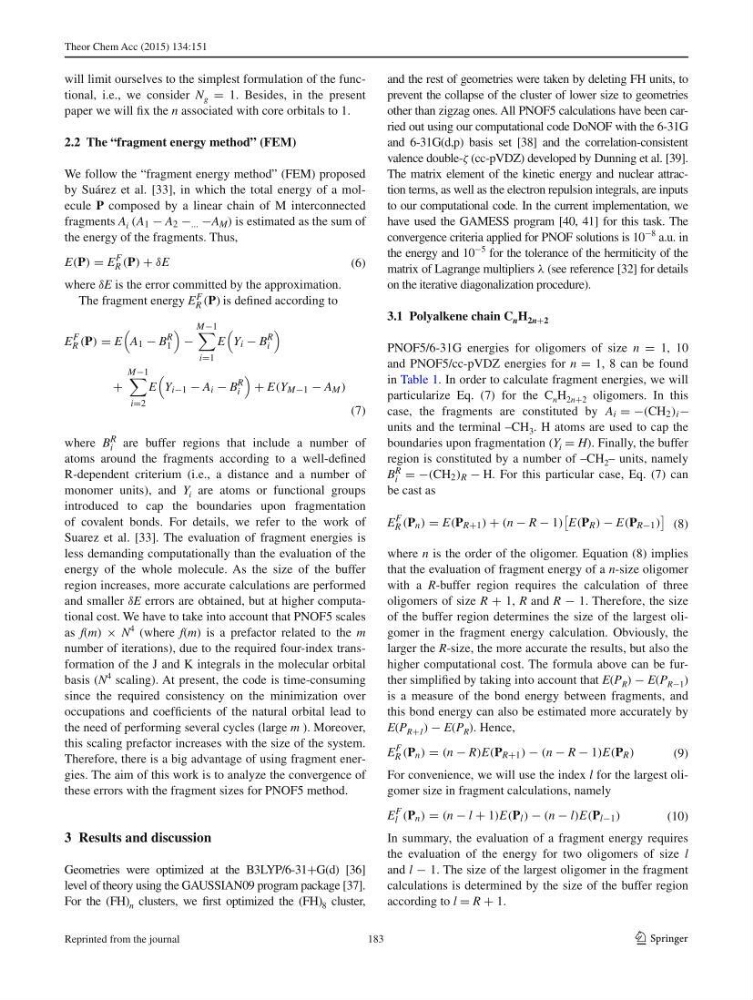
We follow the “fragment energy method” (FEM) proposed
by Suárez et al. [ 33 ], in which the total energy of a molecule P composed by a linear chain of M interconnected
fragments A i ( A 1 − A 2 − ... −A M ) is estimated as the sum of
the energy of the fragments. Thus,
where δ E is the error committed by the approximation.
The fragment energy E F
R (P) is defi ned according to
where B R
i are buffer regions that include a number of
atoms around the fragments according to a well-defi ned
R-dependent criterium (i.e., a distance and a number of
monomer units), and Y i are atoms or functional groups
introduced to cap the boundaries upon fragmentation
of covalent bonds. For details, we refer to the work of
Suarez et al. [ 33 ]. The evaluation of fragment energies is
less demanding computationally than the evaluation of the
energy of the whole molecule. As the size of the buffer
region increases, more accurate calculations are performed
and smaller δ E errors are obtained, but at higher computational cost. We have to take into account that PNOF5 scales
as f ( m ) × N
4 (where f ( m ) is a prefactor related to the m
number of iterations), due to the required four-index transformation of the J and K integrals in the molecular orbital
basis ( N
4 scaling). At present, the code is time-consuming
since the required consistency on the minimization over
occupations and coeffi cients of the natural orbital lead to
the need of performing several cycles (large m ). Moreover,
this scaling prefactor increases with the size of the system.
Therefore, there is a big advantage of using fragment energies. The aim of this work is to analyze the convergence of
these errors with the fragment sizes for PNOF5 method.
3 Results and discussion
Geometries were optimized at the B3LYP/6-31+G(d) [ 36 ]
level of theory using the GAUSSIAN09 program package [ 37 ].
For the (FH) n clusters, we fi rst optimized the (FH) 8 cluster,
(6)
E(P) = E
F
R (P) + δE
(7)
E
F
R (P) = E
A 1 − B
R
1
−
M−1
i=1
E
Y i − B
R
i
+
M−1
i=2
E
Y i−1 − A i − B
R
i
+ E(Y M−1 − A M )
and the rest of geometries were taken by deleting FH units, to
prevent the collapse of the cluster of lower size to geometries
other than zigzag ones. All PNOF5 calculations have been carried out using our computational code DoNOF with the 6-31G
and 6-31G(d,p) basis set [ 38 ] and the correlation-consistent
valence double- ζ (cc-pVDZ) developed by Dunning et al. [ 39 ].
The matrix element of the kinetic energy and nuclear attraction terms, as well as the electron repulsion integrals, are inputs
to our computational code. In the current implementation, we
have used the GAMESS program [ 40 , 41 ] for this task. The
convergence criteria applied for PNOF solutions is 10
−8 a.u. in
the energy and 10
−5 for the tolerance of the hermiticity of the
matrix of Lagrange multipliers λ (see reference [ 32 ] for details
on the iterative diagonalization procedure).
3.1 Polyalkene chain C n H 2 n +2
PNOF5/6-31G energies for oligomers of size n = 1, 10
and PNOF5/cc-pVDZ energies for n = 1, 8 can be found
in Table 1 . In order to calculate fragment energies, we will
particularize Eq. ( 7 ) for the C n H 2 n +2 oligomers. In this
case, the fragments are constituted by A i = −(CH 2 ) i −
units and the terminal –CH 3 . H atoms are used to cap the
boundaries upon fragmentation ( Y i = H ). Finally, the buffer
region is constituted by a number of –CH 2 – units, namely
B R
i = −(CH 2 ) R − H . For this particular case, Eq. ( 7 ) can
be cast as
where n is the order of the oligomer. Equation ( 8 ) implies
that the evaluation of fragment energy of a n -size oligomer
with a R -buffer region requires the calculation of three
oligomers of size R + 1, R and R − 1. Therefore, the size
of the buffer region determines the size of the largest oligomer in the fragment energy calculation. Obviously, the
larger the R -size, the more accurate the results, but also the
higher computational cost. The formula above can be further simplifi ed by taking into account that E ( P R ) − E ( P R −1 )
is a measure of the bond energy between fragments, and
this bond energy can also be estimated more accurately by
E ( P R+1 ) − E ( P R ). Hence,
For convenience, we will use the index l for the largest oligomer size in fragment calculations, namely
In summary, the evaluation of a fragment energy requires
the evaluation of the energy for two oligomers of size l
and l − 1. The size of the largest oligomer in the fragment
calculations is determined by the size of the buffer region
according to l = R + 1.
(8)
E
F
R (P n ) = E(P R+1 ) + (n − R − 1)
E(P R ) − E(P R−1 )
(9)
E
F
R (P n ) = (n − R)E(P R+1 ) − (n − R − 1)E(P R )
(10)
E
F
l (P n ) = (n − l + 1)E(P l ) − (n − l)E(P l−1 )
183
Reprinted from the journal
1 3
will limit ourselves to the simplest formulation of the functional, i.e., we consider N g = 1. Besides, in the present
paper we will fi x the n associated with core orbitals to 1.
2.2 The “fragment energy method” (FEM)
We follow the “fragment energy method” (FEM) proposed
by Suárez et al. [ 33 ], in which the total energy of a molecule P composed by a linear chain of M interconnected
fragments A i ( A 1 − A 2 − ... −A M ) is estimated as the sum of
the energy of the fragments. Thus,
where δ E is the error committed by the approximation.
The fragment energy E F
R (P) is defi ned according to
where B R
i are buffer regions that include a number of
atoms around the fragments according to a well-defi ned
R-dependent criterium (i.e., a distance and a number of
monomer units), and Y i are atoms or functional groups
introduced to cap the boundaries upon fragmentation
of covalent bonds. For details, we refer to the work of
Suarez et al. [ 33 ]. The evaluation of fragment energies is
less demanding computationally than the evaluation of the
energy of the whole molecule. As the size of the buffer
region increases, more accurate calculations are performed
and smaller δ E errors are obtained, but at higher computational cost. We have to take into account that PNOF5 scales
as f ( m ) × N
4 (where f ( m ) is a prefactor related to the m
number of iterations), due to the required four-index transformation of the J and K integrals in the molecular orbital
basis ( N
4 scaling). At present, the code is time-consuming
since the required consistency on the minimization over
occupations and coeffi cients of the natural orbital lead to
the need of performing several cycles (large m ). Moreover,
this scaling prefactor increases with the size of the system.
Therefore, there is a big advantage of using fragment energies. The aim of this work is to analyze the convergence of
these errors with the fragment sizes for PNOF5 method.
3 Results and discussion
Geometries were optimized at the B3LYP/6-31+G(d) [ 36 ]
level of theory using the GAUSSIAN09 program package [ 37 ].
For the (FH) n clusters, we fi rst optimized the (FH) 8 cluster,
(6)
E(P) = E
F
R (P) + δE
(7)
E
F
R (P) = E
A 1 − B
R
1
−
M−1
i=1
E
Y i − B
R
i
+
M−1
i=2
E
Y i−1 − A i − B
R
i
+ E(Y M−1 − A M )
and the rest of geometries were taken by deleting FH units, to
prevent the collapse of the cluster of lower size to geometries
other than zigzag ones. All PNOF5 calculations have been carried out using our computational code DoNOF with the 6-31G
and 6-31G(d,p) basis set [ 38 ] and the correlation-consistent
valence double- ζ (cc-pVDZ) developed by Dunning et al. [ 39 ].
The matrix element of the kinetic energy and nuclear attraction terms, as well as the electron repulsion integrals, are inputs
to our computational code. In the current implementation, we
have used the GAMESS program [ 40 , 41 ] for this task. The
convergence criteria applied for PNOF solutions is 10
−8 a.u. in
the energy and 10
−5 for the tolerance of the hermiticity of the
matrix of Lagrange multipliers λ (see reference [ 32 ] for details
on the iterative diagonalization procedure).
3.1 Polyalkene chain C n H 2 n +2
PNOF5/6-31G energies for oligomers of size n = 1, 10
and PNOF5/cc-pVDZ energies for n = 1, 8 can be found
in Table 1 . In order to calculate fragment energies, we will
particularize Eq. ( 7 ) for the C n H 2 n +2 oligomers. In this
case, the fragments are constituted by A i = −(CH 2 ) i −
units and the terminal –CH 3 . H atoms are used to cap the
boundaries upon fragmentation ( Y i = H ). Finally, the buffer
region is constituted by a number of –CH 2 – units, namely
B R
i = −(CH 2 ) R − H . For this particular case, Eq. ( 7 ) can
be cast as
where n is the order of the oligomer. Equation ( 8 ) implies
that the evaluation of fragment energy of a n -size oligomer
with a R -buffer region requires the calculation of three
oligomers of size R + 1, R and R − 1. Therefore, the size
of the buffer region determines the size of the largest oligomer in the fragment energy calculation. Obviously, the
larger the R -size, the more accurate the results, but also the
higher computational cost. The formula above can be further simplifi ed by taking into account that E ( P R ) − E ( P R −1 )
is a measure of the bond energy between fragments, and
this bond energy can also be estimated more accurately by
E ( P R+1 ) − E ( P R ). Hence,
For convenience, we will use the index l for the largest oligomer size in fragment calculations, namely
In summary, the evaluation of a fragment energy requires
the evaluation of the energy for two oligomers of size l
and l − 1. The size of the largest oligomer in the fragment
calculations is determined by the size of the buffer region
according to l = R + 1.
(8)
E
F
R (P n ) = E(P R+1 ) + (n − R − 1)
E(P R ) − E(P R−1 )
(9)
E
F
R (P n ) = (n − R)E(P R+1 ) − (n − R − 1)E(P R )
(10)
E
F
l (P n ) = (n − l + 1)E(P l ) − (n − l)E(P l−1 )
183
Reprinted from the journal