

Theor Chem Acc (2016) 135:6
1 3
for Hartree–Fock or DFT wavefunctions. This is proportional to the number of the expansion functions for the
potential. By contrast, the number of CPHF/CPKS calculations in the method of Ref. [ 28 ] is nV , where n is the number of occupied and V is the number of virtual orbitals, i.e.,
it scales quadratically with the molecular size at constant
basis set quality. For this reason, it becomes impractical for
larger molecules and basis sets.
Verifying the correctness of the DRF program is
somewhat challenging because there are few published
numerical results. A simplest test was introduced by
Liu et al. [ 10 ]. It states that the integral of the DRF with
respect to one of its coordinates ( r or r ′) over the whole
space gives zero. It can be easily proven from the second
equality in Eq. ( 1 ), by noting that the electron density
is unchanged if the potential is changed uniformly. It
is particularly easy to apply in our case because of our
uniform rectangular grid. Satisfying this test is not, of
course, a proof for the correctness of the program, but a
random programming error is unlikely to preserve this
property.
4 Examples
Although the main content of this paper is to describe our
technique to calculate the DRF, we give a few numerical
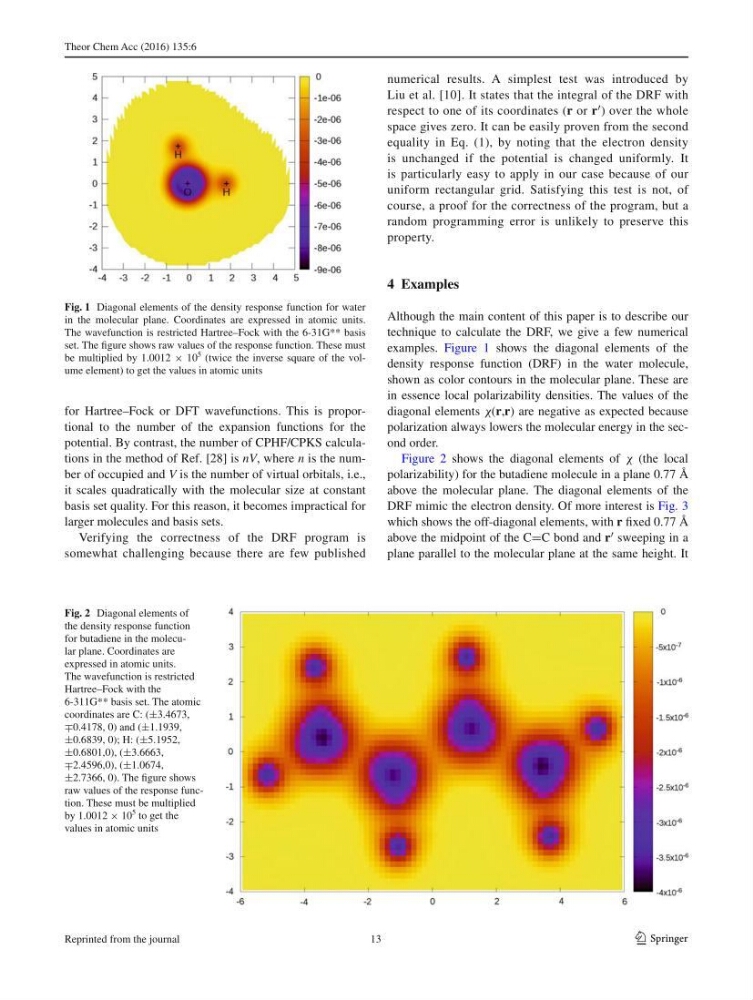
examples. Figure 1 shows the diagonal elements of the
density response function (DRF) in the water molecule,
shown as color contours in the molecular plane. These are
in essence local polarizability densities. The values of the
diagonal elements χ ( r , r ) are negative as expected because
polarization always lowers the molecular energy in the second order.
Figure 2 shows the diagonal elements of χ (the local
polarizability) for the butadiene molecule in a plane 0.77 Å
above the molecular plane. The diagonal elements of the
DRF mimic the electron density. Of more interest is Fig. 3
which shows the off-diagonal elements, with r fi xed 0.77 Å
above the midpoint of the C=C bond and r ′ sweeping in a
plane parallel to the molecular plane at the same height. It
Fig. 1 Diagonal elements of the density response function for water
in the molecular plane. Coordinates are expressed in atomic units.
The wavefunction is restricted Hartree–Fock with the 6-31G** basis
set. The fi gure shows raw values of the response function. These must
be multiplied by 1.0012 × 10
5 (twice the inverse square of the volume element) to get the values in atomic units
Fig. 2 Diagonal elements of
the density response function
for butadiene in the molecular plane. Coordinates are
expressed in atomic units.
The wavefunction is restricted
Hartree–Fock with the
6-311G** basis set. The atomic
coordinates are C: (±3.4673,
∓0.4178, 0) and (±1.1939,
±0.6839, 0); H: (±5.1952,
±0.6801,0), (±3.6663,
∓2.4596,0), (±1.0674,
±2.7366, 0). The fi gure shows
raw values of the response function. These must be multiplied
by 1.0012 × 10
5 to get the
values in atomic units
13
Reprinted from the journal
1 3
for Hartree–Fock or DFT wavefunctions. This is proportional to the number of the expansion functions for the
potential. By contrast, the number of CPHF/CPKS calculations in the method of Ref. [ 28 ] is nV , where n is the number of occupied and V is the number of virtual orbitals, i.e.,
it scales quadratically with the molecular size at constant
basis set quality. For this reason, it becomes impractical for
larger molecules and basis sets.
Verifying the correctness of the DRF program is
somewhat challenging because there are few published
numerical results. A simplest test was introduced by
Liu et al. [ 10 ]. It states that the integral of the DRF with
respect to one of its coordinates ( r or r ′) over the whole
space gives zero. It can be easily proven from the second
equality in Eq. ( 1 ), by noting that the electron density
is unchanged if the potential is changed uniformly. It
is particularly easy to apply in our case because of our
uniform rectangular grid. Satisfying this test is not, of
course, a proof for the correctness of the program, but a
random programming error is unlikely to preserve this
property.
4 Examples
Although the main content of this paper is to describe our
technique to calculate the DRF, we give a few numerical
examples. Figure 1 shows the diagonal elements of the
density response function (DRF) in the water molecule,
shown as color contours in the molecular plane. These are
in essence local polarizability densities. The values of the
diagonal elements χ ( r , r ) are negative as expected because
polarization always lowers the molecular energy in the second order.
Figure 2 shows the diagonal elements of χ (the local
polarizability) for the butadiene molecule in a plane 0.77 Å
above the molecular plane. The diagonal elements of the
DRF mimic the electron density. Of more interest is Fig. 3
which shows the off-diagonal elements, with r fi xed 0.77 Å
above the midpoint of the C=C bond and r ′ sweeping in a
plane parallel to the molecular plane at the same height. It
Fig. 1 Diagonal elements of the density response function for water
in the molecular plane. Coordinates are expressed in atomic units.
The wavefunction is restricted Hartree–Fock with the 6-31G** basis
set. The fi gure shows raw values of the response function. These must
be multiplied by 1.0012 × 10
5 (twice the inverse square of the volume element) to get the values in atomic units
Fig. 2 Diagonal elements of
the density response function
for butadiene in the molecular plane. Coordinates are
expressed in atomic units.
The wavefunction is restricted
Hartree–Fock with the
6-311G** basis set. The atomic
coordinates are C: (±3.4673,
∓0.4178, 0) and (±1.1939,
±0.6839, 0); H: (±5.1952,
±0.6801,0), (±3.6663,
∓2.4596,0), (±1.0674,
±2.7366, 0). The fi gure shows
raw values of the response function. These must be multiplied
by 1.0012 × 10
5 to get the
values in atomic units
13
Reprinted from the journal