

Theor Chem Acc (2015) 134:113
1 3
Although it is unlikely that in general the sums that enter
Eqs. ( 16 )–( 18 ) are reducible to simple analytical expressions, they permit rapid computations of the collective
occupancies for arbitrary angular momenta.
2.1 The case of a polynomial correlation factor
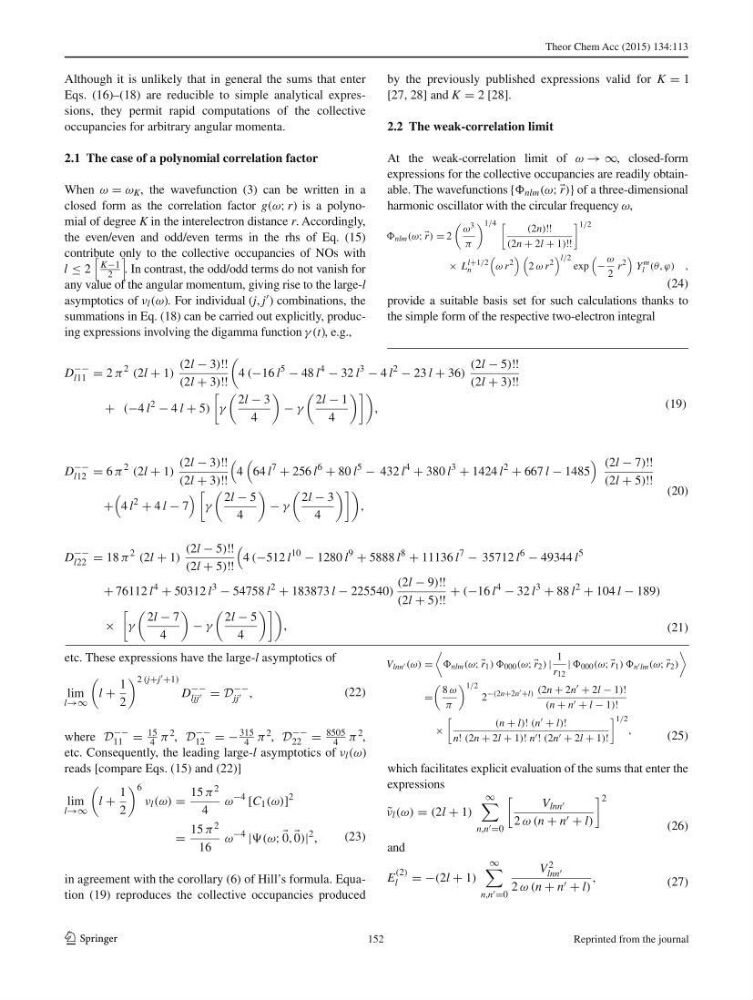
When ω = ω K , the wavefunction ( 3 ) can be written in a
closed form as the correlation factor g(ω; r) is a polynomial of degree K in the interelectron distance r . Accordingly,
the even/even and odd/even terms in the rhs of Eq. ( 15 )
contribute only to the collective occupancies of NOs with
l ≤ 2
K−1
2
. In contrast, the odd/odd terms do not vanish for
any value of the angular momentum, giving rise to the large- l
asymptotics of ν l (ω) . For individual (j, j ) combinations, the
summations in Eq. ( 18 ) can be carried out explicitly, producing expressions involving the digamma function γ (t) , e.g.,
by the previously published expressions valid for K = 1
[ 27 , 28 ] and K = 2 [ 28 ].
2.2 The weak-correlation limit
At the weak-correlation limit of ω → ∞ , closed-form
expressions for the collective occupancies are readily obtainable. The wavefunctions { nlm (ω; ; r)} of a three-dimensional
harmonic oscillator with the circular frequency ω ,
provide a suitable basis set for such calculations thanks to
the simple form of the respective two-electron integral
(24)
nlm (ω; ; r) = 2
ω 3
π
1/4 횿
(2n)!!
(2n + 2l + 1)!!
1/2
× L
l+1/2
n
ω r
2
2 ω r
2
l/2
exp
−
ω
2
r
2
Y
m
l (θ, ϕ) ,
(19)
D
−−
l11 = 2 π
2
(2l + 1)
(2l − 3)!!
(2l + 3)!!
4 (−16 l
5
− 48 l
4
− 32 l
3
− 4 l
2
− 23 l + 36)
(2l − 5)!!
(2l + 3)!!
+ (−4 l
2
− 4 l + 5)
γ
2l − 3
4
− γ
2l − 1
4
,
(20)
D
−−
l12 = 6 π
2
(2l + 1)
(2l − 3)!!
(2l + 3)!!
4
64 l
7
+ 256 l
6
+ 80 l
5
− 432 l
4
+ 380 l
3
+ 1424 l
2
+ 667 l − 1485
(2l − 7)!!
(2l + 5)!!
+
4 l
2
+ 4 l − 7
γ
2l − 5
4
− γ
2l − 3
4
,
(21)
D
−−
l22 = 18 π
2
(2l + 1)
(2l − 5)!!
(2l + 5)!!
훀
4 (−512 l
10
− 1280 l
9
+ 5888 l
8
+ 11136 l
7
− 35712 l
6
− 49344 l
5
+ 76112 l
4
+ 50312 l
3
− 54758 l
2
+ 183873 l − 225540)
(2l − 9)!!
(2l + 5)!!
+ (−16 l
4
− 32 l
3
+ 88 l
2
+ 104 l − 189)
×
γ
2l − 7
4
− γ
2l − 5
4
,
etc. These expressions have the large- l asymptotics of
where D
−−
11 =
15
4 π 2 , D
−−
12 = −
315
4 π 2 , D
−−
22 =
8505
4 π 2 ,
etc. Consequently, the leading large- l asymptotics of ν l (ω)
reads [compare Eqs. ( 15 ) and ( 22 )]
in agreement with the corollary ( 6 ) of Hill’s formula. Equation ( 19 ) reproduces the collective occupancies produced
(22)
lim
l→∞
l +
1
2
2 (j+j +1)
D
−−
ljj = D
−−
jj ,
(23)
lim
l→∞
l +
1
2
6
ν l (ω) =
15 π 2
4
ω
−4
[C 1 (ω)]
2
=
15 π 2
16
ω
−4
|(ω;
0,
0)|
2 ,
which facilitates explicit evaluation of the sums that enter the
expressions
and
(25)
V lnn (ω) =
nlm (ω; ; r 1 ) ) 000 (ω; ; r 2 ) |
1
r 12
| 000 (ω; ; r 1 ) ) n lm (ω; ; r 2 )
=
8 ω
π
1/2
2
−(2n+2n +l) (2n + 2n + 2l − 1)!
(n + n + l − 1)!
×
(n + l)! (n + l)!
n! (2n + 2l + 1)! n ! (2n + 2l + 1)!
1/2
,
(26)
˜
ν l (ω) = (2l + 1)
∞
n,n =0
V lnn
2 ω (n + n + l)
2
(27)
E
(2)
l = −(2l + 1)
∞
n,n =0
V 2
lnn
2 ω (n + n + l)
,
152
Reprinted from the journal
1 3
Although it is unlikely that in general the sums that enter
Eqs. ( 16 )–( 18 ) are reducible to simple analytical expressions, they permit rapid computations of the collective
occupancies for arbitrary angular momenta.
2.1 The case of a polynomial correlation factor
When ω = ω K , the wavefunction ( 3 ) can be written in a
closed form as the correlation factor g(ω; r) is a polynomial of degree K in the interelectron distance r . Accordingly,
the even/even and odd/even terms in the rhs of Eq. ( 15 )
contribute only to the collective occupancies of NOs with
l ≤ 2
K−1
2
. In contrast, the odd/odd terms do not vanish for
any value of the angular momentum, giving rise to the large- l
asymptotics of ν l (ω) . For individual (j, j ) combinations, the
summations in Eq. ( 18 ) can be carried out explicitly, producing expressions involving the digamma function γ (t) , e.g.,
by the previously published expressions valid for K = 1
[ 27 , 28 ] and K = 2 [ 28 ].
2.2 The weak-correlation limit
At the weak-correlation limit of ω → ∞ , closed-form
expressions for the collective occupancies are readily obtainable. The wavefunctions { nlm (ω; ; r)} of a three-dimensional
harmonic oscillator with the circular frequency ω ,
provide a suitable basis set for such calculations thanks to
the simple form of the respective two-electron integral
(24)
nlm (ω; ; r) = 2
ω 3
π
1/4 횿
(2n)!!
(2n + 2l + 1)!!
1/2
× L
l+1/2
n
ω r
2
2 ω r
2
l/2
exp
−
ω
2
r
2
Y
m
l (θ, ϕ) ,
(19)
D
−−
l11 = 2 π
2
(2l + 1)
(2l − 3)!!
(2l + 3)!!
4 (−16 l
5
− 48 l
4
− 32 l
3
− 4 l
2
− 23 l + 36)
(2l − 5)!!
(2l + 3)!!
+ (−4 l
2
− 4 l + 5)
γ
2l − 3
4
− γ
2l − 1
4
,
(20)
D
−−
l12 = 6 π
2
(2l + 1)
(2l − 3)!!
(2l + 3)!!
4
64 l
7
+ 256 l
6
+ 80 l
5
− 432 l
4
+ 380 l
3
+ 1424 l
2
+ 667 l − 1485
(2l − 7)!!
(2l + 5)!!
+
4 l
2
+ 4 l − 7
γ
2l − 5
4
− γ
2l − 3
4
,
(21)
D
−−
l22 = 18 π
2
(2l + 1)
(2l − 5)!!
(2l + 5)!!
훀
4 (−512 l
10
− 1280 l
9
+ 5888 l
8
+ 11136 l
7
− 35712 l
6
− 49344 l
5
+ 76112 l
4
+ 50312 l
3
− 54758 l
2
+ 183873 l − 225540)
(2l − 9)!!
(2l + 5)!!
+ (−16 l
4
− 32 l
3
+ 88 l
2
+ 104 l − 189)
×
γ
2l − 7
4
− γ
2l − 5
4
,
etc. These expressions have the large- l asymptotics of
where D
−−
11 =
15
4 π 2 , D
−−
12 = −
315
4 π 2 , D
−−
22 =
8505
4 π 2 ,
etc. Consequently, the leading large- l asymptotics of ν l (ω)
reads [compare Eqs. ( 15 ) and ( 22 )]
in agreement with the corollary ( 6 ) of Hill’s formula. Equation ( 19 ) reproduces the collective occupancies produced
(22)
lim
l→∞
l +
1
2
2 (j+j +1)
D
−−
ljj = D
−−
jj ,
(23)
lim
l→∞
l +
1
2
6
ν l (ω) =
15 π 2
4
ω
−4
[C 1 (ω)]
2
=
15 π 2
16
ω
−4
|(ω;
0,
0)|
2 ,
which facilitates explicit evaluation of the sums that enter the
expressions
and
(25)
V lnn (ω) =
nlm (ω; ; r 1 ) ) 000 (ω; ; r 2 ) |
1
r 12
| 000 (ω; ; r 1 ) ) n lm (ω; ; r 2 )
=
8 ω
π
1/2
2
−(2n+2n +l) (2n + 2n + 2l − 1)!
(n + n + l − 1)!
×
(n + l)! (n + l)!
n! (2n + 2l + 1)! n ! (2n + 2l + 1)!
1/2
,
(26)
˜
ν l (ω) = (2l + 1)
∞
n,n =0
V lnn
2 ω (n + n + l)
2
(27)
E
(2)
l = −(2l + 1)
∞
n,n =0
V 2
lnn
2 ω (n + n + l)
,
152
Reprinted from the journal